
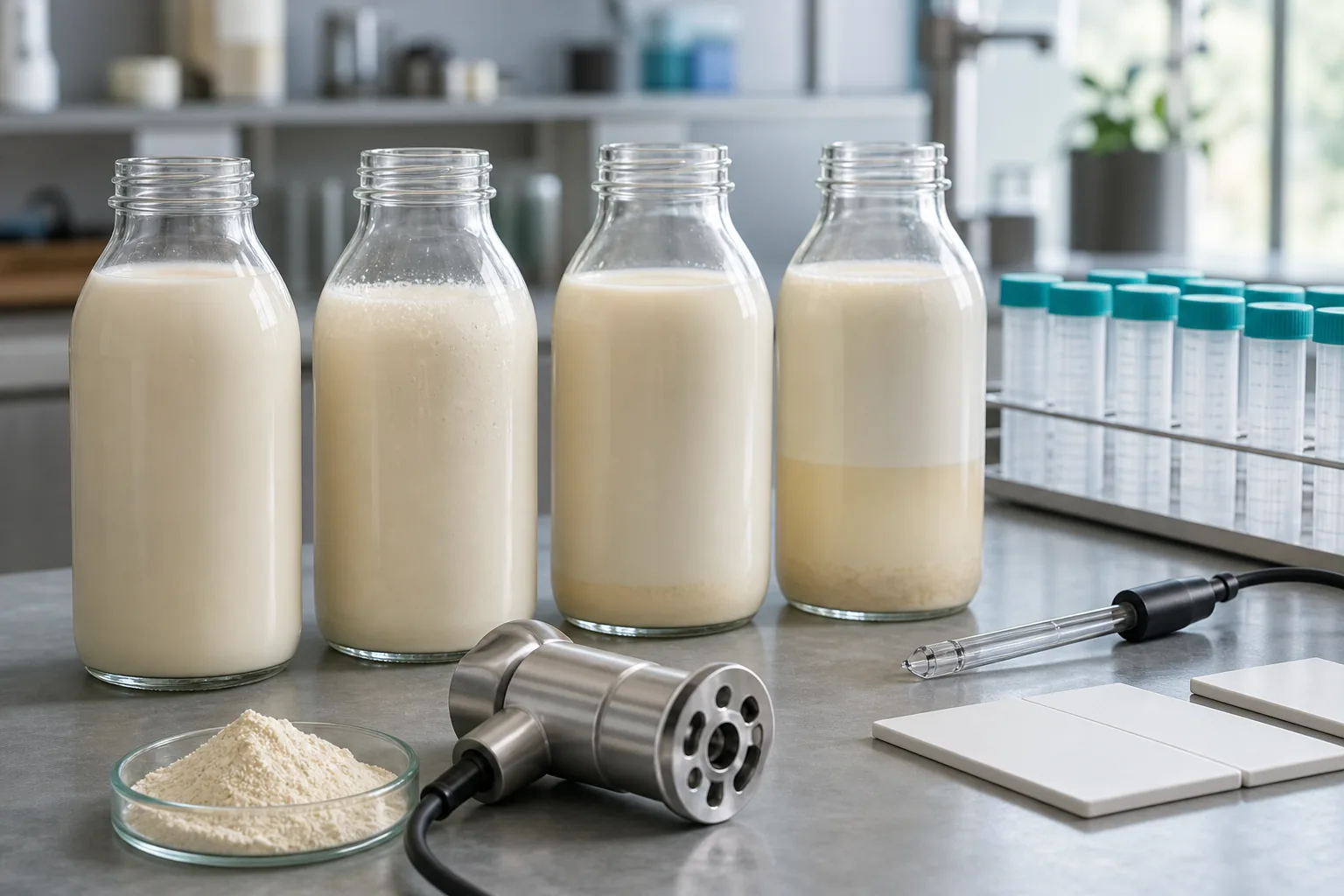
A beverage team can receive an attractive soluble soybean polysaccharide sample and still learn very little from a single bench bottle. Acidified protein systems are sensitive to pH path, protein type, solids, mineral composition, ingredient addition order, shear, heat treatment, filling, and storage. A stable-looking sample on day one does not prove production fit.
The direct answer is: evaluate soluble soybean polysaccharide in the complete target process, not in water and not from a supplier dosage copied into the formula. Fix a control recipe, vary one factor at a time in the screening stage, record the full process history, and measure both immediate and stored stability. Then repeat the leading condition at a scale that reproduces plant mixing, homogenization, thermal treatment, filling, and packaging.
Nutranexa lists soluble soybean polysaccharide for acid protein beverages and related food applications. The available TJ-110 specification describes a low-viscosity powder. Those are product-positioning facts, not guaranteed performance in every beverage. Final use level, process window, sensory result, and shelf-life performance must be demonstrated in the buyer’s own formulation.
What a Good Pilot Must Answer
A useful pilot answers four commercial questions:
- Does the sample disperse reproducibly in the buyer’s water, protein, sugar, acid, mineral, and flavor system?
- Which pH, addition sequence, hydration, shear, and heat window produces acceptable physical stability?
- Does the beverage remain acceptable through filling, storage, transport simulation, and expected consumer handling?
- Can the condition be reproduced with the selected supplier grade, specification, and commercial lot controls?
Published studies show why formula-specific work is necessary. Research on SSPS and milk-protein systems reports pH-dependent interactions, particle-size changes, sedimentation behavior, and differences between polysaccharide types or molecular profiles. These studies explain mechanisms and suggest measurements; they are not a universal recipe for Nutranexa material or a buyer’s finished drink.
Start with an Application Brief
Define the beverage before requesting a sample
Send the supplier a compact technical brief:
- dairy, whey, soy, pea, or other protein system
- protein and total-solids range
- target pH and acidification route
- sugar, minerals, flavors, sweeteners, and other hydrocolloids
- process sequence, hydration temperature, shear, homogenization, and heat treatment
- package and fill conditions
- target storage temperature and intended shelf life
- destination markets and label constraints
Without this information, “recommended dosage” is only a starting hypothesis. Even published model systems use defined protein concentrations, SSPS levels, pH ranges, and test methods that may not represent a commercial formulation.
Lock the sample identity
Record supplier legal entity, product name and code, lot, manufacture or retest information where available, specification revision, sample size, packaging, and storage condition. Photograph the sealed sample and retain enough material for confirmation or a repeat run.
Review the current specification and available COA rather than treating appearance as identity. For a commercial purchase, align the approved sample with the quoted product so that sourcing does not substitute another grade after the formulation team finishes the trial.
A Three-Stage Pilot Design
Stage 1: Controlled screening
Use a small, repeatable batch size and a written base recipe. Include:
- a no-SSPS control
- a current benchmark stabilizer or incumbent system when relevant
- two or more justified SSPS conditions
- at least one repeat of the expected center point
Do not change pH, SSPS level, homogenization, and heat treatment all at once. A compact design that isolates variables produces more useful decisions than many uncontrolled bottles.
Record ingredient temperature, hydration time, mixer geometry, speed or energy input, acid type, acid addition rate, intermediate pH, final pH, homogenization conditions, heat profile, cooling, fill time, and package headspace. Plant scale-up often fails because these process details were never captured.
Stage 2: Process challenge
Take the best screening condition and challenge realistic variation:
- normal raw-material variability
- upper and lower pH targets
- delayed hydration or extended hold
- minimum and maximum planned shear
- actual heat treatment and cooling path
- intended flavor and mineral load
- rework or recirculation only if the plant will use it
The aim is not to force failure. It is to discover how narrow the acceptable operating window is before the commercial run.
Stage 3: Scale-up confirmation
Repeat the leading condition using equipment that resembles production. Match mixing sequence, shear field, homogenizer arrangement, heat-transfer rate, residence time, filling, and package.
Bench-top success does not automatically scale because local ingredient concentration, air incorporation, pumping, hold time, and thermal history change. Keep the same analytical and sensory checkpoints so that bench and pilot results can be compared.
Critical Variables to Control
pH path, not just final pH
Two bottles can finish at the same pH but experience different local acid concentrations and protein aggregation during acid addition. Record where acid enters, how fast it is added, mixing intensity, temperature, and intermediate pH.
Research comparing SSPS and pectin in acidified milk beverages found different interaction behavior across pH regions. More recent model work also measured changes in particle size, zeta potential, viscosity, and accelerated stability as pH changed. The buyer’s lesson is operational: treat pH as a process trajectory and verify the target range in the actual formula.
Addition order and hydration
Decide whether SSPS is pre-dispersed, dry-blended, or added into another phase. Control water quality, temperature, agitation, hydration time, and the point at which protein, sugar, minerals, and acid enter.
Watch for fisheyes, wall deposits, foam, incomplete wetting, and powder loss. A low-viscosity system can still be poorly dispersed. Document the method so a second operator can reproduce it.
Protein and mineral system
Protein source, concentration, heat history, and mineral environment affect charge and aggregation. Do not assume dairy results transfer to whey, soy, or plant protein. If the formula uses calcium, buffering salts, or mineral premixes, include them in the trial at realistic points in the process.
Shear, homogenization, and heat
Measure the effect of pre-homogenization mixing and, where used, homogenization after acidification. Excess or insufficient shear can change particle distribution, foam, and body. Heat treatment can expose a condition that looked stable at ambient bench temperature.
Use actual process limits rather than an impressive laboratory setting. The goal is a robust operating range the factory can control.
What to Measure
Immediate checks
At filling, record:
- visual uniformity and color
- foam and deaeration behavior
- final pH and temperature
- viscosity or flow behavior using a defined method
- particle size or another dispersion measure when available
- package fill consistency
Photographs should use the same lighting, container, fill height, and background. Uncontrolled photos are weak evidence.
Accelerated and storage checks
At predefined intervals, evaluate:
- sediment height or mass using a consistent method
- serum separation or creaming
- flocculation, ringing, or wall deposit
- pH drift
- viscosity change
- particle-size distribution where available
- centrifugation or analytical stability results
- flavor, aroma, mouthfeel, and aftertaste
Accelerated tools can compare candidates quickly, but they do not automatically predict commercial shelf life. Use them as screening evidence and confirm with the intended package and storage program.
Sensory and label fit
A physically stable beverage can still fail because of flavor release, astringency, body, color, or label constraints. Use trained internal evaluation or an appropriate sensory method. Confirm the ingredient name and allergen or source declaration with the responsible regulatory team for each market.
Do not convert a technical-function result into a health claim. This guide addresses formulation performance only.
Pilot Scorecard
| Decision area | Evidence | Acceptable outcome |
|---|---|---|
| Sample identity | Product code, lot, specification, COA | Trial material matches quoted grade |
| Dispersion | Addition record, photos, residue check | Reproducible wetting without uncontrolled lumps |
| Process window | pH, shear, heat, hold challenges | Defined operating range, not one lucky bottle |
| Physical stability | Sediment, separation, viscosity, particle data | Meets project-specific criteria through planned checks |
| Sensory | Blind or controlled comparison | No unresolved flavor, body, or appearance issue |
| Scale-up | Pilot batch record and comparison | Performance reproduced on representative equipment |
| Commercial handoff | Approved specification and change control | Sourcing and production use the tested grade |
How to Compare Two Supplier Samples Fairly
When procurement compares SSP samples, formulation teams should remove avoidable bias. Store both samples under the same conditions, acclimate them for the same period, and prepare them with the same water, batch size, vessels, mixer geometry, operator sequence, and measurement schedule. Randomise sample codes when practical so visual and sensory expectations do not drive the decision.
Run the benchmark and both candidates in the same session or in a balanced order. If one sample receives longer hydration, higher shear, a different acid-addition rate, or fresher protein, the result is not a supplier comparison. Include a repeated center condition to estimate normal pilot variation. A visible difference smaller than normal run-to-run variation should not become a purchasing claim.
Compare more than sediment. Review dispersion time, foam, pH path, viscosity, particle or accelerated-stability results, flavor, mouthfeel, process residue, and repeatability. Also compare the controlled product files: specification, lot COA, storage, packaging, change notification, and commercial identity. The technically strongest bench result can still be a poor procurement choice if the tested sample cannot be matched to repeatable bulk supply.
Close the comparison with a written conclusion such as “advance to scale-up,” “repeat under corrected controls,” or “not suitable for this formulation.” Avoid ranking one supplier as universally superior. The conclusion belongs to the exact formula, process, package, samples, and test date.
Need an Application-Specific SSP Sample?
Share the protein system, target pH, heat process, package, trial size, and annual demand with Nutranexa. Ask for the current SSP specification, available batch evidence, packaging and storage information, and a sample that matches the proposed commercial grade. Use Contact Sales to align the trial identity before the formulation team invests in scale-up.
Common Pilot Errors
- Testing SSPS only in water.
- Copying a published or supplier use level without recreating the full formula.
- Changing several process variables in every bottle.
- Recording final pH but not acid addition rate or intermediate pH.
- Judging stability only on the day of manufacture.
- Using centrifugation as a complete shelf-life prediction.
- Ignoring sensory and label implications.
- Scaling up without matching shear, heat, hold, and fill history.
- Approving a sample without locking the commercial product code and specification.
How Verified Nutranexa Facts Fit the Trial
Nutranexa was founded in 2013 and operates a 110,000+ m2 campus. The company’s product center includes soluble soybean polysaccharide alongside its PS portfolio, and the site provides an SSP specification request path, manufacturing and quality information, packaging and dispatch imagery, and R&D cooperation context.
The TJ-110 specification positions the ingredient as a low-viscosity powder for acid protein beverage stabilization and related food uses. Buyers should request the current controlled version and verify the supplied lot. These facts support sample identification and supplier dialogue; they are not a guarantee of stability, dosage, sensory performance, or shelf life in the buyer’s formula.
Sources
- Nutranexa soluble soybean polysaccharide product page
- Effect of pH on the Stability of Dairy Beverages Stabilized with Soluble Soybean Polysaccharides
- The stabilizing behaviour of soybean soluble polysaccharide and pectin in acidified milk beverages
- Effect of soybean soluble polysaccharides on the stability of milk protein under acidic conditions00095-4)
- Exceptional colloidal stability of acidified whey protein beverages stabilized by soybean soluble polysaccharide
FAQ
What is the best SSPS use level for an acidified protein beverage?
There is no universal answer. Published studies use specific model systems, and commercial formulas differ in protein, solids, minerals, pH path, processing, and sensory targets. Screen a justified range in the complete target formula.
Should SSPS be added before or after acidification?
The appropriate order depends on the formula and process. Compare controlled sequences while recording hydration, mixing, temperature, acid addition, and intermediate pH. Select the sequence that is reproducible at production scale.
Is a stable bench sample enough for supplier approval?
No. Supplier approval also requires product identity, specification and batch evidence, while formulation approval should include process challenges, stored stability, sensory review, and scale-up confirmation.
Can centrifugation replace real-time shelf-life testing?
No. Centrifugation can rank candidates or expose instability quickly, but it does not reproduce every physical, chemical, sensory, packaging, and transport change over the intended shelf life.
What information should a buyer send when requesting an SSP sample?
Send the protein system, total solids, target pH, acidification method, heat and homogenization process, package, trial size, destination market, and expected annual demand. This helps the supplier match the sample and document set to the project.
Conclusion
The strongest SSPS pilot is a controlled process study, not a row of attractive bottles. Define the beverage, lock sample identity, isolate variables during screening, challenge the process window, measure stored stability and sensory performance, and reproduce the result at representative scale.
That workflow gives procurement a defensible commercial decision and gives manufacturing a process it can actually repeat.
Contact Sales
Developing an acidified dairy, whey, or other protein beverage? Contact Nutranexa Sales to request the current soluble soybean polysaccharide specification, sample availability, and product-identification details for your application trial.
Recommended next steps
- Review the Soluble Soybean Polysaccharide product page.
- Define the project through Functional Food Applications.
- Check manufacturing proof and Quality & R&D.
Contact sales for product documents
Share source preference, application, country, and annual quantity.
Contact Sales