

For many B2B buyers, the moment a phosphatidylserine grade passes sample evaluation feels like the finish line. In OEM practice it is only the midpoint. Between a successful pilot run and a stable commercial program sits a stage full of small changes — larger extraction batches, different drying and milling setups, longer blending cycles, new packaging lines — and each can move the powder away from what your validation actually approved.
Scale-up problems rarely announce themselves as quality failures. They appear as a blend that separates on the filling line, a capsule weight that drifts, or a COA reporting the same assay through a different method. By then, correction is measured in rejected batches and delayed launches.
That is why phosphatidylserine OEM scale-up deserves its own planning discipline, separate from supplier qualification and routine batch release. This article explains what buyers should control as a PS ingredient moves from pilot to production: grade lock-in, process parameters, blend uniformity, documentation continuity and release criteria. It is written for supplement brands, contract manufacturers and private-label teams that have approved a supplier and now need that decision to survive contact with a bigger line. Where manufacturing capability is part of the assessment, our phosphatidylserine manufacturing overview outlines the production environment behind each grade.
Why Scale-Up Is the Most Underestimated Stage of a PS Program
Supplier qualification and scale-up answer two different questions. Qualification asks: can this supplier make a consistent material that meets the specification? Scale-up asks: will that material behave the same way when your batch size multiplies ten- or fifty-fold and passes through different equipment?
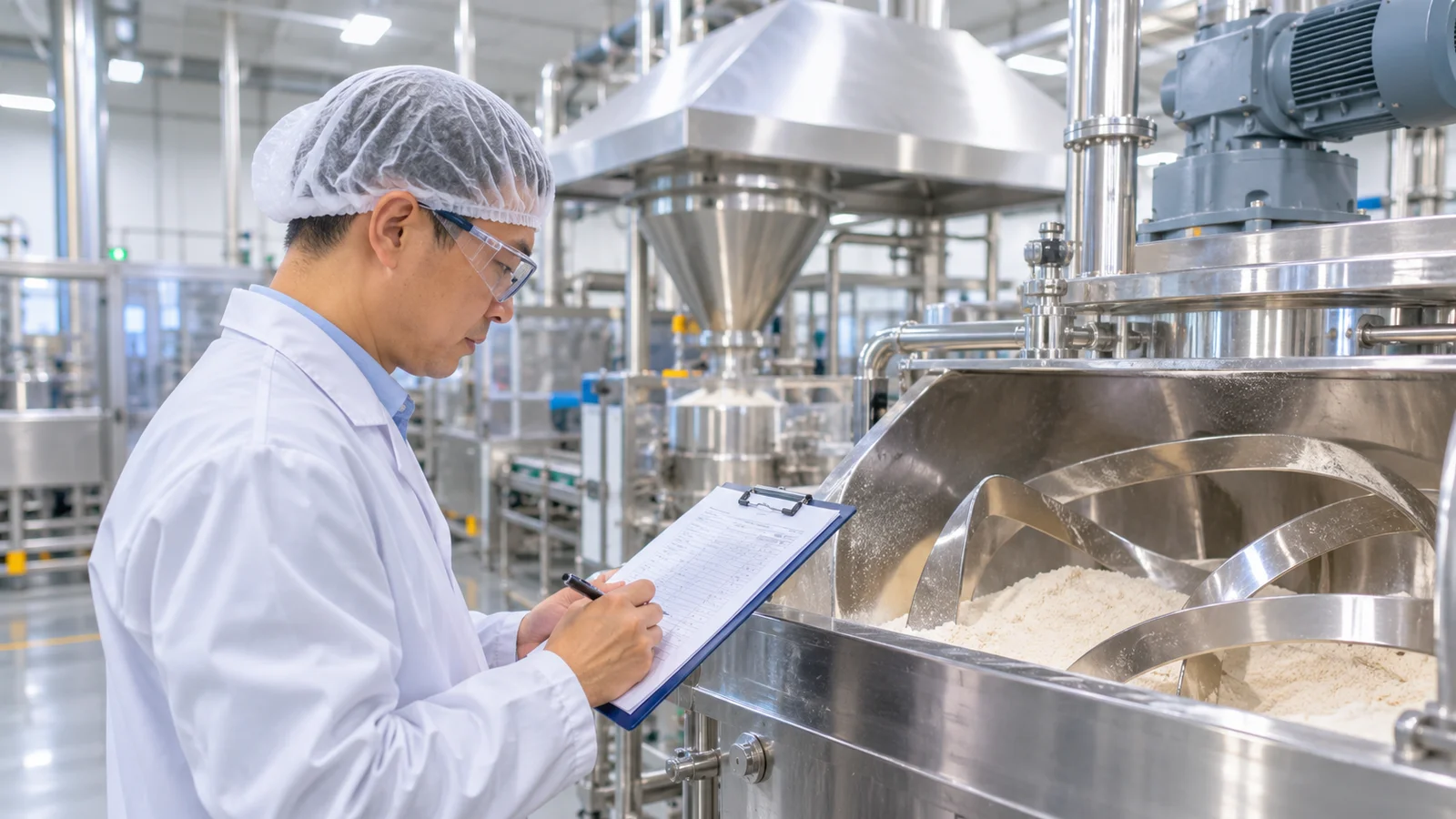
The distinction matters because phosphatidylserine is a functional phospholipid, not an inert filler. Its performance depends on particle size distribution, residual moisture, flow characteristics and how it interacts with other blend components under shear — all of which can shift when a pilot process is translated into an industrial one. A powder that blended uniformly in a 100-litre vessel may segregate in a 2,000-litre ribbon blender, and a spray-dried lot from one campaign may carry a different bulk density than the pilot lot your formulation assumptions were built on.
Buyers who treat scale-up as a logistics step — simply ordering more material — discover these shifts at first commercial production. Buyers who treat it as a controlled technical transfer catch them in a planned pilot-to-production comparison instead. The difference is documentation and sequencing, not budget.
Lock the Approved Grade Before the First Pilot Batch
The most effective scale-up control costs nothing: write down exactly what was approved, and refuse to let it drift. An approved grade is not "PS 50% powder" — it is a specific combination of source (soy or sunflower), concentration, particle size range, carrier or anti-caking system, and a defined document set.
Before the first production-intent batch is scheduled, confirm with the supplier in writing:
- The exact specification version the pilot material was released against, including assay method and acceptance ranges.
- The source identity — soy-derived or sunflower-derived — and that no substitution is permitted without formal change notification.
- Particle size targets, since milling decisions at commercial scale directly affect blend uniformity and mouthfeel.
- Packaging configuration, because drum size and liner type influence moisture uptake during long storage and shipping.
If your team built a handoff pack during supplier qualification, the scale-up stage should extend it rather than replace it. Our earlier guide on the contract manufacturer handoff checklist explains how to keep one approved product record across sourcing, QA and production teams — the same discipline applies when batch size changes.
What Technically Changes Between Pilot and Commercial Batches
Understanding where scale-up risk lives helps buyers ask the right questions. Four areas change most predictably.
Extraction and concentration batch size. Larger batches mean longer processing windows and more variation between early and late fractions. Ask how the supplier controls assay consistency across a commercial-size campaign and whether intermediate testing is performed between sub-lots.
Drying and milling. Spray-drying parameters and mill screens are often tuned on pilot equipment. At scale, the same settings can produce a different particle size distribution or residual moisture level. Both are on your specification for a reason — verify they are measured on every commercial lot, not only pilot lots.
Blending and batching. Finished-product blending moves from laboratory blenders to production equipment with different shear profiles and hold times. This is where blend uniformity is won or lost — the manufacturer's responsibility, but the ingredient's flow properties set the conditions.
Hold times and logistics. Commercial campaigns may involve longer storage between production and shipment. Confirm that peroxide value and moisture limits remain the acceptance criteria at release, and that stability data covers the real storage duration your supply chain will impose.
Controlling Blend Uniformity, Flowability and Overages at Scale
Blend uniformity is the most common technical failure point in PS scale-up because phosphatidylserine powder is often a minor-to-moderate blend component. If the powder does not flow and disperse consistently, label claims drift between samples from the same batch — a finding that triggers investigation under any GMP framework. Three controls protect this stage:
- Run a production-scale blend uniformity study before releasing the first commercial batch. Sample from defined blender positions or discharge intervals, and test assay uniformity across samples.
- Match flow testing to your line. If your filling or encapsulation equipment is sensitive to powder behavior, ask for flowability data (angle of repose, Carr index, or shear cell results where available) on production lots, and compare against the pilot reference.
- Validate overage logic against production data, not pilot data. If the formulation carries a manufacturing overage to protect label claim, confirm that the overage assumption still holds when measured against production-scale uniformity results.
Flowability issues discovered at this stage can usually be solved through milling specification or minor carrier adjustments on the ingredient side — but only if they are raised before, not after, the first commercial campaign. For a worked example of how powder behavior is evaluated before scale-up, our article on flowability and blend uniformity pilot testing walks through the testing logic.
Documentation That Must Follow the Scale-Up
Documentation continuity is where scale-up programs quietly fail audits. The pilot batch had a complete document trail: specification, lot-specific COA, SDS, allergen and GMO statements, and whatever market-specific files your regulatory team collected. The first commercial batch must inherit the same logic, not an improvised set.

Confirm three things before the commercial campaign:
- COA alignment. The commercial-lot COA must report against the same specification version and the same analytical methods used for pilot approval. A method change is a technical change, even if the reported numbers look similar.
- Statement continuity. Allergen, GMO, Halal, Kosher and origin statements must be reissued for the commercial production campaign, since campaign-level details (production dates, batch numbers) differ from pilot documents.
- Traceability linkage. The finished batch record at your contract manufacturer must reference the specific PS lots used, so a single lot can be traced from drum to finished goods if a question arises later.
When buyers request the document package per lot rather than per supplier relationship, they give their QA teams a stable baseline for incoming inspection and for any future regulatory inquiry.
Building a Scale-Up Release Checklist With Your Supplier
A scale-up release checklist converts the points above into an actionable gate with three tiers.
Before production: specification version confirmed in writing; source identity confirmed; batch size, campaign schedule and packaging configuration agreed; commercial-lot testing plan (particle size and moisture on every lot) agreed.
During production: blend uniformity study executed on the production line; hold times within specification assumptions; intermediate assay checks if the campaign runs across multiple sub-lots.
Before release: lot-specific COA reviewed against the approved specification; statements reissued for the campaign; reserve samples retained; traceability links documented between batch record and ingredient lots.
Suppliers with structured OEM experience will recognize this gate immediately and will usually have most of the evidence ready. Suppliers who resist producing production-scale uniformity data or campaign-level statements are signaling where problems will appear later.
FAQ
What is the main difference between pilot and commercial phosphatidylserine batches?
The material may meet the same specification, but commercial batches pass through larger extraction, drying and milling equipment with different residence times and shear profiles. Properties tied to process — particle size distribution, bulk density, residual moisture and flow behavior — are the most likely to shift, which is why they should be measured on every commercial lot.
Who is responsible for blend uniformity — the ingredient supplier or the contract manufacturer?
Blend uniformity on the finished blend is the contract manufacturer's responsibility, since it depends on their equipment and process. However, the ingredient's particle size and flow characteristics set the conditions for success, so buyers should obtain production-lot flow and particle size data from the supplier and production-scale uniformity data from the manufacturer.
Should the COA method change between pilot and commercial lots?
No. The commercial-lot COA should be issued against the same specification version and analytical methods used for pilot approval. Any method change alters the meaning of the reported numbers and should be treated as a formal change requiring review, not a routine variation.
How early should scale-up documentation be requested?
Request the full document package — specification version confirmation, COA template, statements and traceability approach — before the commercial campaign is scheduled. Asking after production removes the supplier's ability to align campaign-level documents with your release requirements.
Conclusion
Scale-up is where an approved phosphatidylserine decision either becomes a stable commercial program or starts eroding. The controls that protect it are inexpensive and mostly documentary: lock the approved grade in writing, keep one specification version across pilot and production, demand production-scale blend uniformity evidence, and require every commercial lot to arrive with a COA and statements aligned to the version you validated.
Buyers who institutionalize these steps turn scale-up from a gamble into a gate — one that protects label claims, audit readiness and launch timelines together. If your team is preparing a first commercial PS campaign and needs the underlying grade and specification context refreshed, our quality and R&D resources describe the testing and specification support behind each Nutranexa grade.
Sources
- Phosphatidylserine and the human brain – nutrition overview (PubMed)
- FDA — Dietary Supplements: Current Good Manufacturing Practice (CGMP) requirements
- EFSA — Guidance on technical and organisational data for food enzyme and ingredient dossiers
- IPEC — Excipient GMP and specification guidance for pharmaceutical and supplement ingredients
Buyer fit
Who this guide is for
This guide is written for the buyer profiles below. Open your profile for the matching grades, documents and next steps, or tell us your requirements directly.
Recommended next steps
- Review the Phosphatidylserine product page.
- Compare Soy PS and Sunflower PS.
- Check manufacturing proof and Quality & R&D.
Contact sales for product documents
Share source preference, application, country, and annual quantity.
Contact Sales