

Two drums of the same phosphatidylserine grade can leave the same factory with the same COA and age completely differently in your warehouse. The difference is usually invisible: the oxygen left inside the package. Unflushed headspace in a 25 kg drum holds roughly 21% oxygen — enough to push peroxide value steadily toward the upper spec limit within a year. A proper nitrogen flush brings that to 2% or less, and a good barrier liner keeps it there. Yet most PS purchase orders say only "nitrogen flushed" or, worse, nothing at all, leaving the flush quality, liner type, and verification method entirely to the supplier's discretion. If your powder has ever arrived caked, darker than usual, or smelling faintly rancid at 12 months, oxygen control is the first suspect. This article gives US and EU buyers the specific numbers, liner options, and receipt checks to write packaging oxygen control into the specification where it belongs. Where supplier qualification is the next step, our manufacturing overview documents the facility, process controls and batch records behind each lot.
Why Headspace Oxygen Decides PS Shelf Life
Phosphatidylserine is a phospholipid rich in polyunsaturated fatty acids — linoleic acid among them — and those double bonds oxidize on contact with air. The oxidation products drive exactly the failures buyers see: rising peroxide value toward the typical ≤5 meq/kg limit, anisidine value creep, color darkening, and the rancid "cardboard" notes that show up on the filling line and in consumer complaints.
The arithmetic is unforgiving. A 25 kg drum with a standard polyethylene liner has several liters of headspace at 21% oxygen — roughly one to two liters of oxygen gas in direct contact with the powder, constantly replenished by permeation through a low-barrier liner. Every month of storage at 25 °C or warmer consumes that margin. A nitrogen-flushed drum at ≤2% residual oxygen starts with ten times less oxygen, and an aluminum-barrier liner cuts permeation to nearly zero. The same chemistry, a different package, and the difference between a comfortable 36-month retest period and a powder that needs early re-qualification.
Heat and humidity accelerate the reaction, which is why the packaging spec and the storage conditions (below 25 °C, RH below 60%) must be written together, not as separate afterthoughts.
The Four Elements of a Packaging Oxygen Spec
Write these four elements into the PS specification and purchase order:
1. Residual headspace oxygen target. Require residual oxygen at sealing of ≤2%, with ≤1% for premium or long-retest grades. A "nitrogen flush" without a number is a gesture, not a specification — flush duration and nozzle placement vary enormously between lines.
2. Liner barrier class. Name the liner construction, not just "poly bag." Acceptable classes, best first: aluminum foil laminate (e.g., PET/Al/PE) or metallized high-barrier laminate; then multilayer co-extruded PE with an EVOH barrier layer; plain PE liners are suitable only with aggressive oxygen-absorber use and short holding periods, and should be rejected for 36-month retest claims.
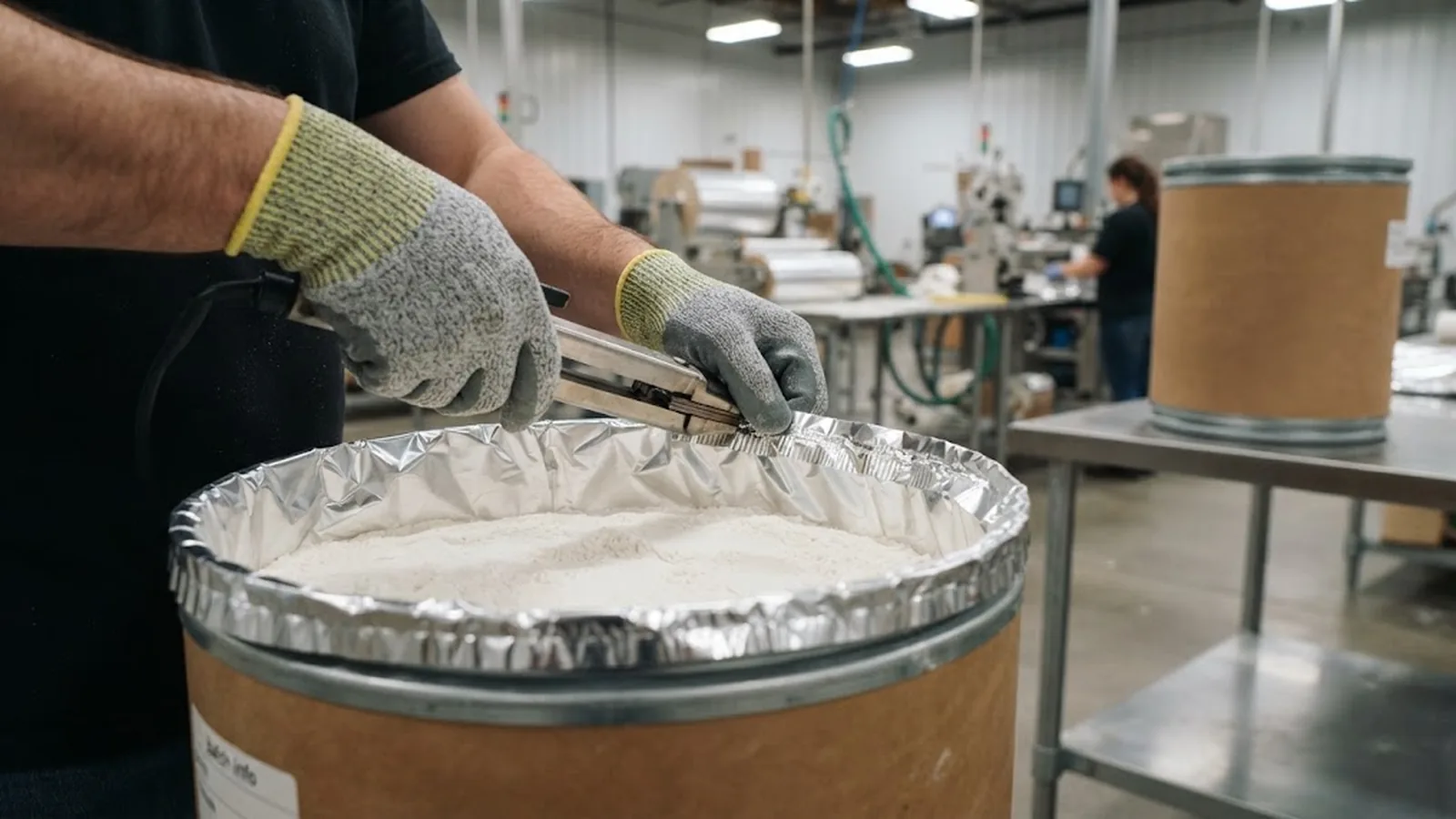
3. Seal integrity requirement. Specify that the liner is heat-sealed or vacuum-clamped gas-tight after flush, with closure integrity verified in the supplier's batch record — a folded-over liner bag under a drum lid loses its nitrogen within days.
4. Auxiliary protection, if claimed. If oxygen absorbers or desiccant sachets are part of the claim, specify type, number, and food-contact compliance (FDA 21 CFR or EU Regulation 10/2011 as applicable), and require them to be visible and countable at receipt.
Add the verification clause: "Supplier to record residual headspace oxygen per drum or per batch on the batch record; COA to state flush method and target." This single sentence converts packaging from folklore to a documented process — and gives you a rejection basis if a lot arrives oxidized.
Choosing Liners: What Actually Blocks Oxygen
| Liner class | Oxygen transmission (indicative) | Use case |
|---|---|---|
| Aluminum foil laminate (PET/Al/PE) | Near zero | Premium PS, 36-month retest claims |
| Metallized PET laminate | Very low | Standard choice for PS exports |
| Co-extruded PE/EVOH | Low | Acceptable with verified ≤2% flush |
| Plain PE (single layer) | High | Short holds only, with absorbers |
Three practical notes. First, drum size matters more than buyers expect: 20 kg and 25 kg drums give a smaller headspace-to-powder ratio than 10 kg pails, so per-kilogram oxygen exposure falls. Second, the liner is only as good as its closure — ask the supplier to describe the sealing step in their process description during qualification, and photograph it during an on-site audit. Third, PPWR and EU packaging rules increasingly push toward recyclable mono-material packaging; if a supplier proposes a mono-PE "recyclable" liner for a 36-month claim, require permeation data before accepting the change under your change-notification terms.
Verifying Flush Claims at Receipt
Trust, then verify. For critical grades, buyers can spot-check residual oxygen on arrival with a portable headspace analyzer (needle-through-seal fluorescence or electrochemical sensor, 0–25% range; instruments are a few hundred dollars and pay for themselves with one saved lot):
- Select one drum per lot (or one per pallet for high-value shipments).
- Insert the analyzer needle through the liner seal area immediately after opening the drum lid, before the liner is disturbed.
- Record the reading on the incoming inspection record. ≤2% passes; 5–10% flags a marginal flush; 15%+ means the claim failed.
- Cross-check sensory and chemistry: a high reading should correlate with higher PV on the lot's retest panel — if you later re-qualify the lot, include peroxide and anisidine values.
A pragmatic alternative where you lack equipment: compare the lot's sensory attributes and peroxide value against the previous lot at similar age. Trending lot-by-lot in your supplier scorecard exposes a packaging change at the supplier long before a failure lot.
Handling Opened Drums at Your Facility or 3PL
Most oxidation in practice happens after opening, not in transit. Write the open-drum procedure into your warehouse SOP and your 3PL agreement:
- Open one drum per work order; never stage multiple open drums across shifts.
- After sampling or dispensing, re-seal the liner gas-tight — ideally with a small nitrogen purge from a food-grade cylinder, or at minimum with a portable vacuum sealer on the liner mouth — and re-seat the drum lid with the clamp ring.
- Return the drum to storage below 25 °C and below 60% RH the same day.
- Mark the opened date on the drum and consume opened drums within 30 days, or move the balance to smaller containers rather than leaving partial drums.
- Never top up an opened drum from another lot — that destroys your one-step traceability.
At 3PL sites, audit this procedure physically at least annually; oxygen control after opening is one of the most common gaps between the spec sheet and the warehouse floor.
FAQ
Q: What residual oxygen level should I require in a nitrogen-flushed PS drum?
A: Specify ≤2% at sealing as the standard, and ≤1% for premium grades or long retest-period claims. Suppliers with modern flush equipment routinely achieve 1–2%; if a supplier cannot commit to a number, that itself is useful qualification information.
Q: Are oxygen absorbers a substitute for nitrogen flush?
A: Not for phospholipids at scale. Absorbers can polish a small residual oxygen content, but a 25 kg drum's headspace would need a large absorber capacity and days to work, during which the powder surface is exposed. Use flush as the primary control and absorbers, if at all, as a supplementary layer.
Q: How can I check the flush without lab equipment?
A: Trend the evidence you already have: lot-to-lot color, odor, and peroxide value at similar storage ages. A portable headspace analyzer is inexpensive, but consistent scorecard trending usually exposes a failing flush within two or three lots.
Q: Does packaging type change the shelf life I can claim on my finished product?
A: It changes your justification. EU durability dates and US shelf-life determinations must rest on your finished-product data; ingredient packaged with ≤2% headspace oxygen and a foil-barrier liner gives your stability study the best possible starting material, while marginal packaging shows up as accelerated PV drift and shortens what you can defensibly claim.
Q: We received a lot with 8% headspace oxygen and normal COA. What now?
A: Quarantine, run peroxide and anisidine values on the lot, and open a supplier complaint referencing your flush specification. If chemistry is in spec, you may accept with documented justification and shortened internal use-by; if PV is trending high, reject. Either way, require the supplier's CAPA on the flush line before the next lot ships.
Conclusion
Phosphatidylserine powder is manufactured well and then protected — or not — by its packaging. The difference between a drum that is fine at month 30 and one that is rancid at month 12 is usually residual headspace oxygen, liner barrier class, and seal integrity: three things that cost the supplier little and cost the buyer dearly when unspecified. Put the numbers in your specification — ≤2% residual O2, named liner construction, verified sealing, documented flush records — verify at receipt, and enforce the same discipline after opening at your own warehouse and 3PL. Packaging oxygen control is among the cheapest shelf-life insurance available in this category. When you are ready to move from checklist to quotation, contact our team with the grade, source and document set described above.
Sources
- FDA — 21 CFR Part 111, Current Good Manufacturing Practice for Dietary Supplements (packaging and labeling controls): https://www.fda.gov/regulatory-information/title-21-code-federal-regulations-part-111-current-good-manufacturing-practice-dietary-supplements
- ASTM F2714 — Standard Test Method for Oxygen Headspace Analysis of Packages Using Fluorescent Decay: https://www.astm.org/f2714-08r16.html
- ASTM D3985 — Standard Test Method for Oxygen Gas Transmission Rate Through Plastic Film and Sheeting: https://www.astm.org/d03985-17.html
- EUR-Lex — Commission Regulation (EU) No 10/2011 on plastic materials and articles intended to come into contact with food: https://eur-lex.europa.eu/legal-content/EN/TXT/?uri=CELEX%3A32011R0010
- FDA — Food Contact Substances / Packaging notifications: https://www.fda.gov/food/food-additives-petitions/food-contact-substances-fcs
Buyer fit
Who this guide is for
This guide is written for the buyer profiles below. Open your profile for the matching grades, documents and next steps, or tell us your requirements directly.
Recommended next steps
- Review the Phosphatidylserine product page.
- Compare Soy PS and Sunflower PS.
- Check manufacturing proof and Quality & R&D.
Contact sales for product documents
Share source preference, application, country, and annual quantity.
Contact Sales