
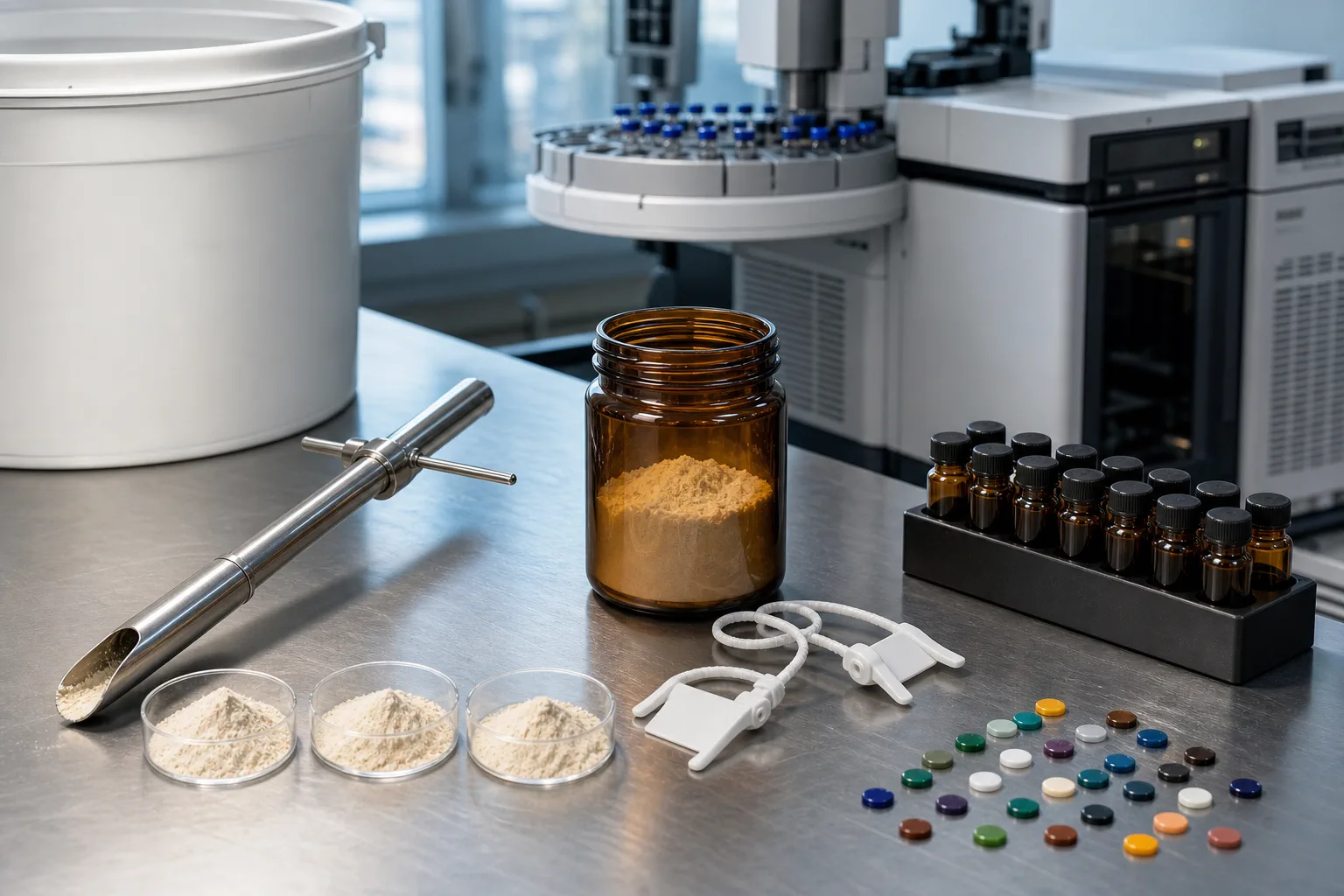
European buyers reviewing phosphatidylserine may have a laboratory report but still lack answers to four practical questions: which regulatory food category was used, which analyte groups were measured, whether the sample represents the purchased lot, and whether the result suits the intended release decision.
The direct answer is this: do not approve a phosphatidylserine route for Europe from a single “dioxin: pass” line. First identify the exact PS product and finished-food route. Then map the applicable current EU rules, verify representative sampling, distinguish screening from confirmatory analysis, and read the result basis, units, WHO toxic equivalents, reporting bound, limits of quantification, and measurement uncertainty as one package. Finally, connect the report to the supplier, product specification, batch, and shipment being released.
This operational guide covers phosphatidylserine, soy phosphatidylserine, and sunflower phosphatidylserine sourcing. It is not legal advice and does not assign a universal contaminant limit to every PS product.
The Short Answer for European Buyers
European buyers should treat dioxin and PCB review as a product-specific, food-category-specific, and lot-linked quality decision. The current consolidated version of Commission Regulation (EU) 2023/915 sets maximum levels for dioxins and PCBs in listed food categories. Commission Regulation (EU) 2017/644 sets detailed sampling and analytical requirements for official controls and also addresses controls performed by food business operators.
Those rules do not justify copying a convenient number into a PS specification. The buyer must determine how the exact ingredient and finished product are classified and whether a maximum level applies on a product basis, fat basis, or another stated basis. If the legal mapping is uncertain, hold and escalate.
A usable review therefore answers:
- What exact PS source, composition, and lot are being evaluated?
- What finished food or supplement category will use it?
- Which dioxin and PCB groups were measured?
- Was the sample representative of the lot?
- Was the analytical approach suitable for screening, confirmation, or both?
- Are the units, reporting basis, bound convention, and uncertainty clear?
- Who approved the regulatory category and final release decision?
Why Dioxin and PCB Review Is a Separate Quality Task
The European Commission classifies dioxins, dioxin-like PCBs, and non-dioxin-like PCBs as halogenated persistent organic pollutants within its food-contaminant framework. These substances are not intentionally added to food. Council Regulation (EEC) No 315/93 provides the wider principle that unacceptable contaminant levels must not be placed on the market and that levels should be kept as low as reasonably achievable through good practices.
That framework is different from a phosphatidylserine heavy-metals review or residual-solvent review. Each contaminant family has different analytical language, regulatory categories, sampling concerns, and decision rules. One broad “contaminants comply” statement cannot cover them all.
Three analyte groups must not be collapsed into one line
“Dioxins and PCBs” is a convenient phrase, but a buyer should separate at least three result groups:
| Result group | What the report is addressing | Buyer review point |
|---|---|---|
| Dioxins | Polychlorinated dibenzo-p-dioxins and dibenzofurans, commonly shown as PCDD/Fs | Confirm the congener scope and reported WHO-TEQ basis |
| Dioxin-like PCBs | PCB congeners evaluated through toxic equivalency factors because they have dioxin-like activity | Confirm whether the report gives a combined dioxin plus dioxin-like PCB result |
| Non-dioxin-like PCBs | Indicator PCBs handled separately from the WHO-TEQ calculation | Confirm the named PCB sum and the unit used |
The EU legal table identifies the relevant sums and explains that maximum levels refer to upper-bound concentrations. A report that lists only “total PCB” without defining the congeners, calculation, and unit may not match the legal comparison the buyer intends to make.
Risk-assessment values and legal maximum levels do different jobs
EFSA’s June 2026 update concluded that dietary exposure to dioxins and dioxin-like PCBs remains a health concern in Europe and established a tolerable weekly intake of 0.6 picograms WHO toxic equivalents per kilogram of body weight per week using the updated 2022 WHO toxic equivalency factors.
That TWI is a population risk-assessment reference. It is not a raw-material specification for phosphatidylserine, not a per-lot pass/fail value, and not a replacement for the maximum levels and food categories in the current EU legislation. Buyers should record the scientific context, then make the legal and product-release comparison against the correct regulatory provision for the exact food route.
This distinction matters because a very small number can look like an ingredient limit when removed from its context. Procurement should not paste the EFSA TWI into an RFQ. Quality should not compare a laboratory result reported per gram of product with a weekly intake reported per kilogram of body weight. Regulatory should own the bridge between food classification, finished use, and the applicable legal requirement.
A Seven-Step Review Workflow
Lock the exact product and intended EU food category
Start with the sellable ingredient, not the abbreviation “PS.” Record:
- soy, sunflower, or other confirmed source route
- quoted PS content and carrier or matrix, where applicable
- supplier product code and specification revision
- intended use in a food supplement, functional food, or another defined format
- destination Member State or markets
- finished-product composition and use assumptions needed for category review
Commission Regulation (EU) 2023/915 applies maximum levels to specified food categories and includes category-specific remarks. The buyer should check the current consolidated text on the review date and document why the chosen provision applies. If the classification depends on the finished formula, an ingredient supplier report may support the file but cannot make the finished-product decision alone.
Do not assume that a result assessed for an oil, a general food, a food supplement, or a product of animal origin is interchangeable with another route. The same numerical result can lead to a different conclusion when the legal category, expression basis, or product composition changes.
Define the evidence decision before requesting a test
Ask what the report must accomplish. Common decisions include:
- initial supplier qualification
- route comparison between soy and sunflower PS
- periodic monitoring
- investigation after a process, source, or site change
- current-lot release
- customer questionnaire support
- follow-up after an unusual screening result
The evidence depth should match the decision. A historical report may support preliminary risk review but not release a new lot. Screening can support routine monitoring, while a suspected non-compliant result requires the confirmatory path in Regulation (EU) 2017/644.
Before sampling, define the analytes, report basis, regulatory comparison, sampling responsibility, lot link, review owner, and escalation rule.
Confirm that the sample represents the purchased lot
The analytical result is only as useful as the sample it describes. Regulation (EU) 2017/644 defines a lot, sublot, incremental sample, aggregate sample, and laboratory sample. It requires lots or sublots to be sampled separately, incremental samples to be taken from different places as far as possible, and the aggregate sample to combine those increments. The regulation also describes sample protection, sealing, labelling, and a sampling record that allows the lot to be identified unambiguously.
For a phosphatidylserine purchase, the review file should therefore show:
- supplier product and batch or lot number
- who sampled, where, and when
- how the aggregate sample was homogenised and divided
- sample container, seal, storage, and transport conditions
- laboratory receipt identity and condition
An unknown grab sample does not represent the shipment. If an equivalent sampling procedure was used, ask how equivalent representation was demonstrated. The buyer’s incoming inspection and warehouse release process should state when sampling, quarantine, and external testing occur.
Check analyte scope, method type, and laboratory reporting
Regulation (EU) 2017/644 distinguishes screening and confirmatory methods. Screening methods are designed to identify samples that may exceed maximum or action levels while avoiding false-compliant outcomes. Suspected non-compliant screening results for PCDD/Fs and dioxin-like PCBs need determination or confirmation by a confirmatory method.
Confirmatory methods provide congener-level identification and quantification. The regulation describes GC-HRMS and permits GC-MS/MS for confirming compliance or non-compliance with a maximum level when the stated criteria are met. Non-dioxin-like PCB analysis has its own applicable method provisions.
The buyer does not need to operate the instrument, but the review should identify:
- whether the result is screening or confirmatory
- method reference and current laboratory procedure
- analyte and congener list
- limits of quantification
- laboratory accreditation scope relevant to the method and matrix
Ask the laboratory or qualified reviewer to confirm method suitability for the matrix and intended decision rather than inventing an instrument requirement in the RFQ.
Read units, basis, bounds, and uncertainty together
Dioxin reports are easy to misread because several calculation concepts appear together. Regulation (EU) 2017/644 defines:
- upper-bound: each non-quantified congener contributes its limit of quantification
- lower-bound: each non-quantified congener contributes zero
- medium-bound: each non-quantified congener contributes half its limit of quantification
The applicable maximum levels in Regulation (EU) 2023/915 refer to upper-bound concentrations. That means a buyer should not compare a lower-bound or unspecified result with an upper-bound limit and call it equivalent. The report should also make clear whether the result is expressed on a product basis, fat basis, or another basis required by the applicable category.
Measurement uncertainty is part of compliance interpretation. Regulation (EU) 2017/644 accounts for expanded uncertainty and, in specified cases, duplicate analysis. Near a decision boundary, have the complete calculation and decision rule reviewed.
Match the report to the supplier and shipment file
Build one traceable line:
supplier legal entity → manufacturing route → product code → specification revision → lot → sample record → laboratory report → purchase order → shipment → release decision
Do not mix a soy-source result with a sunflower-source quote or reuse an old report after a material source, process, site, method, or composition change. Distinguish a sample COA, current batch COA, and separate third-party contaminant report.
For Nutranexa, buyers can request the available route-specific specification and COA evidence, then align it with manufacturing information, Quality & R&D, packaging details, and the exact quotation. Those materials help establish identity and document continuity. They do not replace the buyer’s EU classification, laboratory-scope, or release review.
Close with an approve, hold, retest, or escalate decision
Use a written status that everyone can understand:
- Approve: the route, category, sampling, method, report basis, lot link, and decision rule are all closed.
- Hold: information is incomplete or mismatched, so the lot remains quarantined.
- Retest: a representative sample and suitable method are required to replace or confirm the existing evidence.
- Escalate: regulatory classification, near-limit interpretation, suspected non-compliance, or market action needs a qualified specialist or competent-authority discussion.
Record the reviewer, date, evidence version, conclusion, and any monitoring frequency or change-control trigger. If the result creates reason to believe food may be unsafe or non-compliant, the responsible European food business operator should follow its legal notification, withdrawal, and recall procedures rather than treating the issue as a supplier-document correction.
Dioxin and PCB Report Review Matrix
| Review field | Acceptable evidence | Hold or escalate signal |
|---|---|---|
| Product identity | Exact PS source, product code, composition, and specification revision | Generic “PS” description or mismatched source |
| Regulatory mapping | Current EU provision, food category, basis, and documented rationale | Copied limit with no category explanation |
| Lot representation | Traceable incremental and aggregate sampling record | Unknown grab sample or unrelated batch |
| Analyte scope | Defined PCDD/F, dioxin-like PCB, and non-dioxin-like PCB results as required | “Total dioxin/PCB” with no definition |
| Method status | Screening or confirmatory purpose stated; suitable method reference | Screening result used to close a suspected exceedance |
| Result expression | WHO-TEQ, units, product/fat basis, and upper-bound status clear | Missing basis, mixed units, or lower-bound comparison |
| Analytical quality | LOQs, uncertainty, laboratory identity, and relevant scope available | Near-boundary result reduced to a simple pass flag |
| Shipment link | Report, sample record, PO, lot, and release decision align | Historical report used for a different shipment |
Need a Route-Specific PS Document Pack?
If your European quality file still uses a generic PS name, ask for the exact source route, current specification, available COA evidence, MOQ and packaging baseline, and manufacturing-support information before ordering a specialised contaminant test. Nutranexa’s PS MOQ is 25 kg and its standard PS bulk pack is 25 kg net per drum. Use Contact Sales to identify the exact route and document set; your importer or finished-product operator should then define the EU category, laboratory scope, sampling plan, and release criteria.
Common Review Mistakes
- Copying a dioxin limit from an unrelated food category into the PS specification.
- Treating EFSA’s tolerable weekly intake as a raw-material pass/fail limit.
- Accepting “total PCB” without the congener group, calculation, and unit.
- Comparing a lower-bound or unspecified result with an upper-bound legal maximum.
- Releasing a shipment from a report that is not linked to the purchased lot.
- Using a screening result as final confirmation after a suspected non-compliant finding.
- Ignoring the sampling record, even though the test portion may not represent the drums received.
- Assuming supplier documents transfer final food-business-operator responsibility.
How Verified Nutranexa Facts Fit the Workflow
Nutranexa was founded in 2013 and operates a 110,000+ m2 campus. Its primary export focus includes Europe and North America. The website provides separate product routes for general PS, soy PS, and sunflower PS, available specification and COA evidence, and manufacturing, packaging, and dispatch imagery. It also documents R&D cooperation.
These facts support supplier identity, route selection, and document scope; they are not proof of a contaminant result. Match the current product file to the quote and lot, then review dioxin and PCB evidence against the buyer’s risk assessment and market requirements.
Sources
- Commission Regulation (EU) 2023/915 on maximum levels for certain contaminants in food — current consolidated text
- Commission Regulation (EU) 2017/644 on sampling and analysis for dioxins and PCBs
- European Commission: Contaminants in food
- Council Regulation (EEC) No 315/93 on contaminants in food
- EFSA: Dioxins and PCBs, including the 2026 risk-assessment update
FAQ
Should every phosphatidylserine lot be tested for dioxins and PCBs before entering Europe?
EU law does not create one universal test frequency for every PS purchase. The food business operator should set a risk-based plan using the product, source, supplier history, food category, legal requirements, and change events. Qualification, periodic monitoring, and current-lot release reports serve different purposes.
Is an EFSA tolerable weekly intake the same as a PS ingredient limit?
No. EFSA’s tolerable weekly intake is a population health risk-assessment value expressed per kilogram of body weight per week. A raw-material or food compliance decision must use the applicable legal maximum level, food category, result basis, and analytical decision rules. Do not place the TWI directly into a PS purchasing specification.
What is the difference between screening and confirmatory dioxin analysis?
Screening methods efficiently identify samples that may exceed a maximum or action level and should avoid false-compliant outcomes. Confirmatory methods provide congener-level identification and quantification. Under Regulation (EU) 2017/644, suspected non-compliant screening results for dioxins and dioxin-like PCBs require determination or confirmation by an appropriate confirmatory method.
Why does upper-bound reporting matter?
An upper-bound result assigns the limit of quantification to each non-quantified congener. Regulation (EU) 2023/915 states that its dioxin and PCB maximum levels refer to upper-bound concentrations. A result reported only as lower-bound, medium-bound, or without a bound convention should not be compared as though it were the same value.
Can a supplier’s historical third-party report release the shipment we just received?
Not automatically. Confirm the same supplier, route, product code, composition, and control period. Current-lot release also needs a defensible link between the purchased lot, representative sample, laboratory receipt, report, and internal decision. Otherwise, treat it as qualification support.
Conclusion
A strong European phosphatidylserine dioxin and PCB review is not a search for one convenient pass number. It is a controlled chain from product and food-category classification through representative sampling, suitable analysis, correct WHO-TEQ and upper-bound interpretation, lot traceability, and a written release decision.
Keep the roles clear. The supplier supports route identity, specification, COA, manufacturing context, and sample coordination. The European importer or finished-product food business operator owns the applicable category, control plan, legal comparison, and market action. When any link is uncertain, hold the decision and resolve the evidence rather than simplifying the report.
Contact Sales
Planning a European PS project? Contact Nutranexa Sales with the target market, soy or sunflower preference, intended application, annual quantity, and requested document set. The team can confirm the available route-specific specification, COA evidence, 25 kg drum baseline, and supporting manufacturing information for your buyer review.
Recommended next steps
- Review the Phosphatidylserine product page.
- Compare Soy PS and Sunflower PS.
- Check manufacturing proof and Quality & R&D.
Contact sales for product documents
Share source preference, application, country, and annual quantity.
Contact Sales