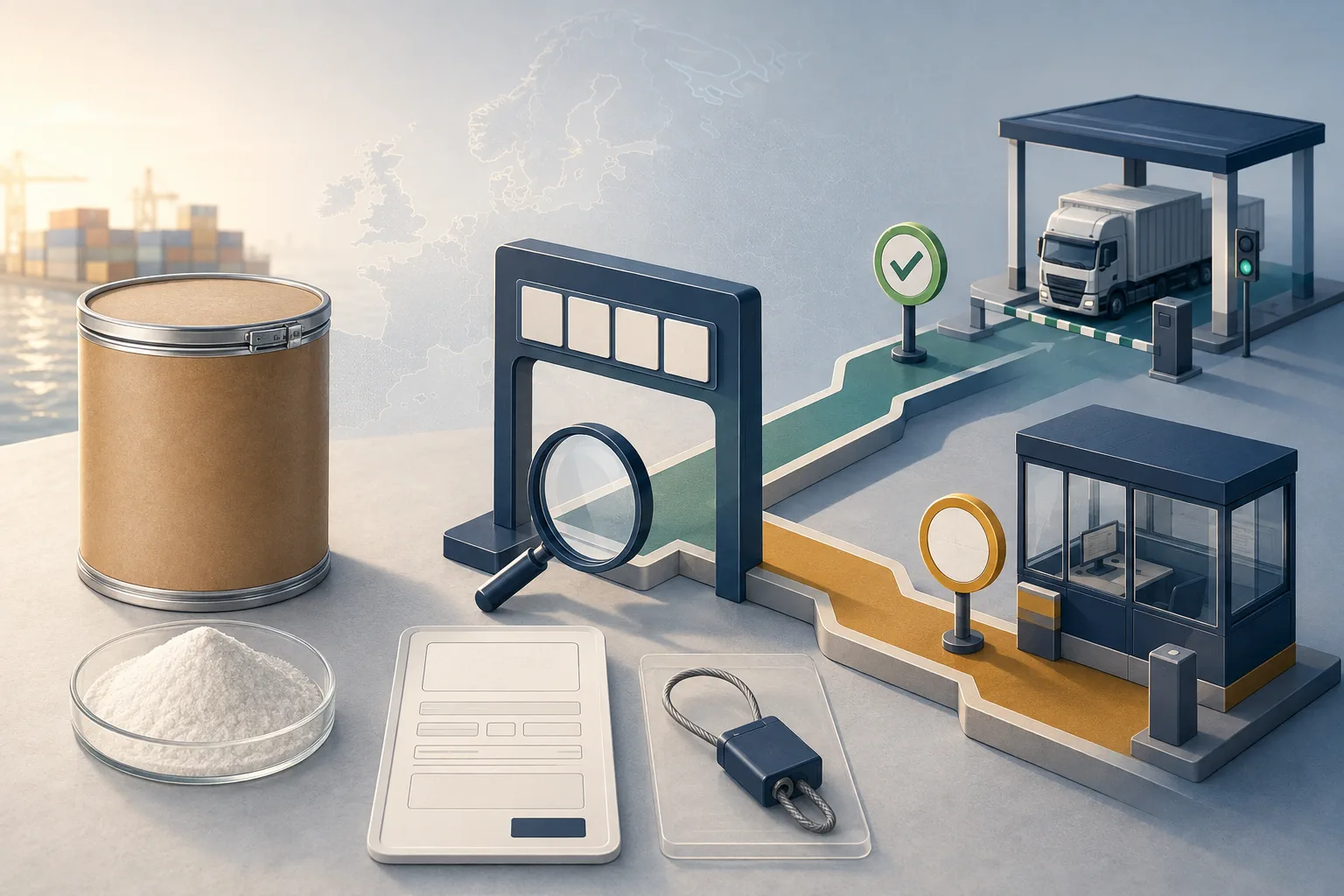
European importers often hear “food ingredient” and assume every bulk shipment must be registered in TRACES NT and routed through a border control post. The direct answer is no: a conventional phosphatidylserine (PS) powder of non-animal origin does not automatically require a CHED-D merely because it is a food or supplement ingredient. TRACES NT and CHED-D become mandatory when the exact consignment falls within the categories of goods subject to official controls at entry, including a product-country-hazard combination listed under Commission Implementing Regulation (EU) 2019/1793 or another applicable emergency measure.
For the current decision, buyers must check the exact product description, composition, intended use, CN/TARIC classification, country of origin, country of dispatch, and latest legal lists. The consolidated version of Regulation 2019/1793 available on EUR-Lex on 18 February 2026 contains no named entry for phosphatidylserine, lecithin, soybean, or soya. That is an important screening result, but it is not a binding classification decision and it does not guarantee that every PS formulation, carrier system, or future shipment remains outside special controls.
This is regulatory and operational information, not legal advice. Confirm the final route with the customs representative, competent authority, and border control post where needed before the goods depart.
The Short Answer: Use a Product-Country-Code Test
The EU does not place all food of non-animal origin into one border-control lane. The European Commission states that the vast majority of these foods, including additives and other substances that affect food characteristics, are not channelled through mandatory border entities before entry. The exception is a defined set of goods subject to increased controls or emergency conditions because a particular risk has been identified.
Use this five-part test for each proposed PS shipment:
| Decision point | What the importer verifies | Why it changes the route |
|---|---|---|
| Exact product | PS source, grade, assay, carrier or matrix, physical form, and intended food use | Commercial names alone are too broad for border decisions |
| Tariff classification | Proposed CN code and any applicable TARIC subdivision | Regulation 2019/1793 identifies goods through codes and descriptions |
| Origin and dispatch | Country where the goods originate and any different country of dispatch | Entries are tied to specified third countries, and some Annex II rules address dispatch through another country |
| Current legal list | Annex I, Annex II, Annex IIa, and other emergency measures in force | The list is risk-based and reviewed at intervals not exceeding six months |
| Entry procedure | Routine customs entry or BCP/control-point route with CHED-D | The wrong route can cause delay, re-routing, sampling, or refusal |
If the exact combination is not captured by a special measure, the consignment can still face normal customs, food-law, and risk-based official controls. “No CHED-D identified” means only that the checked measure did not place the shipment in that mandatory workflow.
Why PS Is Food of Non-Animal Origin, but Not Automatically High Risk
Soy- and sunflower-derived PS are plant-source ingredients. Regulation (EU) 2017/625 creates the general framework for official controls and lists the categories of goods that must be controlled at the border control post of first arrival. Article 47(1)(d) covers goods from certain third countries for which the Commission has required a temporary increase in official controls because of a known or emerging risk or evidence of widespread serious non-compliance. Article 47(1)(e) and (f) cover goods subject to emergency measures or specific entry conditions.
Implementing Regulation 2019/1793 turns that framework into operational lists. It does not say that every plant-derived powder is high risk. Instead, each entry connects a particular food or feed, a country, CN/TARIC codes, a hazard, and a frequency of identity and physical checks.
A 25 kg drum described only as “phosphatidylserine powder” cannot be screened reliably. The importer needs the soy or sunflower source, carrier or matrix, formulation, intended use, and proposed classification. The manufacturing-process guide explains the ingredient route; the EU customs-clearance checklist covers classification and entry documents.
What the Current 2019/1793 Check Shows for Phosphatidylserine
The latest consolidated version reviewed for this article is dated 18 February 2026 and incorporates Commission Implementing Regulation (EU) 2026/194. A direct search of that consolidated legal text returned no occurrence of “phosphatidylserine,” “lecithin,” “soybean,” or “soya.” The listed China entries visible in the annexes concern other named foods and hazards, not a generic category covering all plant-derived ingredients.
For a conventional PS powder, no PS-specific Annex I or Annex II listing was identified in the current consolidated text. Article 12 requires reviews at intervals not exceeding six months, and a future amendment, different classification, emergency measure, or formulation under another description can change the answer.
For a defensible import file, save the grade-specific technical sheet, customs classification rationale, current annex check, and written routing conclusion. A dated record shows which identity, code, country, and legal version produced the decision.
Annex I, Annex II, and Annex IIa: Three Different Outcomes
The annex matters because “listed” does not describe one uniform document package.
Annex I: temporary increased controls
Annex I contains food and feed of non-animal origin subject to a temporary increase of official controls. These consignments enter through a border control post or eligible control point and face documentary checks plus identity and physical checks at the listed frequency. A CHED-D is used. Annex I does not by itself impose the Annex II official-certificate and pre-export laboratory package.
Annex II: special conditions and stronger evidence
Annex II covers specified high-risk goods under special entry conditions. In addition to border controls at the listed frequency, each consignment generally must carry the official certificate set out by the regulation and the required sampling and analytical results from the competent authority of the origin country, or relevant dispatch country where the regulation permits.
An identification code must connect the certificate, analytical results, packaging, and CHED-D. This is more than uploading a commercial supplier COA.
Annex IIa: suspended entry
Annex IIa is the stop lane. It identifies food and feed for which entry into the Union is suspended. A commercial document pack or extra test does not convert a suspended combination into an admissible shipment.
| List result | Buyer action before shipment |
|---|---|
| Not listed under the checked measure | Keep the dated classification and list review; continue normal import compliance |
| Annex I | Book an eligible entry point, prepare CHED-D Part I, and plan for listed controls |
| Annex II | Do all Annex I routing work plus obtain the required official certificate and analytical evidence |
| Annex IIa | Do not ship under that product-country combination; escalate immediately |
What CHED-D and TRACES NT Actually Do
CHED-D is the Common Health Entry Document used for feed and food of non-animal origin that is subject to the measures or entry conditions in Article 47(1)(d), (e), or (f) of Regulation 2017/625. TRACES NT is the Commission's electronic platform through which the document is created, submitted, completed, and shared.
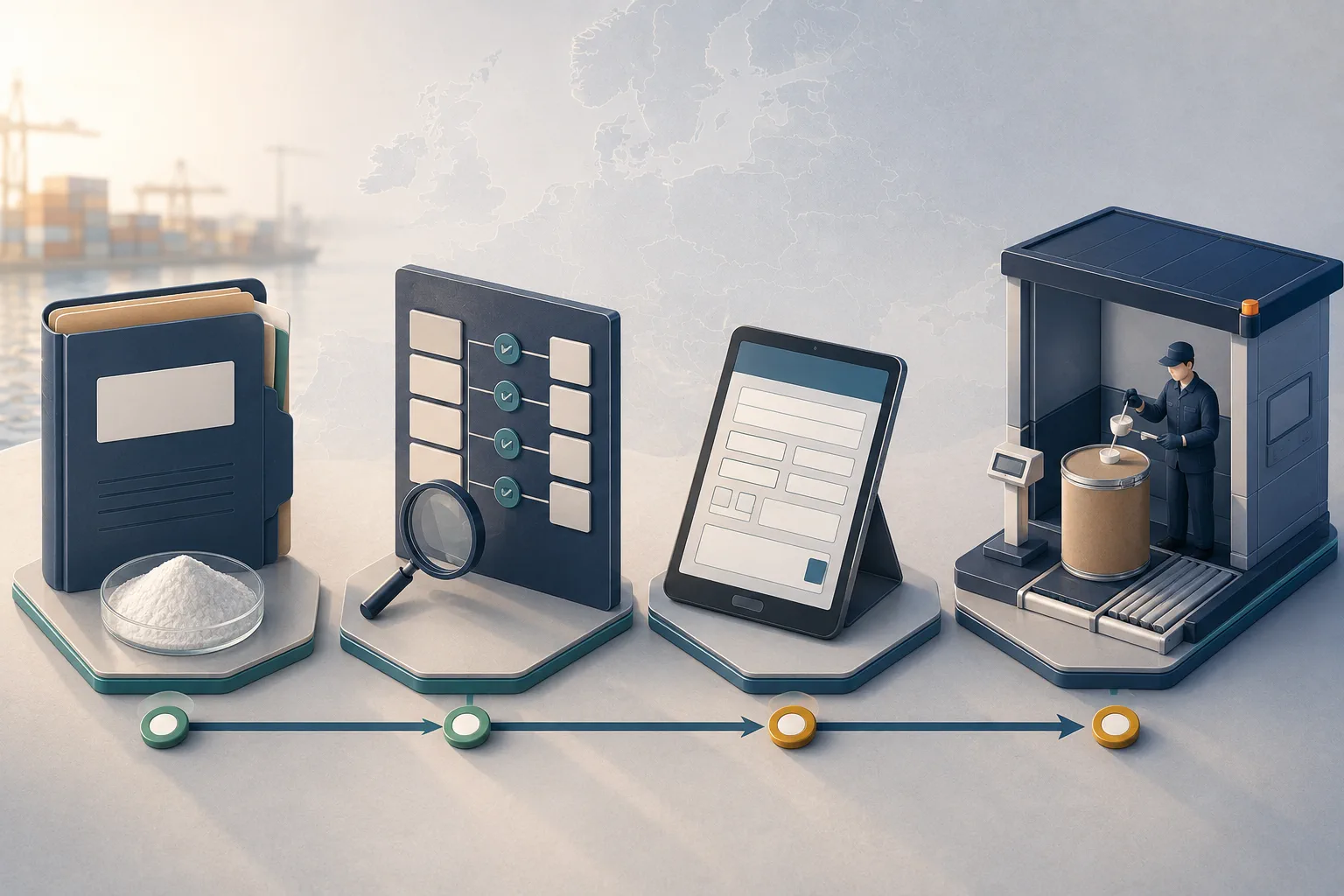
The economic operator responsible for the consignment in the EU completes Part I with the parties, transport, entry point, goods, package count, weights, container or seal, and intended use. The border authority records controls and its decision in Part II; Part III records follow-up where required.
Under Article 56 of Regulation 2017/625, the operator uses the CHED to give prior notification to the border control post and submits the relevant part in IMSOC before physical arrival. Implementing Regulation 2019/1013 sets the normal minimum at one working day before expected arrival. Where transport logistics prevent that timing, the competent authority may apply a minimum of four hours. Importers should not plan around the exception; confirm the local BCP cut-off and submit when the shipment data is stable.
Customs release is linked to the official-control outcome. Article 4 of Regulation 2019/1793 allows release for free circulation of listed consignments only when a duly finalised CHED confirms compliance. A draft CHED-D number is not a release decision.
Do Not Confuse CHED-D With ICS2 or Customs Clearance
Three lanes can touch the same shipment, but they answer different questions:
| Lane | Main purpose | Typical owner |
|---|---|---|
| ICS2 Entry Summary Declaration | Pre-arrival safety and security data for goods entering the EU customs territory | Carrier or filing party, supported by importer data |
| Customs declaration | Classification, origin, value, duties, importer status, and customs procedure | Importer and customs representative |
| TRACES NT / CHED-D | Official food-control entry process for specified categories of goods | EU operator responsible for the consignment and competent authority |
A consignment may require ICS2 and a customs declaration without requiring a CHED-D. A listed high-risk consignment can require all three. The ICS2 guide covers ENS data and carrier handoff; it cannot answer the sanitary-control question. Likewise, an EORI number and correct customs code do not replace TRACES pre-notification when the goods are listed.
Build the Import Decision Before Booking Freight
The safest workflow starts before the purchase order is released:
- Lock the grade. Record soy or sunflower source, PS assay basis, carrier or matrix, product code, intended use, and packaging.
- Confirm the code. Ask the customs representative to review the complete specification, not only the product name. Record the proposed CN/TARIC code and reasoning.
- Confirm origin and dispatch. Match the commercial invoice, certificate of origin where used, manufacturer address, and actual shipping route.
- Check live rules. Review the latest 2019/1793 consolidated text and amendments, plus any other product-specific emergency measure. Do this again before each shipment because the list changes.
- Choose the entry point. If listed, confirm that the planned BCP or control point is designated for the category and can perform the required checks.
- Assign TRACES ownership. Identify the EU operator responsible for Part I, its approved TRACES user setup, the customs representative, and the contact at the BCP.
- Collect shipment data. Invoice, packing list, transport document, seal, lot, weights, package count, origin, dispatch, and destination must agree.
- Pre-notify and monitor. Submit within the applicable period, track documentary and any identity or physical checks, and do not treat the lot as released until the CHED is finalised.
Need a source-matched PS document file?
Nutranexa's published PS pages distinguish general, soy, and sunflower routes and show specification and COA evidence for buyer review. Contato de vendas with the exact grade, destination country, proposed code, shipping route, and importer document list so the product and shipment data can be aligned before your broker makes the final entry decision.
Supplier Data the Importer Should Request
Even when no CHED-D is identified, request enough supplier data to support the decision:
- legal manufacturer and shipper identities and addresses;
- exact commercial product name and code;
- soy or sunflower source and ingredient composition;
- intended food or supplement use;
- current specification, available batch COA, lot, and shelf-life position;
- packaging format, drum count, and weights;
- country of origin and country of dispatch;
- invoice description consistent with the technical file;
- container, seal, bill of lading, or airway-bill details when available;
- any official certificate or laboratory result required if a legal list applies.
The supplier supports identity and shipment evidence; the EU importer decides the legal entry route with its representatives and authorities.
Red Flags That Should Stop Dispatch
- Classification is based on “PS powder” without composition or intended use.
- Invoice, specification, and packing list use different product descriptions.
- Origin and dispatch country are treated as interchangeable.
- A previous clearance is used instead of checking the current list.
- A listed Annex II consignment has only a commercial COA.
- The port is not confirmed for the goods, pre-notification is late, or a draft CHED is treated as release.
How Verified Nutranexa Facts Fit the Review
Nutranexa was founded in 2013 and operates a 110,000+ m2 campus. Its website presents PS as a lead ingredient, separates soy and sunflower PS routes, shows available specification and COA evidence, and references R&D cooperation with East China University of Science and Technology. Published commercial information states a 25 kg MOQ and 25 kg net per drum for PS, with primary export focus in Europe and North America. Factory, packaging, and dispatch imagery is also available for buyer review.
Those facts support the identity, supplier, packaging, and lot-data layer. They do not establish a tariff code, decide Regulation 2019/1793 scope, register an importer in TRACES, or replace a BCP decision.
Perguntas frequentes
Does every phosphatidylserine shipment need to be registered in TRACES NT?
No. Food of non-animal origin does not automatically require a CHED-D. The requirement applies when the exact goods fall within a category subject to official controls at entry, such as a product-country-code combination in Regulation 2019/1793 or another emergency or special measure. Check the current rules for every shipment.
Is phosphatidylserine currently listed in Regulation (EU) 2019/1793?
The consolidated version reviewed on 18 February 2026 contains no named occurrence of phosphatidylserine, lecithin, soybean, or soya. That supports a “no PS-specific listing identified” conclusion for a conventional grade, but it is not a binding CN/TARIC classification and the list is updated regularly.
What is the difference between Annex I and Annex II?
Annex I imposes temporarily increased border controls at the listed frequency. Annex II adds special entry conditions, including an official certificate and required analytical results for the consignment. Both use the CHED-D workflow when the exact listed goods are imported.
Who completes a CHED-D for an EU import?
The economic operator responsible for the consignment in the EU completes and submits Part I in TRACES NT. The competent authority completes Part II with the control results and decision, and Part III is used for follow-up where applicable.
How early must CHED-D pre-notification be submitted?
The normal rule is at least one working day before expected arrival. If logistics prevent that, the competent authority may apply a minimum of four hours. Confirm the actual cut-off with the border control post and avoid relying on the exception.
Is CHED-D the same as an ICS2 Entry Summary Declaration?
No. ICS2 handles customs safety and security pre-arrival data. CHED-D records official food controls for specified goods of non-animal origin. A shipment can need ICS2 and customs declarations without CHED-D, or all three when special food-import controls apply.
Conclusion
Phosphatidylserine does not need TRACES NT or a CHED-D simply because it is a plant-derived supplement ingredient. The decision is made shipment by shipment by matching the exact grade, composition, intended use, CN/TARIC code, origin, dispatch country, and current EU control lists. The current consolidated 2019/1793 text contains no PS-, lecithin-, soybean-, or soya-named entry, so no PS-specific high-risk listing was identified; nevertheless, the importer should preserve a dated review and repeat it before dispatch.
If the goods enter Annex I or Annex II scope, routing, documentation, pre-notification, and release all change. Resolve the question before booking freight, because a correct technical file and code review are far cheaper than trying to redirect a consignment after arrival.
Fontes
- European Commission: Official controls on imported products
- European Commission: Import controls of food and feed - Questions and Answers
- EUR-Lex: Regulation (EU) 2017/625 on official controls
- EUR-Lex: Consolidated Implementing Regulation (EU) 2019/1793, 18 February 2026
- EUR-Lex: Implementing Regulation (EU) 2019/1013 on prior notification
- EUR-Lex: Implementing Regulation (EU) 2019/1715 on IMSOC and CHED formats
- European Commission: TRACES modules and CHED-D workflow
Contato de vendas
Contact Nutranexa Sales to request the current PS specification, available COA evidence, source and composition information, packaging details, and shipment data for the exact soy or sunflower grade you plan to import. Share the EU destination, proposed CN/TARIC code, importer or broker document list, and intended application so the commercial file can be prepared for your entry-route review.
Próximas etapas recomendadas
- Revise o Phosphatidylserine página do produto.
- Comparar Soy PS e Sunflower PS.
- Verifique prova de fabricação e Qualidade e P&D.
Entre em contato com o departamento de vendas para obter documentos do produto
Compartilhe preferência de fonte, aplicação, país e quantidade anual.
Contato de vendas