

Walk the supplement aisles of any US or European retailer and count the gummies: they now lead most categories, and cognitive health is no exception. Brands want phosphatidylserine in the format their customers prefer — and every month, procurement teams discover that PS is one of the harder ingredients to put into a gummy that survives its shelf life.
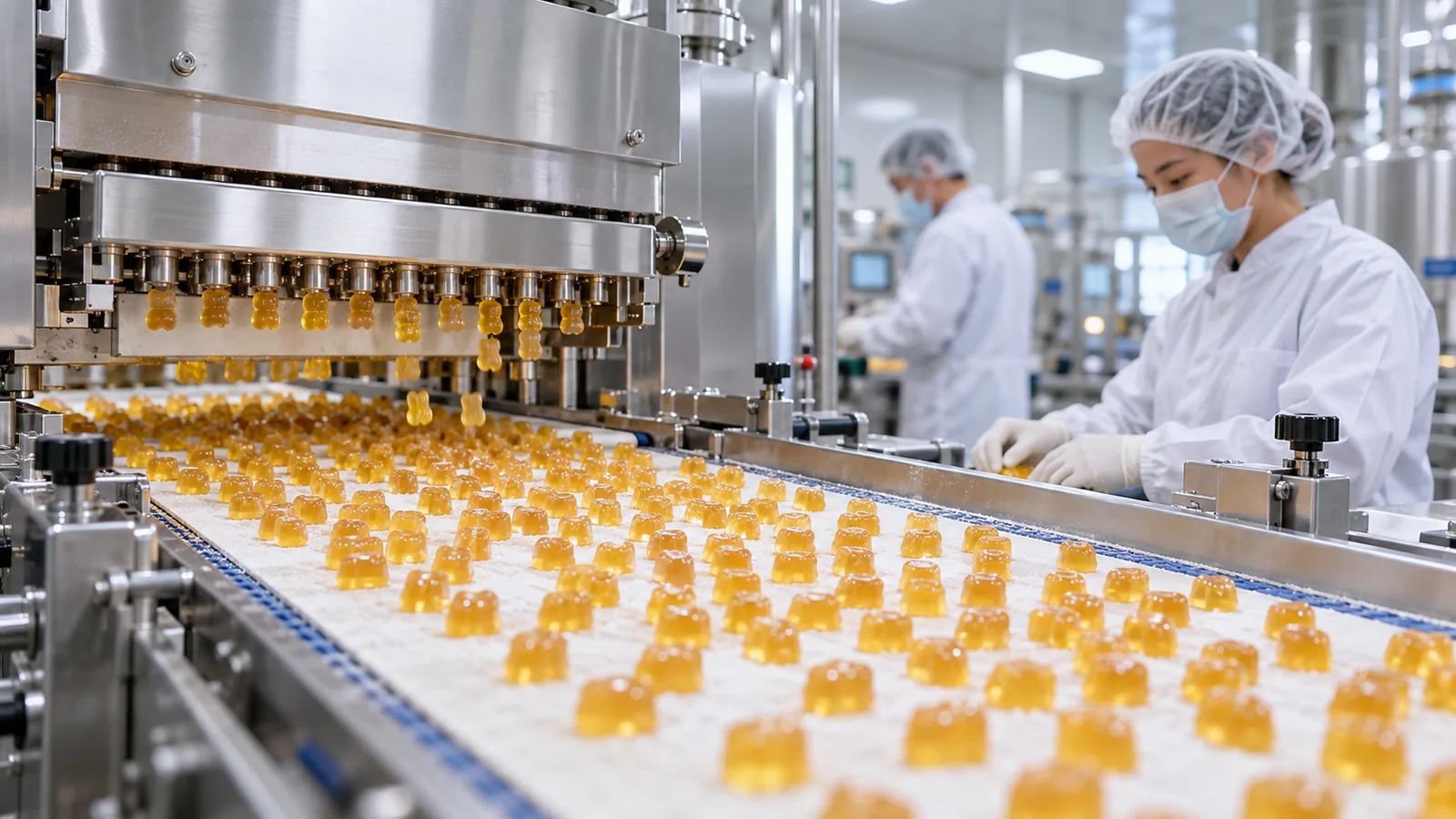
The problem is chemistry, not manufacturing capacity. PS is an amphiphilic phospholipid — part water-loving, part fat-loving — designed by nature to sit in membranes, not to dissolve cleanly in a pectin or gelatin matrix held together with sugar, acid, and water. Rushed PS gummy projects fail in predictable ways: assay drift, off-flavour development, texture collapse, and label claims that stop matching the product halfway through shelf life. This article maps the real challenges, the development path that solves them, and the OEM selection criteria that keep the project on schedule.
Why Gummies Attract PS Brands — and Why PS Resists Them
The commercial case is strong. Gummy formats dominate new cognitive-health launches, command price premiums, suit consumers who avoid capsules, and open gifting and family SKUs. But PS differs from the ingredients gummy platforms were built around. Vitamins and many botanicals are either water-soluble or present at small loadings; PS is typically dosed at 100 to 300 mg per serving, is fat-soluble in character, and carries its own taste profile — a distinct phospholipid note that does not hide behind fruit acid the way bitter botanicals sometimes can. A gummy that works for 5 mg of melatonin is not automatically a platform for 300 mg of a phospholipid. Recognising that mismatch early is what separates successful PS gummy launches from reformulation cycles.
The Core Formulation Challenges for PS in a Gel Matrix
Four challenges dominate. Dispersion and phase behaviour: PS in powder form must disperse uniformly through the gel mass without forming fatty pockets or hazing; the order of addition, pre-dispersion carriers, and slurry preparation matter as much as the gelling system. Water activity and migration: phospholipids interact with water and with the gel network, and over shelf life this drives moisture migration, weeping, or sandiness — the texture failures consumers notice first. Heat load: gummy cooking and depositing run hot, and phospholipids are oxidation-prone; processes that keep cook temperatures and hold times gentle protect both assay and sensory profile. Taste and mouthfeel: at functional PS loadings, the ingredient itself contributes texture and flavour, so acid blend, sweetener system, and flavour house selection need to be designed around PS rather than applied as a standard fruit base. A capable OEM solves these with controlled experiments — matrix trials varying gelling agent, water activity targets, and PS dispersion technique — not with a single heroic formulation attempt.
Stability, Analytical, and Label-Claim Considerations
Stability is where PS gummies are won or lost. The development program should include accelerated stability at real-world humidity, because gummies are moisture-sensitive dosage forms and phospholipid oxidation accelerates with heat and oxygen exposure. Analytical method matters more than brands expect: the HPLC method that assays bulk PS powder does not always extract PS cleanly from a gel matrix, so the OEM must validate a gummy-specific assay with proper extraction — otherwise stability data is noise. Packaging and coating decisions compound the picture: oil or wax coating layers designed for other actives can interact with phospholipids, while uncoated gummies need moisture-barrier packaging and desiccant strategy consistent with the water-activity target. Finally, label claims: declare per-gummy amounts achievable within overage and stability margins, and let the stability data — not optimism — set the expiry date. A PS gummy labelled at 300 mg that assays at 260 mg at month twelve is a compliance failure in the US and EU alike.
The Development Path from Pilot Batch to Commercial Production
A disciplined path has five stages. Feasibility: small-lab matrix trials confirming that the target PS dose disperses, assays, and tastes acceptably in the chosen gelling system — weeks, not months, and inexpensive relative to what it de-risks. Pilot batch: production-scale equipment at pilot volume to observe the real process — cook, hold, deposit, cure — and capture process parameters that survive scale-up. Stability initiation: pilot batches enter real-time and accelerated protocols immediately, because shelf-life data is the long pole in the launch timeline. Scale-up and validation: transfer to commercial moulds, depositor speeds, and drying tunnels with validated process windows and in-process controls for weight, moisture, and content uniformity. Registration and documentation: specification, method validation summary, stability protocol, and the batch-record structure your quality agreement will reference. Brands that compress or skip the pilot stage to hit a launch date typically buy back the time as post-launch reformulation.

Selecting and Contracting the Gummy OEM
OEM selection for a PS gummy is a technical fit question before a price question. Evidence to request: prior phospholipid or fat-soluble-active gummy work, water-activity and texture analytical capability in-house, method development capacity for matrix-specific PS assay, and stability chambers running both real-time and accelerated conditions. Process capability: low-oxidation handling — nitrogen protection or controlled atmosphere where relevant, gentle cook and hold parameters, and coating options that do not fight the ingredient. Quality structure: 21 CFR Part 111 compliance for US supply, EU food-supplement expectations where applicable, and willingness to sign a quality agreement with change-notification terms for the matrix, flavour suppliers, and coating materials. Commercial terms: who owns the formulation and its improvements, minimum order quantities matched to a realistic demand curve, and development-phase milestones with defined acceptance criteria before bulk commitment. One warning sign outweighs all marketing decks: an OEM who quotes your PS gummy in a day, at standard pricing, with no questions about dose, matrix, or stability, has not understood the ingredient.
FAQ
Q: Can phosphatidylserine be formulated into gummies at all?
A: Yes, and commercial products exist — but it requires deliberate formulation work: dispersion carriers, water-activity control, oxidation-protective processing, and a matrix-specific analytical method. It is a development project, not a drop-in from a capsule formula.
Q: What PS dose is realistic in a single gummy?
A: Functional doses of 100 mg per gummy are achievable with good dispersion technique; 300 mg per serving is commonly reached with two or three gummies. Very high single-gummy loadings push the matrix toward texture and taste problems, so multi-gummy servings are usually the better design.
Q: How long does PS gummy development typically take?
A: Feasibility and pilot work commonly run one to three months, but real-time stability data for a compliant expiry date takes twelve months or more. Many brands launch on accelerated data with a conservative initial dating claim, then extend as real-time results mature — a structure to agree with the OEM in advance.
Q: Should the brand or the OEM own the gummy formulation?
A: Negotiate it explicitly. Brand ownership gives freedom to move manufacturers; OEM ownership is often cheaper upfront but locks in the relationship. The worst position is silence — formulation ownership disputes surface exactly when the product succeeds.
Conclusion
PS gummies are a legitimate, growing opportunity — and a genuine formulation project. The phospholipid's dispersion behaviour, heat sensitivity, oxidation risk, and taste contribution demand a development path with feasibility work, pilot batches, and matrix-specific stability and analytical methods, executed by an OEM with demonstrated phospholipid capability and contract terms that clarify formulation ownership. Brands that respect the chemistry launch on schedule; brands that treat a PS gummy like a vitamin gummy pay for it in reformulation. Nutranexa supplies phosphatidylserine powder and granulation formats optimised for dispersion in gummy matrices, supports OEM development teams with technical documentation and stability guidance, and coordinates directly with your contract manufacturer through scale-up.
Sources
- U.S. FDA — Current Good Manufacturing Practice for Dietary Supplements (21 CFR Part 111): https://www.fda.gov/food/current-good-manufacturing-practice-cgmp-dietary-supplements
- U.S. FDA — Dietary supplements guidance documents and regulatory information: https://www.fda.gov/food/dietary-supplements-guidance-documents-regulatory-information
- NIH Office of Dietary Supplements — Dietary Supplements background and safety resources: https://ods.od.nih.gov
- European Commission — Food Supplements portal: https://food.ec.europa.eu/food-labelling-and-nutrition/food-supplements_en
- ICH — Stability Testing Guidelines (Q1A): https://www.ich.org/page/quality-guidelines
Étapes suivantes recommandées
- Passez en revue le Phosphatidylserine page produit.
- Comparer Soy PS et Sunflower PS.
- Vérifier preuve de fabrication et Qualité & R&D.
Contacter le service commercial pour obtenir les documents produits
Partagez la préférence de source, l'application, le pays et la quantité annuelle.
Contacter le service commercial