
Phosphatidylserine is not the most fragile ingredient in a warehouse, but it is far from bulletproof: elevated temperatures accelerate peroxide-value growth and color drift, and repeated cycling between warm and cool conditions does more damage than a single modest excursion. The trouble for buyers is that transport damage is invisible at the dock — a lot can arrive sealed, dry, and undented, yet with its oxidative clock quietly advanced. That is why serious importers do not rely on "keep cool" labels; they validate the shipping configuration the way they would validate a process: define the required temperature profile, design thermal packaging for the lane's worst case, test it, monitor real shipments, and keep the documentation that proves all of it. This guide covers that validation chain for PS raw material and finished goods moving on US and EU lanes: what temperature profile to specify, how thermal packaging is qualified, what a lane qualification actually involves, and which documents must exist before the first commercial container ships.
Step 1: Define the Required Temperature Profile — From the Product, Not From Habit
Validation starts with a specification, and the specification must come from the ingredient's stability behavior. For PS raw material, typical supplier storage recommendations are cool and dry — commonly 15–25 °C with low humidity, protected from light and oxygen — with the real constraint being cumulative heat exposure over the journey rather than any single reading. Work from three inputs: the supplier's recommended storage condition and shelf-life claim, your stability data (or the supplier's) showing behavior at accelerated conditions, and the finished-product dosage form's own sensitivities (softgels and gummies soften at lower temperatures than powders). The output is a written transport temperature profile: e.g., "maintain mean kinetic temperature below 25 °C; no more than 72 cumulative hours above 30 °C per shipment." Without a numeric profile, excursion disputes later have no reference point. ICH's stability-testing framework (ICH Q1A(R2)) is the standard reference for the accelerated and long-term condition logic behind such profiles.
Step 2: Thermal Packaging Design and Qualification
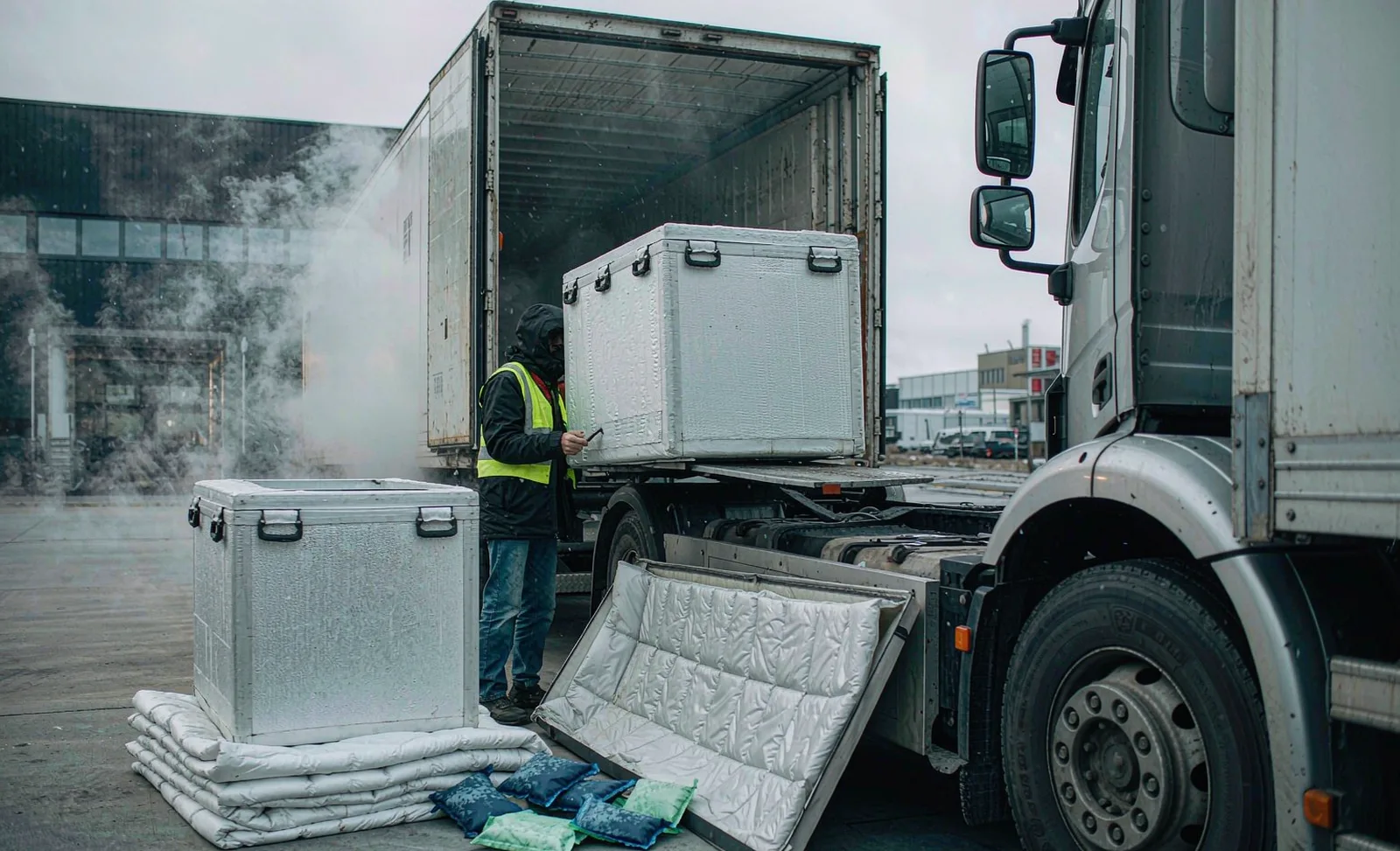
Once the profile is set, the shipping configuration is engineered against it. For summer lanes or refrigerated-equipment gaps, this usually means insulated shippers (molded EPS, polyurethane panels, or vacuum panels) with conditioned gel packs or phase-change material, sized for the transit duration plus a buffer of 48–72 hours for delays. Qualification answers one question: does this configuration hold the profile under the lane's worst case? The standard approach is summer/winter chamber testing — the packed shipper is placed in a chamber programmed to the lane's extreme ambient profile (for example, 38 °C mean summer for a Gulf-bound lane) while internal probes record the product-space temperature over the required duration. Key practical points buyers should insist on:
- The chamber test duration equals the maximum planned transit time plus the delay buffer, not the average transit time.
- Probes measure the product space (against or inside a simulated product), not the box air only.
- The refrigerant is conditioned (gel packs at a defined temperature) and the conditioning is written into the packing SOP.
- The qualified configuration is documented with drawings and photos — what was tested is what must ship.
USP's storage-and-distribution guidance (General Chapter on the risks and mitigation strategies for storage and transportation of drugs, extended in practice to excipients) and the general quality-system expectation of documented control make this the defensible benchmark for B2B customers; see USP standards.
Step 3: Lane Qualification and Ongoing Monitoring
Chamber tests prove the packaging; lane qualification proves the route. A lane is defined by origin, destination, mode, season, and service level — "Shanghai to Los Angeles, ocean LCL, summer, port-to-door" is a lane. Qualification uses instrumented shipment(s) on the actual route, recording temperature (and humidity where relevant) from dock to dock, and comparing the profile against both the packaging qualification and the product's transport specification. Practical guidance:
- Instrument at least the first three shipments on a new lane, covering different seasons if feasible; after that, move to every shipment or a risk-based sampling plan.
- Use calibrated loggers with an appropriate range and accuracy (±0.5 °C is typical), placed with the product, plus one in the outer packaging to distinguish ambient shocks from product-space response.
- Define alarm thresholds in the logger before shipment, so reviews are objective rather than interpretive.
- Record handling milestones — stuffing, transshipment, customs dwell, de-vanning — so any excursion can be located in the journey.
In the US, the sanitary-transportation framework under FSMA (FDA's Sanitary Transportation Rule) sets baseline requirements for vehicles and temperature control where applicable, and your customer-facing quality file should reference how your lanes satisfy it.
Step 4: The Documentation Pack That Proves Control
A validated lane produces a specific, auditable document set. Before the first commercial shipment of PS on any lane, you should hold:
- Transport temperature profile for the product, derived from stability data and approved by your quality unit.
- Thermal packaging qualification report — chamber protocols, ambient profiles used, internal temperature curves, pass/fail against the profile.
- Lane qualification report — logger data from instrumented shipments with route timing and excursion analysis.
- Packing SOP and packing list referencing the qualified configuration, including refrigerant conditioning.
- Logger calibration certificates and a defined review-and-archive process for logger data per shipment.
- Excursion decision tree — in advance, define what happens when a threshold is breached: quarantine, stability or peroxide-value testing against the spec, and a documented release/reject rationale.
This pack is what turns a customer complaint or a customs query into a five-minute document retrieval instead of an argument. It also protects you commercially: with profile-based acceptance criteria in the purchase contract, "the truck looked hot" is no longer a basis for rejection — data is.

Step 5: Excursion Management — Deciding Before You Have To
Despite good packaging, excursions happen: a transshipment delay, a de-vanning bottleneck, a refrigerated trailer failure. A pre-agreed decision tree converts a stressful event into a controlled procedure. A workable version: on any threshold breach, quarantine the lot on arrival; pull the logger curve and compute cumulative time above each threshold band; test peroxide value (and color) against the raw-material specification, or — for finished goods — review against the release spec and the stability headroom; release with documented justification, or reject and claim against the carrier or insurance with the logger data as evidence. Note that cumulative heat, not peak temperature alone, drives PS oxidation — a long mild excursion can matter more than a brief spike, so your decision tree should work from cumulative-exposure bands rather than a single maximum reading.
Costs and Trade-Offs: Right-Sizing the Validation Effort
Cold-chain validation is an investment, and it should be right-sized. Full summer/winter chamber qualification plus multi-shipment lane qualification is clearly warranted for high-value lanes, retail customers with audit programs, and summer-loaded reefer-dependent routes. For shorter, temperate lanes with robust ambient evidence, a risk-based approach — passive protection sized on supplier data, instrumented verification shipments, and annual re-verification — may be proportionate. What is never proportionate is skipping validation entirely and discovering oxidative drift at the shelf-life test point, when the affected inventory is measured in pallets rather than cartons. Align the effort with your quality agreement expectations and, where your customers are EU-based, with the documented food-safety controls expected under an ISO 22000-aligned system (ISO 22000:2018).
FAQ
Q1: Does phosphatidylserine powder really need cold-chain shipping?
Not refrigerated transport in most cases — but it does need a validated temperature profile. PS degrades oxidatively with cumulative heat exposure, so the question is whether the lane's worst-case ambient keeps cumulative exposure within what the stability data supports. For summer ocean or overland lanes with long dwells, thermal protection and monitoring are usually justified.
Q2: What is the difference between packaging qualification and lane qualification?
Packaging qualification tests the shipper against a worst-case ambient profile in a controlled chamber; lane qualification tests the actual route with instrumented real shipments. You need both — a perfect shipper cannot compensate for an unexpected week-long customs dwell, and a benign route does not prove the packaging would survive a summer peak.
Q3: How many data loggers should I use per shipment?
Minimum practice is two: one placed with the product (product-space response) and one in the outer packaging (ambient reference). For consolidated pallets or high-value loads, add loggers per pallet or per lot so individual lots can be released or quarantined independently.
Q4: Who pays if an excursion occurs — the carrier, the shipper, or the buyer?
It depends on the Incoterm and the evidence. With logger data, a documented transport specification, and packaging qualified for the lane, the importer can attribute the loss and support cargo-insurance or carrier claims. Without that documentation, excursion disputes typically collapse into shared losses — which is exactly what the validation pack prevents.
Q5: How often should lane qualification be repeated?
Re-qualify when the route, mode, season coverage, service level, or packaging configuration changes materially. Otherwise, ongoing shipment data under your monitoring plan effectively re-verifies the lane continuously; a formal annual review of that data against the transport profile is good practice.
Conclusion
Cold-chain validation for phosphatidylserine is a chain of four deliverables: a numeric transport temperature profile derived from stability data, a chamber-qualified thermal packaging configuration, instrumented lane qualification with ongoing logger coverage, and a documentation pack with a pre-agreed excursion decision tree. Together they convert PS's quiet oxidative risk into a measured, contractual, and auditable quantity. Buyers who build this chain ship with confidence across seasons and continents — and when something goes wrong, they have data instead of opinions.
Sources
- FDA — FSMA Final Rule on Sanitary Transportation of Human and Animal Food: https://www.fda.gov/food/food-safety-modernization-act-fsma/fsma-final-rule-sanitary-transportation-human-and-animal-food
- ICH Q1A(R2) — Stability Testing of New Drug Substances and Products: https://database.ich.org/sites/default/files/Q1A%28R2%29%20Guideline.pdf
- USP — Standards for Storage and Distribution Quality: https://www.usp.org/standards
- ISO 22000:2018 Food Safety Management Systems: https://www.iso.org/standard/71726.html
- FDA — Dietary Supplements (import and quality context): https://www.fda.gov/food/dietary-supplements
Étapes suivantes recommandées
- Passez en revue le Phosphatidylserine page produit.
- Comparer Soy PS et Sunflower PS.
- Vérifier preuve de fabrication et Qualité & R&D.
Contacter le service commercial pour obtenir les documents produits
Partagez la préférence de source, l'application, le pays et la quantité annuelle.
Contacter le service commercial