

A supplier audit for phosphatidylserine is not a search for a dramatic failure. It is a check that the plant which produced the lot you tested is the plant that will produce the next twelve. That matters more for PS than for a commodity excipient: the material is specification-sensitive, oxidation-prone, and sourced from either soy or sunflower, so allergen status and oxidative history travel with every drum.

For US buyers, supplier verification is an explicit obligation under dietary supplement GMP; for EU buyers, the operator carries traceability one step back and one forward, with hygiene duties set by Regulation (EC) No 852/2004. An audit turns those obligations into observed practice.
What a Phosphatidylserine Audit Is Actually Testing
A useful audit tests three things. Capability: does the plant have the equipment and utilities to make this material consistently? Control: are the parameters that define the product — assay basis, peroxide value, moisture, heavy metals, residual solvent, microbiology — measured and released against a written specification? Continuity: will the same process, source and site be in place in twelve months?
Structure the visit around those questions rather than a generic checklist. Request the document pack at least ten working days ahead and name what you want: specification with methods, three consecutive lot records with full batch production records, HACCP plan and flow diagram, allergen matrix, twelve months of change control and CAPA logs, complaints register, and the scope of any food safety certificate. Ask which documents exist in Chinese only and whether English translations can be provided in advance.
Facility and Hygienic Design: What to Walk and Record
Walk the process in the order material flows, not the order the host prefers: raw material receipt and warehousing, enzymatic conversion or blending, drying, milling and sieving, blending, and packing. At each step record the equipment identification, the product contact surfaces and the cleaning method.
Look for details that predict problems rather than details that photograph well: zoning between raw and finished areas, segregation of drying and milling from open product, flooring and drainage that can actually be cleaned, product-contact compressed air and nitrogen, and sieves and magnets with recorded inspection.
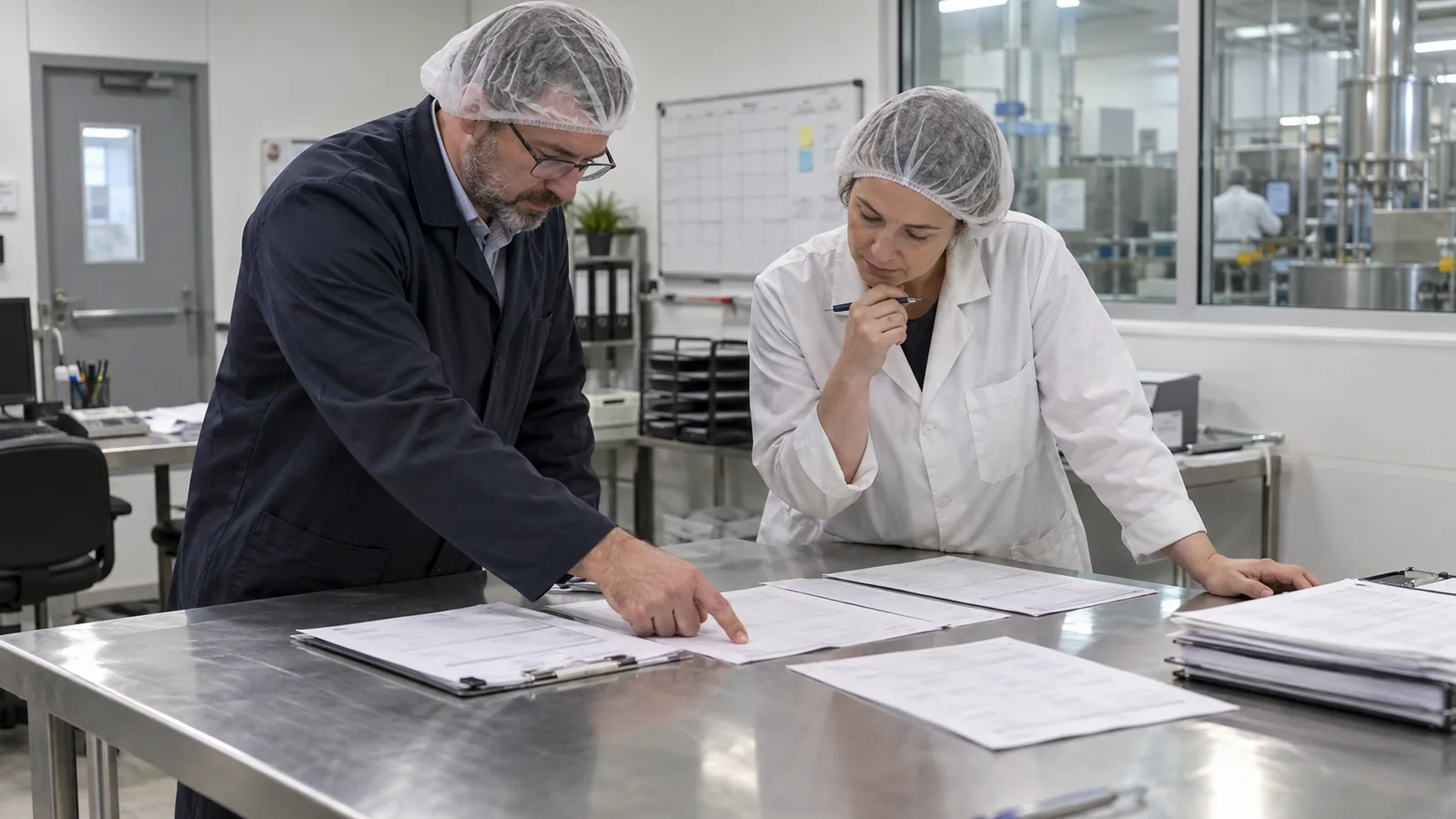
Request cleaning records for the equipment that will make your material, particularly where a line also runs soy phospholipid, and ask who signs them. Confirm the photography policy before the walk.
Allergen Segregation and Cross-Contact Control
Allergen control most often decides a PS award, because soy and sunflower supply chains can share equipment. Ask for the allergen matrix first — which allergens are on site, which run on shared equipment — then test it against the production schedule: if soy lecithin ran on Monday and your sunflower lot on Tuesday, what happened in between?
Verify segregated storage for allergenic raw materials, colour-coded utensils, gowning rules, and a documented changeover with a recorded cleaning step and release signature. Check that incoming drum labels are verified against the purchase order, because a mislabelled drum is the failure no downstream test reliably catches.
Then reconcile the paperwork with the label you will sell under: US major allergen declaration under the Food Allergen Labeling and Consumer Protection Act framework, EU obligations under Regulation (EU) No 1169/2011. Request a written allergen statement and the evidence behind it — supplier declarations, identity testing and changeover records.
Batch Records, Traceability, and the One-Lot Trace
Do not accept a summary — run a timed one-lot trace. Take a finished lot that shipped to a real customer and require reconstruction back to every raw material lot, including the phospholipid source and enzyme lots, and forward to every customer and retained sample.
Pull the batch production record and read it as an auditor. Are weights, times and yields recorded contemporaneously, in ink or in a validated electronic system with an audit trail? Are deviations explained, or corrections initialled without reason? Is the retention sample labelled, stored under stated conditions and held for the claimed shelf life plus a margin?
Ask how lot numbering works, how rework is handled, and whether lot blending is permitted and recorded — a supplier that blends out-of-specification material into a compliant lot without disclosure has failed the audit regardless of what the finished COA shows. Close by requesting the last mock recall and its timing result.
CAPA, Change Control, and Complaint Handling
CAPA maturity shows how a plant behaves when something goes wrong. Read the CAPA log for shape rather than volume: are corrective actions tied to root cause, or are they retraining and re-inspection by default? Are effectiveness checks closed with evidence, and do due dates slip?
Read the change control register next. Has the incoming phospholipid supplier, the enzyme supplier, the drying profile or the sieve mesh changed? Each can move assay, peroxide value or particle size distribution, and each should have triggered a change assessment and, where relevant, customer notification. Ask how much notice customers receive.
Complaints deserve the same treatment: a register with categorisation, investigation records and response times. Ask for the last three PS complaints, their root causes and what changed afterwards.
QC Laboratory Capability and the Limits of Remote Review
Ask what is tested in house and what is subcontracted, then look at the laboratory: method documentation at the bench, calibration schedules for balances and chromatographs, and control charts for the assay. Where work is subcontracted, request the laboratory's ISO/IEC 17025 accreditation and check that its scope covers the method and matrix.
Remote review is useful for document-heavy elements — specifications, COAs, batch records, CAPA logs, certificates and video interviews with QA staff. It is weak on what decides whether a supplier can actually make the material: physical condition of the plant, housekeeping, gowning discipline, whether operators follow the written procedure, and whether the warehouse matches the inventory system.
Treat remote review as a screen, not as qualification: use it to shortlist and plan a focused on-site visit, then close with what remote work cannot replace — a sample tested by an independent laboratory against the supplier's COA, and a repeat audit on a requalification cycle.
FAQ
Q: What should a phosphatidylserine supplier audit cover?
A: Six areas: hygienic design walked in material flow order, allergen segregation and changeover control, batch records with a full one-lot trace, CAPA and change control, QC laboratory capability including subcontracted testing, and supply continuity.
Q: How do buyers verify traceability for a phosphatidylserine lot?
A: Run a timed one-lot trace: reconstruct a shipped lot back to every raw material lot, including the phospholipid and enzyme lots, and forward to every customer and retained sample, with the batch production record read in full.
Q: Can a remote audit replace an on-site visit?
A: No. Remote review works for documents and interviews but not for physical condition, housekeeping or whether operators follow written procedures. Use it to screen and plan an on-site visit, then verify by independent testing.
Q: Which CAPA evidence should buyers request from a PS supplier?
A: The CAPA log for twelve months with root cause analysis and effectiveness checks, the change control register covering raw material and process changes, and the three most recent PS complaints with investigations.
Q: How should allergen cross-contact be checked in a phospholipid plant?
A: Request the allergen matrix, test it against the production schedule and cleaning records for shared equipment, verify incoming label checks, and require written statements backed by supplier declarations and identity testing.
Conclusion
An audit works when it is built as exercises rather than a tour: walk the flow, pull the record, run the trace, read the CAPA, test the laboratory. Suppliers with mature systems answer quickly because the evidence already exists.
For phosphatidylserine the highest-value checks are tied to the material's real risks — allergen changeover between soy and sunflower, oxidative history at release, and change control on the raw phospholipid source — which is why the checklist ends with a sample, an independent test and a repeat visit.
Sources
- U.S. Food and Drug Administration (FDA) — Current Good Manufacturing Practice for Dietary Supplements (21 CFR Part 111): https://www.fda.gov/food/current-good-manufacturing-practice-cgmp-dietary-supplements
- U.S. Food and Drug Administration (FDA) — Foreign Supplier Verification Programs (FSVP) for Imported Food: https://www.fda.gov/food/importing-food-products-united-states/foreign-supplier-verification-programs-fsvp-imported-food
- European Commission — Regulation (EC) No 178/2002, General Food Law (traceability obligations): https://eur-lex.europa.eu/legal-content/EN/TXT/?uri=CELEX%3A32002R0178
- European Commission — Regulation (EC) No 852/2004 on the Hygiene of Foodstuffs: https://eur-lex.europa.eu/legal-content/EN/TXT/?uri=CELEX%3A32004R0852
- ISO/IEC 17025:2017 — General requirements for the competence of testing and calibration laboratories: https://www.iso.org/standard/66912.html
Recommended next steps
- Review the Phosphatidylserine product page.
- Compare Soy PS and Sunflower PS.
- Check manufacturing proof and Quality & R&D.
Contact sales for product documents
Share source preference, application, country, and annual quantity.
Contact Sales