
Stability is the evidence that connects a phosphatidylserine specification to the shelf life you can print on a finished product. For most dry powders, stability review is routine. For phosphatidylserine, it deserves more attention: PS is a phospholipid with unsaturated fatty acid chains, which makes it inherently more sensitive to oxygen, heat, and light than many botanical or mineral ingredients. A powder that meets assay on the day of release can still drift over months if the formulation, packaging, or storage conditions do not protect it.
This guide explains what US and European buyers should request, how to read a supplier stability summary, and which oxidative indicators deserve the closest review. It is written for importers, supplement manufacturers, distributors, and functional food teams that need to defend a shelf-life claim, not just pass an incoming check.
Where relevant, this article uses verified Nutranexa site facts only. Nutranexa presents itself as the international brand of Shandong Nutranexa Biopharmaceutical Co., Ltd., founded in 2013, with a 110,000+ m2 campus in Yanggu County, Shandong. Buyers should still confirm current batch-specific data and market-specific files before purchase or shipment.
Why Stability Evidence Matters More for Phosphatidylserine Than for Many Powders
Phosphatidylserine degrades through pathways that are well understood in lipid chemistry: oxidation of unsaturated fatty acid chains, hydrolysis of the phospholipid ester bonds, and physical changes such as caking when moisture is absorbed. Each pathway affects the buyer differently. Oxidation can raise peroxide value and generate off-odors that survive into finished capsules. Hydrolysis can shift the assay of phosphatidylserine itself, because the molecule breaks into lyso-PS and free fatty acids. Caking affects handling but can also signal moisture ingress that accelerates the other two pathways.
Because degradation is gradual, a single COA at release cannot tell you how the material will behave in your warehouse, in your blending room, or inside a finished product over 24 months. That is what a stability study is for: it shows the trajectory of the material under defined conditions, so buyers and regulators can see how much margin exists between the release values and the specification limits at the end of the requested period.
For finished-product teams, supplier stability data is only the first layer. Your own formulation matrix, processing temperatures, and packaging determine the final expiry claim. But a supplier whose PS shows poor inherent stability will consume that margin before your process even starts.
What a Credible Stability Program Should Contain
Study design and conditions
Ask how the study was designed. Common and defensible designs follow ICH logic even for non-drug ingredients: long-term storage near 25C with controlled humidity, and accelerated storage near 40C with elevated humidity for a shorter duration. For a phospholipid, oxygen exposure and light protection should be described as well, because those are realistic stresses during warehouse storage.
The tested batches matter. A study on one pilot batch is weaker than a study on three production-scale batches, and a buyer importing at commercial volume should know which one they are looking at. Ask whether the batches studied are representative of the grade and source you are quoting, for example sunflower PS 50% rather than a different grade in the same family.
Time points and tested attributes
A credible report shows multiple time points, for example 0, 3, 6, 12, 18, and 24 months for long-term conditions, with the accelerated arm sampled more frequently. The tested attributes should include at least:
- phosphatidylserine assay versus specification
- peroxide value and free fatty acids or acid value as oxidation and hydrolysis indicators
- moisture and physical appearance, including flow and caking observations
- microbiological limits at final time points where applicable
Analytical methods and data presentation
Ask which method measured the PS assay and whether it distinguishes phosphatidylserine from other phospholipids. HPLC methods with appropriate standards are the norm. Data should be presented as actual values per batch per time point against the specification limits, not only as a pass/fail statement. Trend visibility is what lets your QA team judge margin, and it is what a notified body or an FDA investigator would expect you to be able to explain if your finished-product claim is questioned.

Retest Period vs Expiry Date: What Each One Means for Your Inventory
Many ingredient suppliers assign a retest period instead of an expiry date. A retest period means the material is expected to remain within specification until that date if stored as recommended, after which the holder should retest against the specification before deciding whether the material can still be used. An expiry date, in contrast, states that the material should not be used after that date regardless of retesting.
Both models are legitimate, but they create different obligations. If your supplier provides a 24-month retest period, your quality system should track that date, plan retesting for material still in stock, and document the retest decision. If you are building a finished-product expiry claim, your formulation stability study, not the raw material retest period alone, supports the label. Buyers should also confirm that the retest period on the COA matches the period supported by the stability study; a COA that promises 36 months when the study covers 18 months is a documentation gap worth resolving before the first order.
Packaging and Storage: The Other Half of the Stability Story
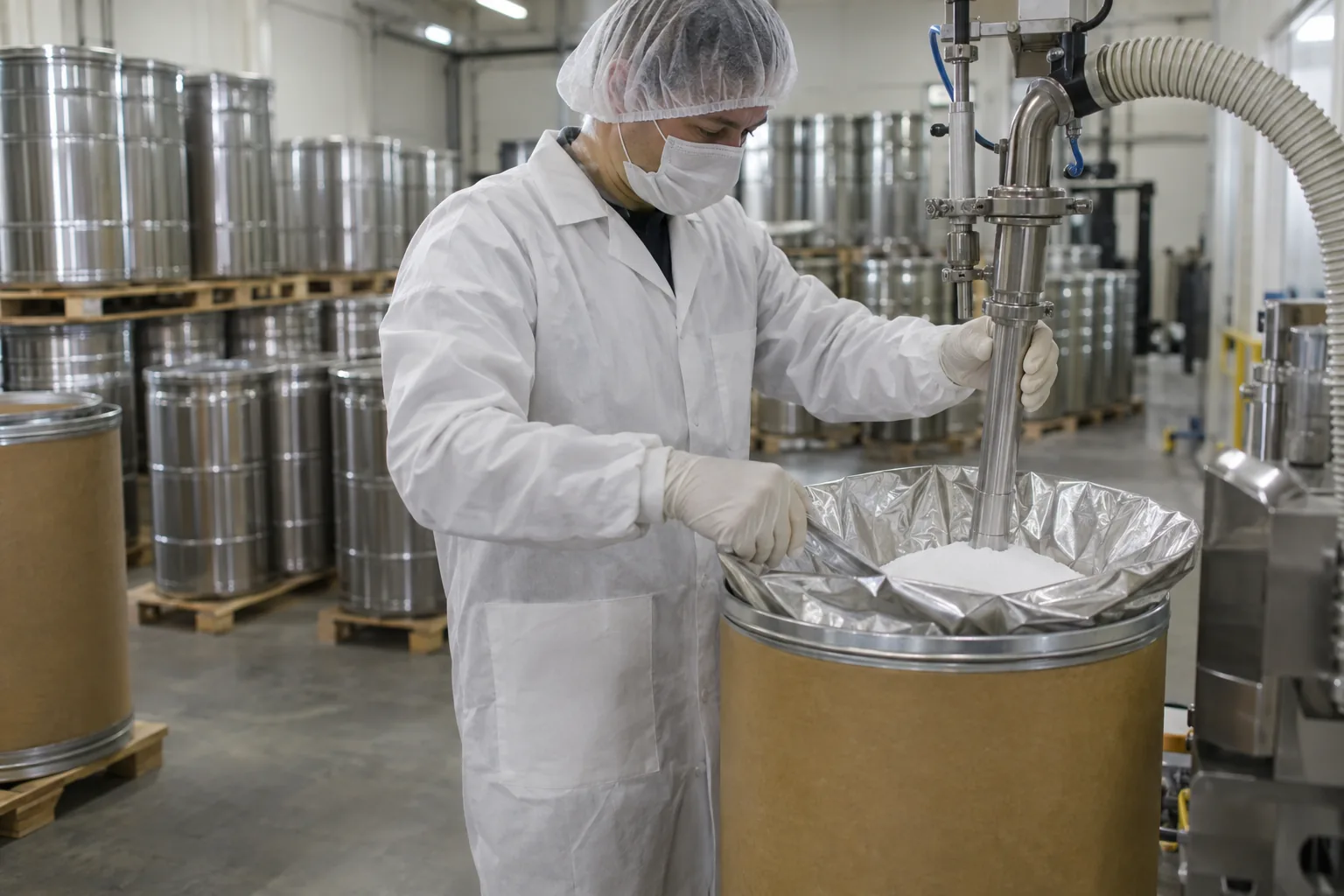
Stability data is only valid for the packaging in which it was generated. For an oxidation-sensitive phospholipid, typical protective packaging includes a foil or aluminum barrier bag or an inner poly liner with nitrogen flush, inside a sealed fiber drum, with desiccant where appropriate. Ask which package the stability study used, and confirm that commercial shipments use the same configuration. If the supplier studied material in a nitrogen-flushed foil bag but ships in a plain poly bag, the study no longer supports the proposed storage period.
Storage recommendations should be specific: temperature range, humidity expectations, light protection, and whether opened containers must be resealed with inert gas. Warehouse teams should treat "store cool and dry, protect from light and oxygen" as an instruction with audit relevance, not as decorative label text. Receiving records should show that drums went into the designated storage area promptly and that opened containers were resealed according to the recommendation.
Red Flags When Reviewing Supplier Stability Data
Buyers and QA teams should slow down when they see any of the following:
- a single time point at release with no intermediate or end-of-period data
- accelerated data only, with no long-term condition, or the reverse
- peroxide value rising close to the specification limit before the end of the claimed period
- stability generated on a different grade or source than the one being quoted
- a study report without batch numbers, test methods, or specification limits
- storage recommendations that differ from the packaging used in the study
None of these automatically disqualify a supplier, but each one is a question that deserves a written answer before qualification. Serious manufacturers answer these questions routinely.
FAQ
How long is the typical shelf life of bulk phosphatidylserine powder?
It depends on grade, packaging, and storage, but commonly assigned periods range from 18 to 24 months under recommended conditions. Ask the supplier to show the study that supports the specific period printed on the COA, rather than accepting an industry-typical number.
Which indicator rises first when phosphatidylserine oxidizes?
Peroxide value is usually the earliest practical indicator in routine testing, followed by secondary oxidation markers and sensory changes. Because PS also hydrolyzes, trends in free fatty acids or acid value and in the PS assay itself should be reviewed together with oxidation indicators.
Can accelerated stability data replace long-term data?
Accelerated studies are useful for comparing formulations and for early confidence, but a finished-product or long-supply decision should rest on real-time data under the labeled storage conditions, or on a documented and justified extrapolation. For dietary supplements in the US and foods in the EU, the finished-product manufacturer carries the shelf-life claim.
What should we ask a supplier to send with a stability summary?
Request the protocol or design description, batch information, time points, methods, actual data against limits, the packaging configuration tested, and the storage conditions. Nutranexa can provide product-specific documentation when the inquiry identifies the market, grade, source, quantity, and required files.
Conclusion
A phosphatidylserine stability review is not about collecting one more PDF. It is about confirming that the trajectory of the material under defined conditions leaves enough margin for your warehouse time, your processing, and your finished-product claim. Buy from suppliers who test the right attributes at the right time points, in the packaging they actually ship, and who can explain their retest or expiry position without hesitation.
Sources
- ICH Q1A(R2): Stability Testing of New Drug Substances and Products
- FDA: Containers and Storage Conditions guidance overview
The sources above provide external scientific context. This article is a buyer workflow guide, not legal or regulatory advice. Confirm final shelf-life and labeling decisions with your quality and regulatory professionals.
Recommended next steps
- Review the Phosphatidylserine product page.
- Compare Soy PS and Sunflower PS.
- Check manufacturing proof and Quality & R&D.
Contact sales for product documents
Share source preference, application, country, and annual quantity.
Contact Sales