

Southeast Asia has quietly become one of the fastest-growing destinations for cognitive-health supplements, and phosphatidylserine is part of that wave. Rising disposable income, an aging urban population, and a strong cultural interest in memory and study-support products have pushed brands to look beyond the United States and Europe. Yet many B2B buyers discover too late that Southeast Asia is not one market. It is a patchwork of five or more regulatory regimes, each with its own registration pathway, language rules, and — critically for PS — halal expectations.
This guide is written for sourcing managers, importers, and brand owners who already understand phosphatidylserine as an ingredient and now need to answer a practical question: what must be true about the ingredient and its documentation before finished products can legally enter Indonesia, Malaysia, Thailand, Vietnam, or Singapore? The short answer is that the ingredient itself is rarely the obstacle. The obstacle is the document trail behind it — registrations, certificates, and declarations that national authorities will ask the importer or registration holder to produce. Getting that trail right starts at the supplier qualification stage, months before the first shipment.
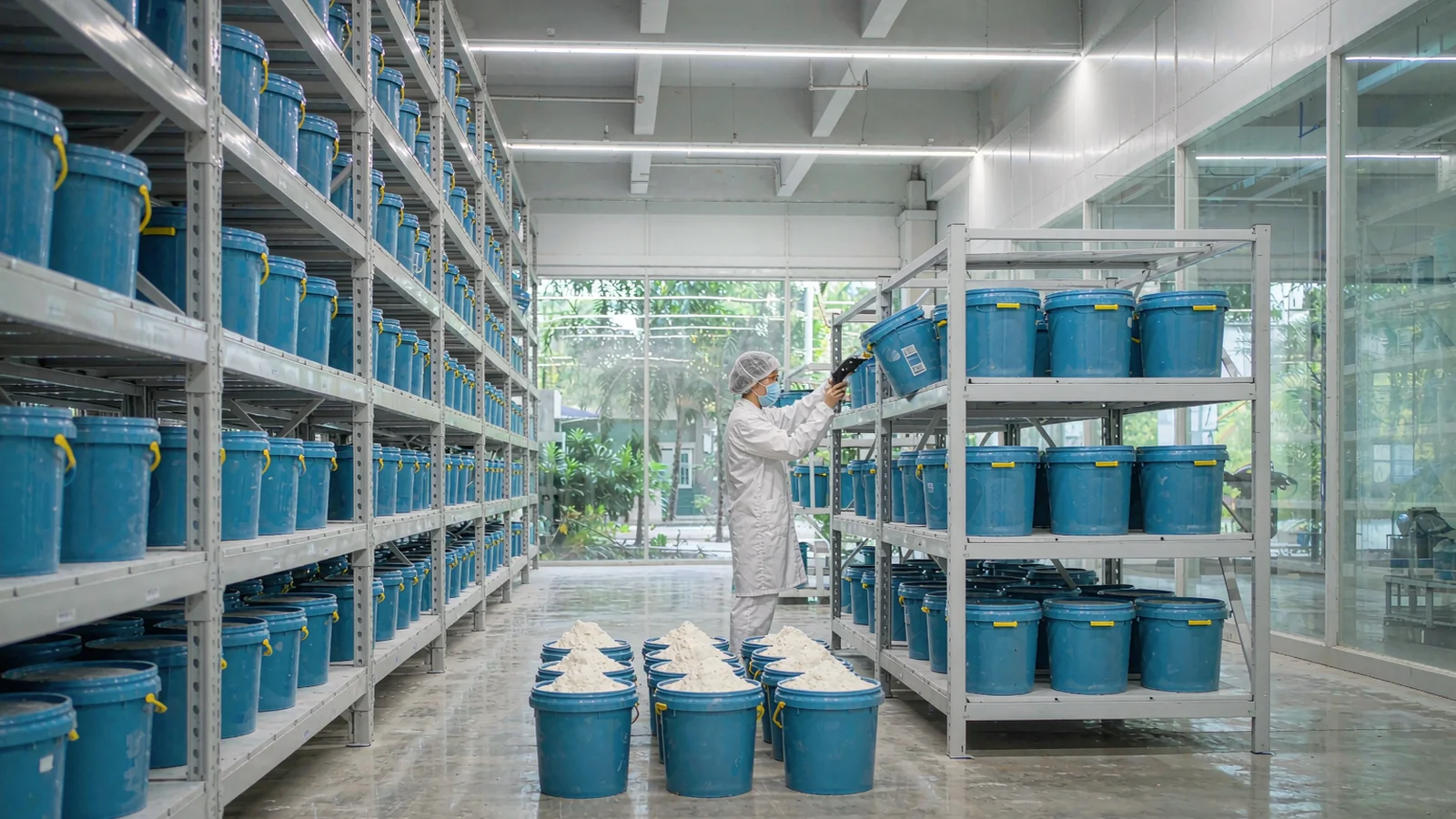
!Phosphatidylserine supplement ingredient drums in a clean tropical warehouse prepared for ASEAN import registration For non-GMO and European programmes, our sunflower phosphatidylserine page covers the specification and documentation set buyers typically request.
Why Southeast Asia belongs on the PS sourcing map
The commercial case is straightforward. Markets such as Indonesia, Vietnam, the Philippines, and Thailand combine young, digitally engaged consumers with an expanding middle class, while Singapore and Malaysia offer mature, premium supplement demand. Cognitive health and "brain support" claims resonate strongly in education-focused cultures, and phosphatidylserine fits naturally into study-support, work-performance, and healthy-aging formulations. For ingredient buyers, this means PS is increasingly appearing in RFQs destined for ASEAN ports rather than Rotterdam or Los Angeles.
The sourcing consequence is important: a supplier who is excellent for US and EU business may still be unprepared for Southeast Asian requirements. Halal certification practices, document legalization, and local-language label support all differ from Western norms. Buyers who raise these requirements at the quotation stage avoid expensive surprises later.
Five regulatory regimes, one region
ASEAN has made real progress on harmonization. The ASEAN General Guidelines on the Use of Health Supplements and related claim guidelines encourage member states to align definitions, categories, and labeling principles. In practice, however, each country retains its own pre-market process. There is no single "ASEAN registration" that clears a product for the whole region. Buyers should therefore plan market by market, ideally sequencing launches from the most accessible regime to the most demanding.
A useful sequencing for many brands is Singapore or Malaysia first, Thailand and Vietnam next, and Indonesia last — not because Indonesia is least attractive (it is arguably the largest prize), but because its registration and halal obligations are the most involved.
Indonesia: BPOM registration and mandatory halal
Indonesia requires finished supplement products to hold a BPOM registration (an MD number issued through the e-registration system) before distribution. The dossier relies on the finished-product specification, safety information, and supporting documents that trace back to the ingredient level. For phosphatidylserine, the buyer should expect BPOM-focused questions about the ingredient's origin — soy-derived versus sunflower-derived — and its safety substantiation.
The decisive issue, however, is halal. Under Indonesia's Halal Product Assurance Law and the mandatory halal certification phases administered by BPJPH, halal certification has become compulsory for products marketed to Indonesian consumers, including most supplements. For a soy-derived PS, halal compliance is generally achievable, but the certificate must come from an accepted certification body and cover the relevant supply chain steps. Sunflower-derived PS is often preferred for soy-free claims, yet soy lecithin feedstock with valid halal certification is perfectly compatible with Indonesian requirements as long as documentation is complete. Buyers should verify the halal certificate's issuing body, validity period, and scope — the site's earlier guidance on halal certificate review applies here with extra rigor, because Indonesian authorities and consumers both scrutinize halal claims closely.
Malaysia: NPRA product registration
Malaysia regulates health supplements through the National Pharmaceutical Regulatory Agency (NPRA). A local registration holder must submit the product dossier, and successful registration yields a MAL registration number that must appear on the packaging. Ingredient documentation matters: NPRA assessors expect a clear specification, safety references, and GMP evidence from the finished-product manufacturer. For PS buyers, the practical task is to obtain from the ingredient supplier a current specification, a certificate of analysis per batch, and evidence of the manufacturing site's quality system — the same core pack used elsewhere, formatted to Malaysian expectations. Halal certification is not legally mandatory for supplements in Malaysia, but it is commercially near-essential given the consumer base, so brands typically pursue JAKIM-recognized halal certification for both ingredient and finished product.

Thailand: Thai FDA supplement notification
Thailand uses a notification system for dietary supplements administered by the Thai FDA. Products must meet Thai labeling requirements — including Thai-language panels and the mandated supplement facts format — before sale. The ingredient story matters here as well: Thai authorities maintain expectations about ingredients used in supplements, and buyers should confirm that phosphatidylserine at the intended daily dose fits within Thai guidance for the product category. The supplier documents needed are familiar: specification, COA, and safety substantiation, plus allergen and GMO declarations where the finished-product claim set requires them.
Vietnam and Singapore: two very different models
Vietnam requires supplement products to be declared and registered with the health authorities before circulation, with dossiers supported by ingredient specifications and, for certain claims, scientific references. A local importer or registration service typically manages the filing. Singapore takes the opposite approach for most health supplements: there is no pre-market product registration, and responsibility rests on sellers and importers to ensure products are safe, honestly labeled, and compliant with the Health Sciences Authority's guidelines and Singapore's food regulations. That lighter touch does not mean weaker expectations — it shifts the burden onto the buyer's own quality system, which makes a disciplined supplier qualification file even more valuable.
Labeling and language obligations across ASEAN
Labeling is where Southeast Asian launches most often stumble. Indonesia requires Indonesian-language labeling and a halal mark once certification applies. Malaysia requires Malay-language mandatory information alongside the MAL number. Thailand requires Thai-language panels with prescribed warning and supplement formats. Vietnam requires Vietnamese labeling. Even Singapore, while English-friendly, applies nutrient declaration rules under food regulations. None of this is difficult for a brand with a flexible artwork process, but it does mean the ingredient-level declarations — allergen statements, GMO status, processing aids — must be available in a form that regulators and label reviewers can map onto local text. Buyers should request these declarations once, in supplier-controlled versions, and reuse them across markets, rather than asking suppliers to improvise market-specific wording later.
Logistics realities: tropical heat, humidity and storage
Phosphatidylserine is an oxidation-sensitive phospholipid, and Southeast Asia is hot and humid year-round. This makes storage and last-mile logistics a genuine quality issue, not just a comfort issue. Buyers should require suppliers to state storage conditions on the specification, insist on nitrogen-flushed, well-sealed packaging with adequate moisture barriers, and plan inland distribution through air-conditioned warehousing rather than ambient third-party storage. Retest and expiry periods on the supplier COA should be checked against realistic shelf-life expectations in tropical conditions. The documents are the same ones used for US and EU imports — retest dates, storage statements, per-batch COAs — but the environmental margin for error is narrower.
Building one supplier document pack, adapted per market
The efficient approach is to build a single master document pack at supplier qualification and adapt it per market rather than rebuilding it per registration. The core pack contains: a current specification, a representative COA, allergen and GMO statements, halal certification where relevant, GMP or food-safety certification of the manufacturing site, and stability or retest data. To this, each market adds its own layer: BPOM-focused halal and safety documents for Indonesia, NPRA dossier extracts for Malaysia, Thai-language label masters for Thailand, and Vietnamese declarations for Vietnam. Buyers who structure their supplier questionnaire around this pack — as covered in the site's supplier onboarding and questionnaire-control resources — can typically support multiple ASEAN submissions from one qualification cycle.
FAQ
What is the easiest Southeast Asian market to enter first for a PS supplement?
Singapore and Thailand are generally the fastest starts. Singapore has no pre-market product registration for most health supplements, so a compliant product with good documentation can launch quickly, while Thailand's notification pathway is comparatively straightforward once Thai-language labeling is ready. Malaysia and Indonesia take longer due to formal registration and halal obligations.
Is halal certification mandatory for phosphatidylserine in Indonesia?
Certification obligations are enforced at the product level for goods marketed to Indonesian consumers under the phased halal mandate, so finished supplements need halal certification, and the ingredient chain behind them must support it. A soy-derived PS with valid halal certificates from an accepted body is workable; buyers should verify certificate scope, issuer recognition, and validity before committing to a supplier.
Can one registration dossier be reused across ASEAN countries?
No single registration covers the region. The ASEAN guidelines promote alignment of categories and claims, but Indonesia, Malaysia, Thailand, Vietnam, and Singapore each run their own process with national forms, holders, and language rules. Reuse is possible at the ingredient-document level — specifications, COAs, declarations — not at the registration level.
Do I need a local importer or registration holder in each country?
For markets with formal registration — Indonesia, Malaysia, and Vietnam — a locally licensed registration holder or importer is effectively required, and the registration belongs to that entity. Brands without a local entity typically work with a distributor or a regulatory service provider and should contractually secure the right to transfer or co-own the registration.
Conclusion
Southeast Asia rewards preparation. The regulatory regimes differ, but they draw on the same underlying ingredient documentation — specifications, COAs, safety substantiation, halal and allergen declarations — that disciplined buyers already demand for US and EU business. The winning approach is to treat ASEAN as five sequenced projects built on one master document pack, to make halal and local-language labeling first-class requirements in supplier selection rather than afterthoughts, and to respect the tropical-climate storage realities that make oxidation control a commercial issue for phosphatidylserine. Suppliers who can support that documentation set are worth premium attention; ask for it explicitly in your next RFQ. When you are ready to move from checklist to quotation, contact our team with the grade, source and document set described above.
Sources
- ASEAN General Guidelines on the Use of Health Supplements — https://asean.org
- BPOM (Indonesia Food and Drug Authority) — https://www.pom.go.id
- BPJPH (Indonesian Halal Product Assurance Organizing Agency) — https://bpjph.halal.go.id
- NPRA Malaysia (National Pharmaceutical Regulatory Agency) — https://www.npra.gov.my
- Thai FDA (Food and Drug Administration, Thailand) — https://www.fda.moph.go.th
- Drug Administration of Vietnam — https://www.dav.gov.vn
- Health Sciences Authority, Singapore — https://www.hsa.gov.sg
Buyer fit
Who this guide is for
This guide is written for the buyer profiles below. Open your profile for the matching grades, documents and next steps, or tell us your requirements directly.
Recommended next steps
- Review the Phosphatidylserine product page.
- Compare Soy PS and Sunflower PS.
- Check manufacturing proof and Quality & R&D.
Contact sales for product documents
Share source preference, application, country, and annual quantity.
Contact Sales