
Phosphatidylserine has spent most of its commercial life in capsules, and the specification habits of that world — dry powder, peroxide value on the COA, shelf life at ambient — do not transfer cleanly into a bottle of water-based functional drink. In a beverage, PS faces an emulsion it must survive, a thermal process it must not oxidize through, and a sensory panel that detects off-notes long before a lab instrument does.

RTD is nonetheless one of the most attractive formats for cognition-positioned products in the US and EU, and brands that brief their OEM with the right questions reach a stable product at the first or second pilot instead of the sixth. This article walks through the decisions in order: format, grade, process, stability protocol, regulatory checkpoints, and the written OEM brief that holds them together. Where source selection is part of the decision, our soy phosphatidylserine page documents the extraction, specification and paperwork behind the soy route.
Why Beverages Are the Hardest Format for Phosphatidylserine
PS is an amphiphilic phospholipid, which sounds like a gift to a beverage developer — it partially self-emulsifies — and behaves like a trap in practice. The same surface activity that helps dispersion makes PS migrate to interfaces, where it interacts with proteins, stabilizers and the headspace. Three failure modes dominate:
- Physical instability: creaming or ringing at the neck, phase separation, or sedimentation when PS travels as an oil-phase droplet the emulsion system cannot hold.
- Chemical instability: hydrolysis of the phospholipid (raising free fatty acids) and oxidation (raising peroxide value), both accelerated by heat, light, dissolved oxygen and trace metals from the water.
- Sensory drift: bitterness and "beany" or cardboard notes that grow as oxidation progresses — noticeable in a neutral-water base at levels a flavored, acidic juice base would mask.
Each failure mode is addressable, but only if the format and the ingredient are chosen together — which is why grade selection comes first.
Choosing the PS Grade: Liquid, Powder or Microencapsulated
Three ingredient formats reach beverage lines, and they behave differently. Liquid PS concentrate (typically 20–70% in a carrier) disperses easily and suits oil-phase premix routes, but needs nitrogen-blanketed drums and careful dosing at the co-packer. Standard PS powder (typically 50–70% on a carrier such as lecithin fractions or maltodextrin) disperses under high-shear mixing but can leave visible specks and gritty mouthfeel in clear or lightly opaque bases. Microencapsulated PS powder locks the lipid in a protective matrix, which reduces interaction with the beverage matrix, improves oxidative headroom and usually improves taste — at a higher price per active kilogram and with the need to confirm the release technology works in your pH and temperature window.
As a sourcing rule, ask each candidate supplier for the grade's peroxide value (a 5 meq/kg limit is common; lower is better for beverages), water activity and moisture for powders, and — for microencapsulated grades — beverage-relevant performance data: dispersibility, particle size distribution and evidence of taste-masking in a model system. A grade that performs in a dry blend does not automatically perform in a pH 3.5 drink held at 40°C.
Process Reality: Homogenization, Heat Load and Oxidation
The unit operations, not the formulation, usually decide whether a PS beverage survives its shelf life. Two-stage homogenization at typical pressures (150–250 bar first stage) makes droplets small enough to resist creaming, but high shear also incorporates air — so deaeration before or after matters, because dissolved oxygen is the main oxidation driver for PS.
The thermal process then sets the stakes. Acidified drinks (pH below 4.6) in the US typically run pasteurization and fall outside low-acid canned food rules; low-acid RTDs require commercial sterility under 21 CFR 113 — retort or UHT-plus-aseptic — and the higher heat load of those processes is exactly what drives PS hydrolysis and peroxide growth. Favor acidic, pasteurized formats where positioning allows; where UHT is unavoidable, plan short sterilization with fast cooling and validate PS stability empirically rather than assuming capsule-grade data transfers.
Filling and packaging finish the job: nitrogen dosing or hot-fill with minimal headspace oxygen measurably slows peroxide development, opaque or colored bottles add light protection, and deionized water (with chelating agents such as EDTA where declared) removes metal catalysts. Set quantitative targets in the OEM brief — peroxide value in the finished beverage at release (a working ceiling of 2 meq/kg is a common starting point) and at end of shelf life, plus a sensory acceptance threshold, because oxidation off-notes are the first thing consumers notice and the last thing a release specification catches.
Designing the Stability Program for a PS Beverage
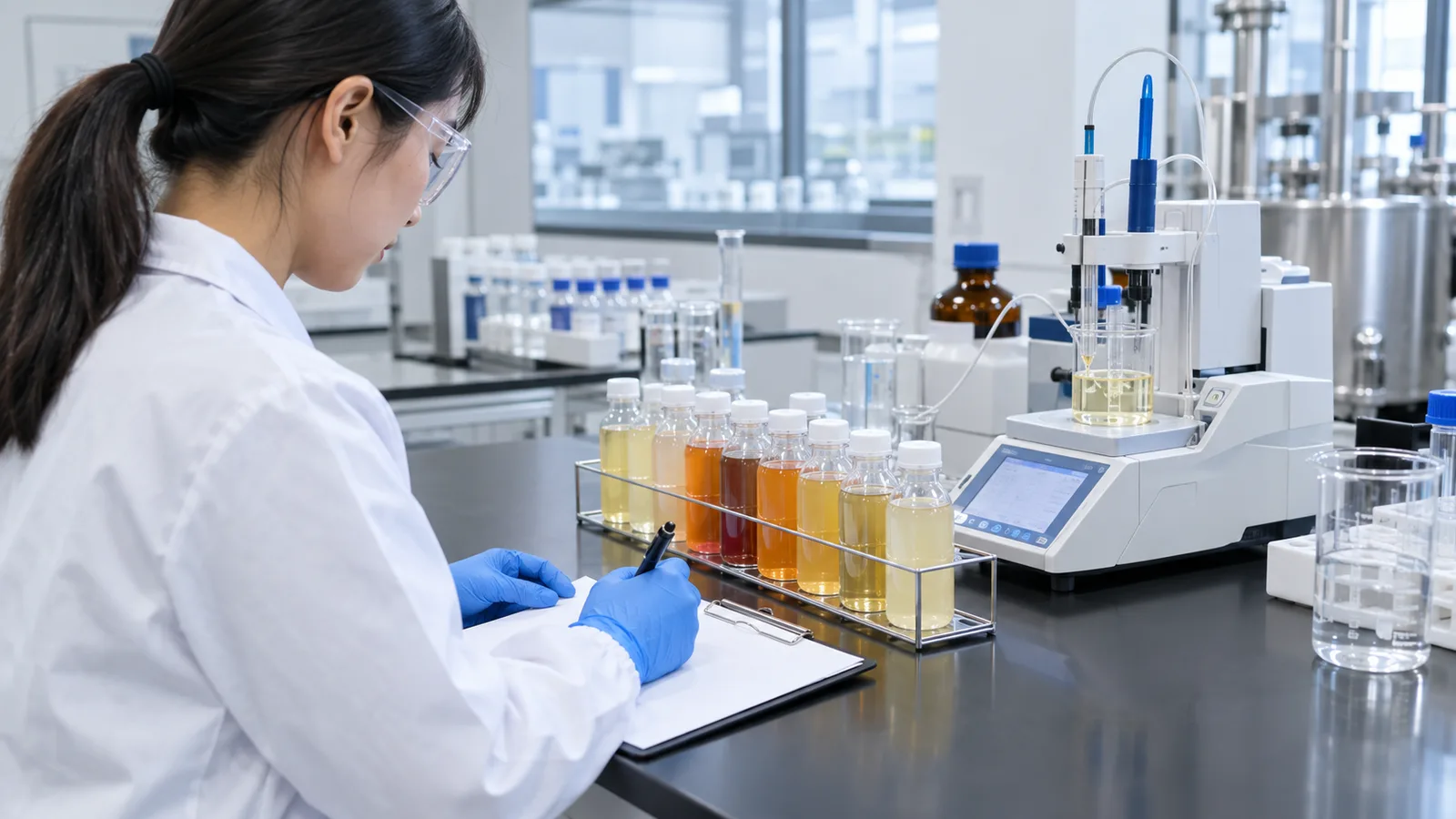
A beverage-specific protocol should combine chemistry and senses: real-time storage at 25°C and accelerated storage at 35–40°C, with a light-exposed arm if the bottle is transparent, sampled at 0, 1, 3, 6 and 12 months minimum. At each pull, measure PS assay per serving, the oxidation pair (peroxide value and free fatty acids), pH and brix, and score physical stability for creaming or separation. Add a trained or at least semi-trained sensory panel — this catches off-note drift that peroxide trends merely confirm. For low-acid formats, include commercial sterility checks and package integrity on the schedule the process authority sets.
Decide the shelf-life claim from real-time data, not accelerated extrapolation; accelerated runs compare formulations, they do not print "best before" dates. And test the actual fill in the actual bottle — headspace and light exposure are part of the product.
US and EU Regulatory Checkpoints for PS Beverages
Format and market determine the regime. In the US, a PS drink positioned as a conventional food (juice, soda, protein RTD) follows food labelling, while a supplement-positioned drink follows the liquid dietary supplement rules with a Supplement Facts panel — confirm which regime applies before designing the panel, and confirm the ingredient's GRAS scope or NDI pathway covers the intended use level and category. In the EU, food supplements fall under Directive 2002/46/EC as implemented per member state, while a PS drink sold as a conventional beverage must respect general food law and the EU register of authorised claims — most US-style cognitive claims have no authorised EU counterpart, so wording must be market-specific. In both markets, soy-derived PS triggers allergen labelling (FALCPA in the US, allergen emphasis under Regulation (EU) 1169/2011), and sunflower-derived PS exists for soy-free positioning.
The OEM Brief: What to Put in Writing Before the Pilot
Hand the contract manufacturer a one-page brief that fixes the variables most pilots waste time re-litigating: target market and regulatory regime, PS grade with supplier and COA attributes (including the peroxide value limit), dose per serving and tolerance, format pH and thermal process, stabilizer system constraints, packaging and light exposure, the stability protocol with sampling points, and release and end-of-shelf-life targets for chemistry and taste. Require the OEM to respond with the parameters they will actually run — homogenization pressures, sterilization regime, deaeration and headspace practice — so stability is tested against the real process, not a lab-scale approximation. This brief also makes second-source grade trials comparable: change only the ingredient, hold everything else, and let the peroxide value and sensory data argue.
FAQ
Q: Can phosphatidylserine be used in ready-to-drink beverages?
A: Yes, and it is increasingly common in functional RTDs, but the lipid is oxidation- and heat-sensitive, so grade selection, deaeration, thermal process and packaging must be engineered together. Acidic, pasteurized formats are the most forgiving starting point.
Q: Which PS grade works best in beverages?
A: Microencapsulated PS powder generally gives the best oxidative and taste performance in water-based drinks; liquid concentrate suits oil-premix routes; standard powder is cheapest but risks specks and mouthfeel issues in clear bases. Confirm peroxide value, particle size and beverage-relevant performance data before the pilot.
Q: How does UHT processing affect phosphatidylserine?
A: High-heat regimes accelerate hydrolysis and oxidation of phospholipids. Where a low-acid RTD requires UHT or retort processing, plan faster heating and cooling, deaeration, and empirical stability data at the actual process — capsule-grade stability data does not transfer.
Q: What stability testing should a PS beverage undergo?
A: Real-time and accelerated storage with pulls at 0, 1, 3, 6 and 12 months, measuring PS assay, peroxide value and free fatty acids, physical separation and sensory panels, plus commercial sterility verification for low-acid formats. Base shelf-life claims on real-time data in the final package.
Q: Can I make cognitive health claims on a PS beverage?
A: In the US, substantiated structure/function claims with the required disclaimer are possible on supplement-positioned drinks. In the EU, claims must appear in the authorised register, and most US-style cognition claims have no authorised counterpart — wording must be market-specific.
Conclusion
Beverages are the highest-reward and highest-risk format for phosphatidylserine: consumer-friendly dosing on one side, oxidation, heat and sensory drift on the other. The gap closes with decisions made before the first pilot — a grade selected against beverage-relevant data, a thermal process chosen with PS in mind, a stability protocol that tests chemistry and taste together in the real package, and an OEM brief that fixes the variables in writing. Brands that run this sequence launch on the second pilot; brands that improvise learn the same lessons one failed fill at a time. When you are ready to move from checklist to quotation, contact our team with the grade, source and document set described above.
Sources
- U.S. Food and Drug Administration — 21 CFR Part 113, Thermally Processed Low-Acid Foods Packaged in Hermetically Sealed Containers: https://www.ecfr.gov/current/title-21/chapter-I/subchapter-B/part-113
- U.S. Food and Drug Administration — Dietary Supplements (guidance and labeling rules): https://www.fda.gov/food/dietary-supplements
- European Commission — Regulation (EU) No 1169/2011 on food information to consumers: https://eur-lex.europa.eu/legal-content/EN/TXT/?uri=CELEX%3A32011R1169
- European Commission — Directive 2002/46/EC on food supplements: https://eur-lex.europa.eu/legal-content/EN/TXT/?uri=CELEX%3A32002L0046
- European Commission — EU Register of nutrition and health claims: https://ec.europa.eu/food/safety/labelling_nutrition/claims/register/
Buyer fit
Who this guide is for
This guide is written for the buyer profiles below. Open your profile for the matching grades, documents and next steps, or tell us your requirements directly.
Recommended next steps
- Review the Phosphatidylserine product page.
- Compare Soy PS and Sunflower PS.
- Check manufacturing proof and Quality & R&D.
Contact sales for product documents
Share source preference, application, country, and annual quantity.
Contact Sales