
Moving phosphatidylserine from an approved raw material into a running production line is where many supplement projects meet their first surprise. PS powders are lipid-based, which changes how they flow, how they distribute in a powder blend, and how they behave under compression or encapsulation. A brand that plans only for assay and price often discovers at pilot scale that the real questions are flowability, blend uniformity, and process temperatures.
This guide describes the handoff that should happen between an ingredient supplier and an OEM or brand manufacturing team: what to lock down before scale-up, how PS behaves in blending and in each dosage form, which documents should travel with the material, and how to verify a pilot batch. It is written for supplement brands, contract manufacturers, and R&D teams in the US and Europe.
Where relevant, this article uses verified Nutranexa site facts only. Nutranexa presents itself as the international brand of Shandong Nutranexa Biopharmaceutical Co., Ltd., founded in 2013, with a 110,000+ m2 campus in Yanggu County, Shandong. Buyers should still confirm current batch-specific data and market-specific files before production.
What "Production Ready" Means for a Phospholipid Ingredient
A raw material is production ready when four things are true at the same time: the specification matches the formula's needs, the incoming material behaves predictably on the equipment, the documentation supports the market and the claim, and the supply plan covers the production calendar. For phosphatidylserine, the second item deserves the most planning, because lipid powders can be stickier, more sensitive to heat, and more variable in flow than the excipient systems many production teams are used to.
Treat the handoff as a technical package, not as a purchase order attachment. The package should connect the PS grade (for example soy or sunflower, and the target active content) to the formulation intent, the equipment list, and the verification plan. Teams that write this down before the pilot batch consistently reach commercial production faster than teams that discover these questions on the floor.
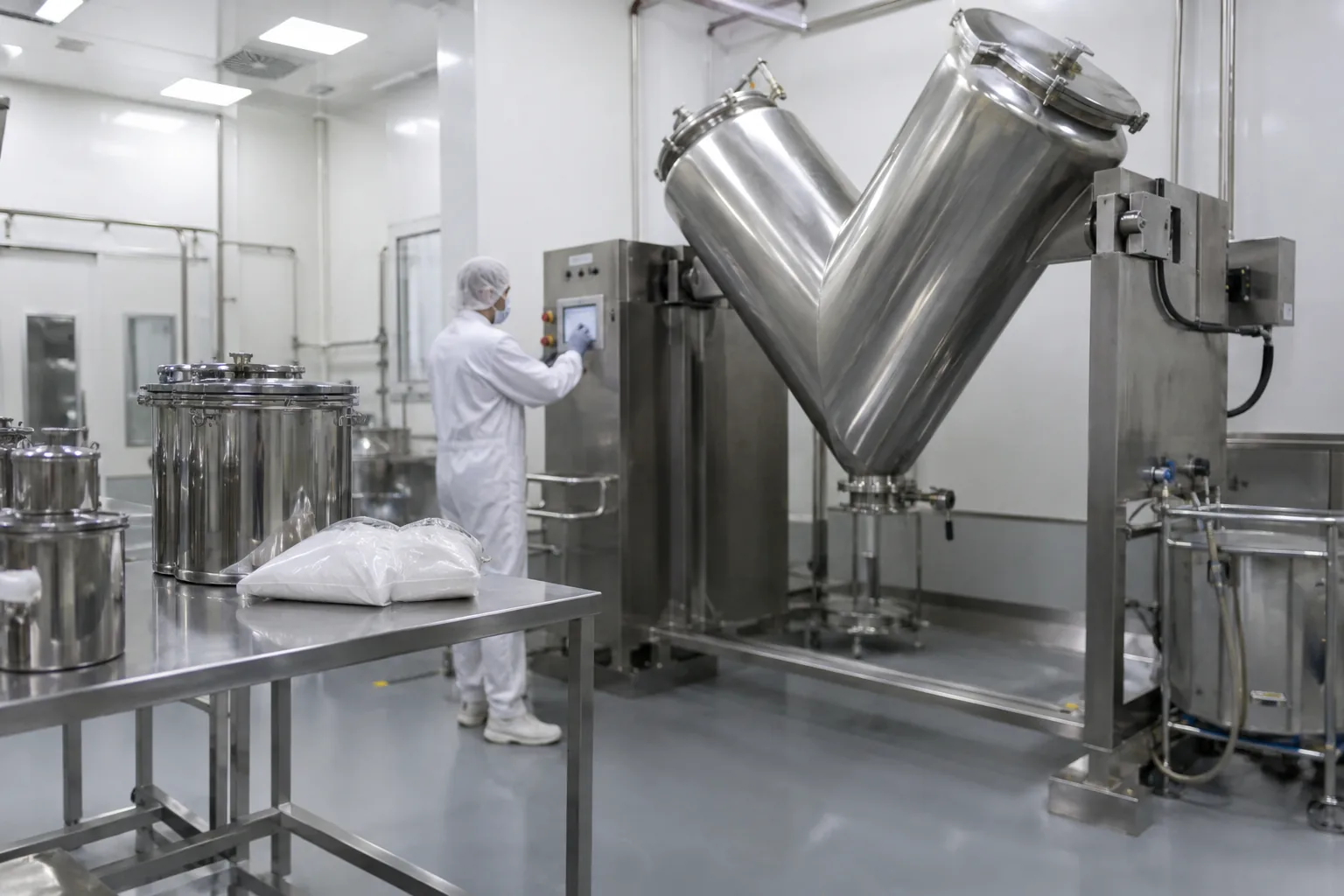
Handling and Blending Behavior of Phosphatidylserine Powder
Flow and caking tendency
Ask the supplier for particle size distribution, bulk and tapped density, and any observed flow characterization. Phospholipid powders can cake under pressure, humidity, or elevated storage temperature, so the condition of the drum when it reaches the blending room matters as much as the powder's intrinsic behavior. If the powder arrives caked, do not force it through screening without documenting the observation and discussing it with the supplier, because forced de-lumping can hide a storage or packaging problem that will reappear in the finished product.
Blend uniformity and analytical sampling
PS is usually a minor or mid-level component in a formula, which makes blend uniformity a sampling question as much as a mixing question. Agree on an assay method that quantifies phosphatidylserine specifically, define sampling locations across the blender, and set uniformity acceptance criteria before the first trial. Where the PS level is low relative to excipients, a geometric dilution step or a pre-blend can be justified, but it should be validated rather than assumed.
Moisture and temperature exposure during processing
Phospholipids tolerate typical blending conditions, but extended high-heat exposure and high humidity should be controlled. Granulation processes that add heat and moisture deserve extra review; direct compression or hard encapsulation routes are usually friendlier to PS-containing formulas. Keep drum-open time short, reseal partial containers promptly, and record room conditions during processing so that any trend in later testing has an explanation.
Dosage Form Fit: Capsules, Tablets, and Softgels
Each dosage form asks something different of the ingredient:
- Hard capsules: usually the most forgiving route for PS powders. The main questions are flow into encapsulation, weight uniformity, and whether a carrier or diluent is needed for low-dose formulas. Confirm that the powder's particle size supports consistent dosing disc performance.
- Tablets: compression is possible, but lipid powders can affect compactibility and ejection. Plan for excipient screening, lubricant level review, and force-versus-hardness trials. If the formula is high in PS relative to the tablet weight, expect a longer development cycle.
- Softgels and lipid systems: for oil-oriented formats, ask whether the supplier offers grades or carriers suited to suspension or fill systems, and confirm the compatibility data. Not every PS powder grade is intended for every format, and the supplier should confirm the intended application for the quoted grade.
Whichever route is chosen, the acceptance criteria should come from the finished product specification, and the supplier should confirm in writing that the quoted grade is appropriate for that application and market.
The Document Handoff Every OEM Should Receive
Before the first production batch, the OEM's quality unit should hold a complete material file:
- current specification and a batch-specific COA with actual values
- manufacturing process summary and, where applicable, the source declaration, such as soy or sunflower
- allergen, GMO, and, where relevant, irradiation and country-of-origin statements
- stability or retest documentation supporting the intended use window
- regulatory support documents for the destination market, such as food-contact or novel-food positioning discussion where applicable
- packaging and storage recommendations that match the shipped configuration
Brands private-labeling into Europe or the United States should reconcile these documents against their own label claims early, because wording that is acceptable in one market may need adjustment in another. Nutranexa supports document-request workflows so buyers can align the file with their QA checklist before the order is finalized.

Pilot Batch Verification Before Commercial Release
A pilot batch converts assumptions into evidence. At minimum, verify:
- blend uniformity across the batch using the PS-specific assay method
- dosage unit weight or fill variation across the run
- content uniformity in finished units against the label claim
- in-process observations: flow, sticking, temperature, and any equipment adjustments
- finished-product stability initiation under the intended storage claim
Agree in advance on what happens when a parameter fails: hold, investigate, adjust, and repeat. A supplier who can join that conversation with technical context, such as the effect of grade or particle size on flow, shortens the loop considerably.
FAQ
Can phosphatidylserine be compressed directly into tablets?
Tablet compression of PS-containing formulas is feasible, but the lipid component changes compactibility and lubrication behavior, so excipient screening and force trials are expected. Direct compression routes are generally easier than wet granulation for PS because they avoid added heat and moisture.
Is a pre-blend required for low-dose PS formulas?
Not always. Whether geometric dilution or a pre-blend step is justified depends on the PS level, the batch size, and the blender geometry. Decide based on validated blend uniformity data rather than habit.
What stability information should the OEM hold before setting an expiry claim?
The OEM needs the supplier's material stability or retest documentation plus its own finished-product stability study under the labeled storage conditions. The finished-product study, not the raw material file alone, supports the label claim.
Which documents should travel with the first commercial PS order?
At minimum: specification, batch COA with actual values, source and allergen statements, storage and packaging recommendations, and the stability or retest summary. Additional market-specific files should be agreed with the supplier before the purchase order.
Conclusion
A phosphatidylserine OEM handoff succeeds when the material's lipid reality is planned for: flow and caking are characterized, blend uniformity is measured with a PS-specific method, the dosage form route matches the grade, and the document package reaches the quality unit before production starts. Brands that treat the handoff as a technical package reach commercial batches with fewer surprises, and suppliers who can support that conversation become easier to qualify.
Sources
- FDA: Dietary Supplement CGMP, 21 CFR Part 111
- EU GMP guide Part II / ICH Q7 as applied to active ingredients
The sources above provide external regulatory context. This article is a production planning guide, not legal or regulatory advice. Confirm final decisions with your quality and regulatory professionals.
Recommended next steps
- Review the Phosphatidylserine product page.
- Compare Soy PS and Sunflower PS.
- Check manufacturing proof and Quality & R&D.
Contact sales for product documents
Share source preference, application, country, and annual quantity.
Contact Sales