
Most phosphatidylserine buyers spend weeks negotiating assay grade and documentation, then treat shipping as an afterthought. That is a mistake. The Incoterm on your purchase order determines who books the freight, who insures the cargo, and who faces customs when a shipment is examined. Transport mode swings landed cost and delivery timing more than buyers expect — especially when a production slot at your contract manufacturer depends on a fixed date. This guide covers the Incoterms 2020 options that appear on real PS purchase orders, the air-versus-ocean decision with illustrative numbers, and the arrival rules that apply in the US and EU.
Why PS Shipments Deserve a Logistics Plan
Phosphatidylserine is a high-value, moderate-density powder. At typical B2B pricing of roughly USD 60–200 per kilogram depending on assay and origin, a 500 kg order can represent USD 50,000–100,000 of cargo value on a single pallet. That combination changes the logistics math compared with commodity powders.
Three properties matter most. Cargo value concentrates risk: a damaged pallet is a material loss, so insurance and carrier selection are not box-ticking. PS is hygroscopic and sensitive to heat cycles; uncontrolled ocean containers in summer can expose drum liners to internal temperatures above 45°C. And delivery timing is often production-critical — buyers ordering against a fixed encapsulation campaign need material in a specific week, not eventually. Two buyers with identical specifications can face very different landed costs and risk profiles purely from how they structured terms and transport.
Incoterms 2020: The Four Options Buyers Actually Use
Incoterms 2020 defines eleven terms, but PS purchase orders concentrate on four:
EXW (Ex Works). The supplier makes goods available at its premises; the buyer arranges everything, including export clearance in the origin country. Buyers rarely have agents positioned to clear exports there, so EXW routinely creates friction and hidden origin-side costs.
FCA (Free Carrier). The supplier delivers cargo, cleared for export, to the carrier you nominate. This is the most balanced term for ingredient buyers who want control of freight cost and carrier choice while the supplier handles origin export formalities. Risk transfers when goods are handed to your carrier.
CIF and CIP. The supplier arranges and pays for carriage and insurance to the named destination port (CIF) or place (CIP). Note the 2020 update: CIP now defaults to all-risks (ICC A) cover, while CIF still carries the weaker ICC (C) minimum — inadequate for high-value PS unless upgraded by agreement. Import clearance and duties remain the buyer's.
DAP/DPU/DDP. The supplier carries goods to your door, with DDP including duties and clearance. DDP sounds convenient but buries true freight and duty cost in the ingredient price, obscures valuation data needed for audits, and is often priced conservatively to cover clearance risk the supplier cannot control.
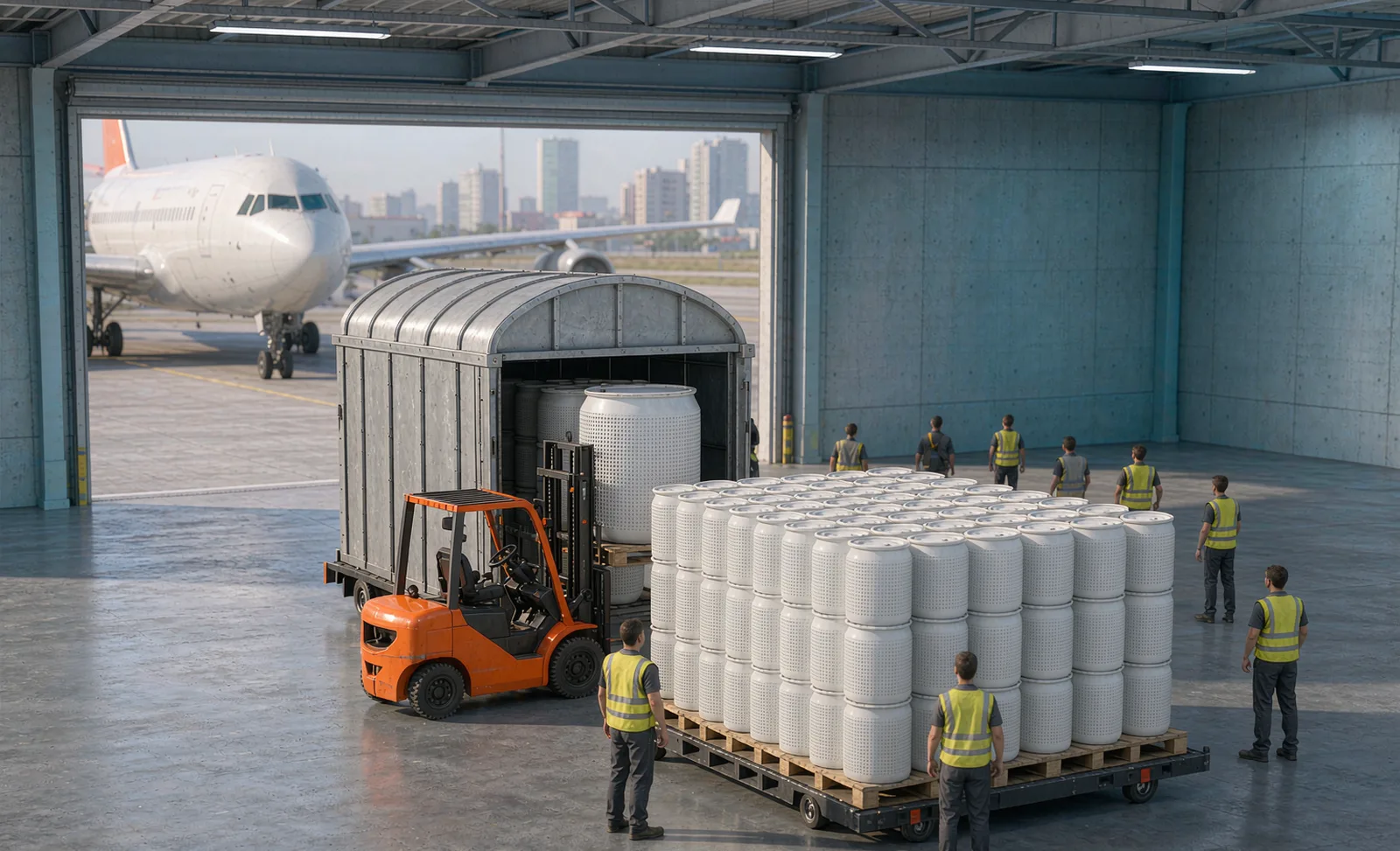
Practical default: FCA named origin airport or port, with your forwarder booking carriage and insurance. It keeps freight economics visible, gives you control of the carrier, and leaves export formalities with the supplier, who does them best.
Air Freight vs Ocean Freight for Phosphatidylserine
The mode decision is dominated by value density and urgency, not weight. Illustrative comparison for a 500 kg consignment from an Asian origin to the US or EU:
Ocean LCL typically prices around USD 100–250 per cubic meter plus origin and destination charges — total freight often USD 1,000–2,500, roughly USD 2–5 per kilogram — with port-to-door transit of 25–45 days depending on lane and customs.
Air freight typically prices around USD 3.50–7.00 per kilogram on chargeable weight, so the same consignment might cost USD 1,750–3,500, with 3–7 days airport-to-airport plus 1–3 days clearance and delivery. Note the chargeable-weight rule: air bills price on the greater of actual and volumetric weight (cm³ divided by 6000). PS powder at roughly 400–600 kg per pallet packs densely, so chargeable weight usually equals actual weight — one reason dense ingredients ship economically by air.
As a rule of thumb, freight is 2–5% of landed cost by ocean and 4–8% by air for PS. Air wins when a batch is needed against a fixed manufacturing slot, when replenishing a stockout, when qualification quantities (25–100 kg) must arrive fast, or when summer ocean transit risks excursions that could compromise peroxide-value and moisture specs. Ocean wins for planned bulk programs with 6–8 weeks of pipeline tolerance.
Air Freight Documents and Timing
Align the document set before the flight, because errors surface late: commercial invoice and packing list with consistent weights and HS classification; the air waybill; the supplier's CoA and specification sheet matching the exact batch; certificate of origin where preferential duty treatment requires it; and any market-specific statements your broker flagged (allergen, non-GMO, irradiation). PS powder is not classified as dangerous goods for air transport in normal commerce, but suppliers should confirm residual solvents are within limits — a solvent line on the CoA doubles as carrier reassurance.
Timing works backward from your need date: 1–3 days for export readiness and booking, 3–7 days airport-to-airport, 1–3 days for clearance and delivery. An order-to-door envelope of 10–14 days is realistic on major lanes; anything promised faster should be confirmed with the forwarder, not assumed.

US and EU Arrival Requirements by Mode
Mode changes pre-arrival obligations. Into the United States, ocean shipments require Importer Security Filing (ISF/10+2) no later than 24 hours before vessel loading; air shipments do not require ISF, but all modes require a customs entry and, for FDA-regulated ingredients, Prior Notice before arrival. Have FDA food facility registration details and a continuous customs bond in place for regular imports.
Into the European Union, air consignments fall under ICS2 advance data rules — the carrier files the entry summary declaration, but your data quality determines whether the shipment clears smoothly or is held at the first EU point. HS classification for PS should be settled with your broker before first shipment in both jurisdictions; phospholipid classification is a recurring source of duty-rate disputes.
Buyer Checklist Before You Book
- Confirm the Incoterm, named place, and risk-transfer point in writing on the PO.
- Decide mode against your production calendar: air for fixed campaign dates and qualification quantities, ocean for planned bulk.
- Appoint your forwarder and customs broker early; share the HS code, cargo value, and document templates.
- For ocean into the US, calendar the ISF 24-hour pre-loading deadline; for EU air, verify ICS2 data will be filed by the carrier.
- Itemize the freight quote: chargeable weight, surcharges, pickup, destination charges, insurance.
- Confirm insurance matches cargo value — all-risks (ICC A) for PS, not minimum cover.
- Freeze the document pack and check weights match across all documents.
- Agree temperature and moisture handling expectations for summer ocean transit.
FAQ
Q: Which Incoterm is best for importing phosphatidylserine?
FCA (origin airport or port) is the practical default: the supplier handles export clearance, you control freight cost, carrier, and insurance, and risk transfers at a clear point. EXW adds origin-side friction; DDP obscures freight, duty, and valuation data you may need later.
Q: Is air freight worth it for PS powder?
For qualification batches, urgent replenishment, or shipments tied to a fixed production slot, yes — the premium of roughly USD 2–3 per kilogram over ocean is small against cargo values of USD 60–200 per kilogram and the cost of a delayed campaign. For planned bulk programs, ocean's 2–5% freight share is hard to beat.
Q: Does ISF filing apply to air shipments into the US?
No. Importer Security Filing (10+2) applies to ocean cargo only. Air imports still require customs entry and FDA Prior Notice before arrival, so a broker must be engaged regardless of mode.
Q: Why did my air freight quote use a higher weight than my actual cargo?
Carriers charge on the greater of actual and volumetric weight (cm³ divided by 6000). Dense powders like PS usually bill at actual weight, but oversized cartons or pallets can push chargeable weight up. Confirm pallet dimensions when comparing quotes.
Q: Who is responsible for customs delays under CIF terms?
CIF covers carriage and minimum insurance to the destination port, but import clearance, duties, and any customs hold remain the buyer's responsibility. Good documentation reduces the risk of a hold but does not transfer clearance responsibility.
Conclusion
Incoterms and transport mode are commercial decisions with regulatory consequences, and for a high-value, production-critical ingredient like phosphatidylserine they deserve the same rigor as your specification review. FCA with buyer-arranged carriage keeps costs and risk visible; air freight buys calendar certainty for a few dollars per kilogram; ocean buys economy for planned programs. Write the Incoterm, mode expectation, and document list directly into your RFQ so quotes are comparable before you compare prices. When you are ready to plan your next PS shipment, send us your destination, volume, and target delivery window, and our desk will quote the ingredient and the logistics plan together.
Sources
- International Chamber of Commerce — Incoterms 2020: https://iccwbo.org/business-solutions/incoterms-rules/
- U.S. Customs and Border Protection — Importer Security Filing (ISF 10+2): https://www.cbp.gov/border-security/ports-entry/cargo-security/importer-security-filing-102
- U.S. Food and Drug Administration — Prior Notice of Imported Food: https://www.fda.gov/food/food-exports-imports/prior-notice-imported-food
- European Commission — Import Control System 2 (ICS2): https://taxation-customs.ec.europa.eu/customs-4/customs-security/import-control-system-2-ics2-0_en
- U.S. Customs and Border Protection — Customs Bonds: https://www.cbp.gov/trade/basic-import-export/cbp-bond
Recommended next steps
- Review the Phosphatidylserine product page.
- Compare Soy PS and Sunflower PS.
- Check manufacturing proof and Quality & R&D.
Contact sales for product documents
Share source preference, application, country, and annual quantity.
Contact Sales