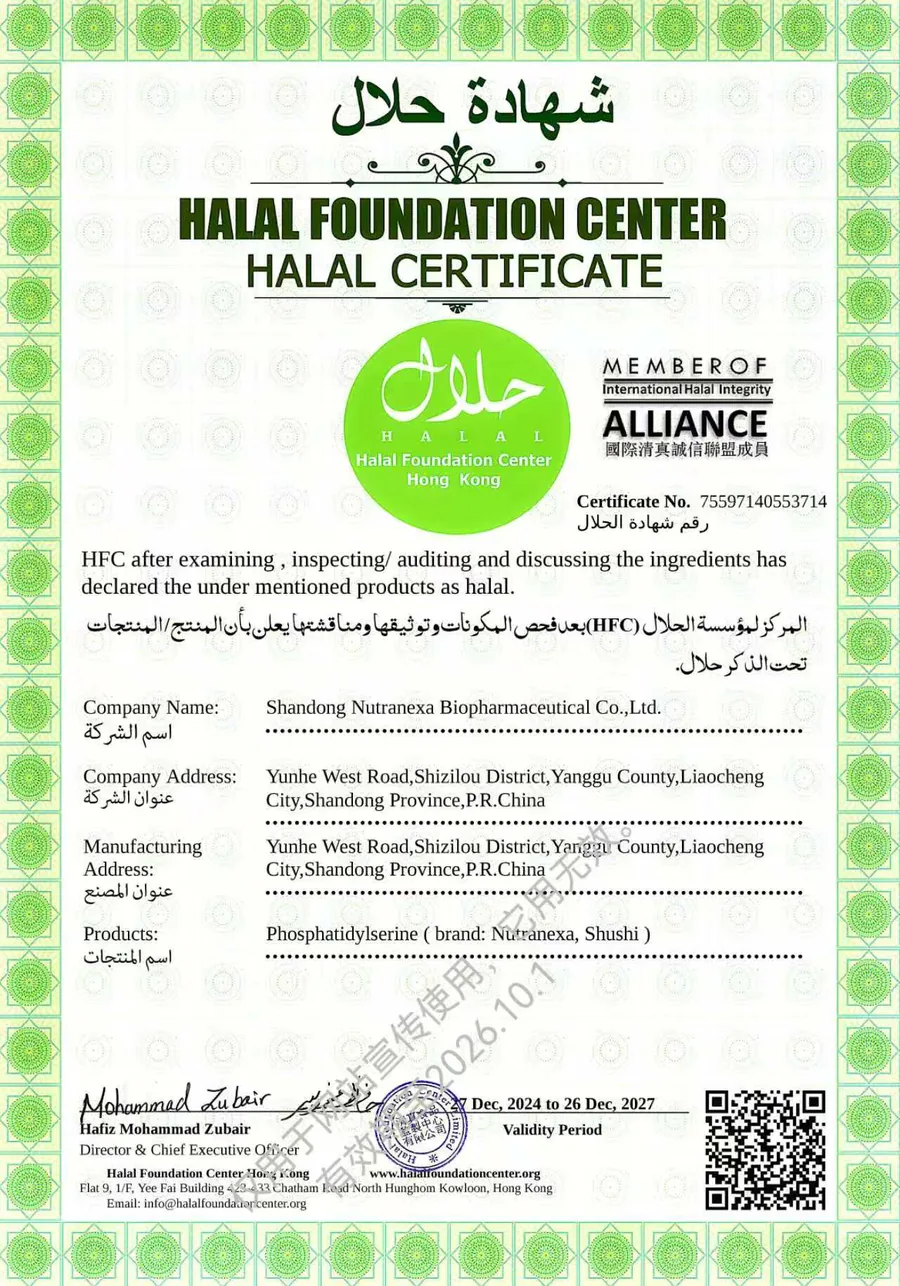
Cross-border phosphatidylserine projects usually begin with familiar technical questions: source route, target assay, MOQ, packaging, COA path, allergen logic, and destination-market document requests. Then a narrower commercial question appears and stalls the file: do we have a halal certificate for this exact phosphatidylserine route, and what does that certificate actually let our team say or do next?
The short answer is that a phosphatidylserine halal certificate should be reviewed as a scope, route, and downstream-use workflow, not as a generic yes-or-no statement. That is the safest inference from authoritative primary sources. Halal Food Authority states that use of its logo depends on prior contractual arrangements and that packaging use is limited to halal products approved by HFA. Its certification procedure also frames halal approval as a process with screening and certification steps, not as a casual one-line declaration. In parallel, US and EU food-label rules prohibit misleading food information. The practical business implication is simple: a supplier file may support qualification of the ingredient route, but buyers should not assume it automatically authorizes every downstream customer questionnaire, private-label artwork, or packaging statement.
That distinction matters because phosphatidylserine sourcing often involves several teams at once. Procurement may still be comparing a general PS route against soy phosphatidylserine or sunflower phosphatidylserine. QA may be reviewing the current document pack. A distributor may need a customer-facing answer. A contract manufacturer may want to know whether the incoming raw material can fit a halal-sensitive finished product program. If those questions are mixed together, the same certificate file gets stretched beyond what it actually proves.
This article is written for ingredient importers, distributors, supplement manufacturers, private-label brands, procurement managers, formulation teams, QA teams, and technical reviewers in Europe and North America. It focuses on supplier qualification, document scope, packaging-use limits, and escalation logic. It does not provide legal or religious advice and it does not make medical treatment claims.
Where Nutranexa is mentioned, only verified site facts are used. The current site identifies the operating company as Shandong Nutranexa Biopharmaceutical Co., Ltd., founded in 2013, operating a 110,000+ m2 campus, and primarily serving Europe and North America. It provides separate buyer paths for Phosphatidylserine, Soy Phosphatidylserine, and Sunflower Phosphatidylserine, plus buyer-facing request routes through Quality & R&D, Manufacturing, and Contact Sales. Final halal approval should still depend on the exact route, the current certifier-controlled file, and the buyer's own downstream review path.
The Short Answer Buyers Need First
If your team is reviewing phosphatidylserine for a halal-sensitive US or EU project, the cleanest workable process is:
- Fix the exact route first: general PS, soy PS, or sunflower PS.
- Confirm whether the file in hand is a supplier halal certificate, a product listing, a packaging-use permission, or a broader commercial statement.
- Match the file to the named company, site, and specific phosphatidylserine route under quotation.
- Check whether the downstream use is ingredient qualification only, customer questionnaire support, or actual halal wording on packaging.
- Keep the ingredient halal file separate from finished-formula approval, co-manufacturing review, and final label signoff.
- Close with one written go, hold, or escalation decision.
That is the operating line buyers need. A halal file can be commercially important without being universal. The stronger question is not only "is this phosphatidylserine halal?" The stronger question is what exact route is covered, what evidence supports that route, and what downstream use does the current file really authorize?
| Buyer question | What the team is really trying to confirm |
|---|---|
| Do you have a halal certificate? | Is there a current certifier-controlled file for this exact PS route and supplier path? |
| Can we use this certificate for a private-label supplement? | Does the current file support only ingredient qualification, or also packaging/logo use for the downstream product? |
| Is soy PS treated the same as sunflower PS? | Does the certificate match the route actually being quoted and approved? |
| Can sales promise halal wording now? | Not until the downstream packaging-use and customer-review limits are checked |
| Is this the same as allergen or kosher review? | No. It is a separate approval question with different scope and supporting logic |
Why a Halal Certificate Is Its Own Buyer Task
Certificate scope is narrower than many buyers assume
The first reason this topic needs its own workflow is that authoritative halal-certifier sources treat certification scope carefully. HFA states that its logo can only be used under prior contractual arrangements and that packaging use is limited to halal products approved by HFA. HFA's certification procedure also presents halal approval as a structured process that begins with application and screening, then moves through certification steps. The business lesson is direct: a halal certificate is not just a decorative attachment in a technical folder. It is evidence tied to a defined certification relationship and product/site scope.
For phosphatidylserine buyers, that means several questions should be asked before approval:
- which phosphatidylserine route the file covers
- whether the file applies to the named manufacturer or supply path actually being quoted
- whether the document is being used for internal supplier qualification or for customer-facing support
- whether the downstream business wants only a halal-capable ingredient route or also wants halal wording on finished packaging
That is why this topic should not be buried inside a broad supplier onboarding or document pack review. Those are wider workflows. The halal question is narrower and easier to mishandle if it is not isolated.
Ingredient halal status and finished-packaging use are different approvals
The second reason this topic matters is that ingredient status and finished-packaging use are not the same decision. HFA's logo-use policy makes that explicit by separating contractual certification status from allowed logo use on communications and packaging. US and EU food-information rules add another layer: food information must not mislead about the nature, identity, properties, or origin-like characteristics of the product. The practical implication is an inference from those primary sources: even if the ingredient route is supported by a halal file, a buyer should not automatically treat that as permission to apply halal wording or symbols to a finished product or private-label package.
This becomes especially important when teams are handling several files at once:
| File type | What it can help answer | What it does not prove by itself |
|---|---|---|
| Supplier halal certificate or letter | That a certifier-controlled file exists for a supplier path, product, or site | That every downstream customer file or finished package may use halal wording freely |
| Product listing or schedule support | That specific products are tied to the certifier's approved scope | That a reformulated, co-manufactured, or repacked downstream product stays inside that scope |
| Specification or COA | That the quoted route and batch framework are identified technically | That the route has finished-packaging halal authorization |
| Customer questionnaire response | That the commercial team is answering a buyer request | That the answer matches the certifier-controlled scope without overstatement |
This is also why halal review sits beside, not inside, Phosphatidylserine Kosher Certificate Review for US and Canada Buyers, Phosphatidylserine Allergen Statement Checklist for US and EU Ingredient Buyers, and Phosphatidylserine Packaging Declaration Review for US and EU Buyers. Those articles answer different buyer questions.
The Six-Part Workflow for Reviewing a PS Halal Certificate
Lock the exact phosphatidylserine route and downstream use first
Before anyone approves a halal file, write the route and downstream use in one short note. Is the team reviewing general phosphatidylserine at shortlist stage, soy PS for an existing supplement formula, or sunflower PS for a non-soy positioning brief? Is the file needed for importer approval, distributor resale, contract-manufacturer intake, retailer review, or private-label artwork planning?
This matters because halal confusion usually starts when the route is still moving. Procurement may still be comparing soy and sunflower routes while QA already saved one certificate in a generic "PS" folder. A customer may be asking about finished-packaging wording while the supplier only supplied an ingredient-level file.
At minimum, the opening note should record:
- exact product route
- intended market
- downstream customer type
- whether the request is ingredient-only or packaging-related
- which decision the next reviewer needs to make
Identify what file is actually in hand
The second step is to stop calling every halal-related document "the certificate." In practice, buyers may receive four different things:
- a supplier halal certificate or halal statement
- a product list or approved-scope reference
- a packaging or logo-use instruction
- a general commercial note saying the route is halal-capable
Those are not interchangeable. A supplier certificate may support early qualification. A product list may help confirm scope. A packaging-use note may matter later. A general commercial note may be useful, but it should not replace a controlled certificate when QA or a customer needs formal evidence.
This is where buyers save time by asking one disciplined question: what exact file will the next team rely on, and what decision is that file supposed to support?
Match the certificate to the named company, site, and route
Once the file type is clear, match the content to the quoted phosphatidylserine route. The review should normally check:
- legal entity named on the file
- whether the relevant site or supply path matches the quoted route
- route identity: general PS, soy PS, or sunflower PS
- whether the product description in the certificate or support file still fits the commercial item under quotation
- whether the file is current enough for the stage under review
This step sounds basic, but it prevents a common failure. A certificate can be real and still be tied to the wrong route, old product description, or earlier supply path.
| Review checkpoint | Buyer question |
|---|---|
| Legal entity match | Does the file belong to the company path actually being quoted? |
| Route match | Is the certificate attached to the same PS route the team plans to buy? |
| Site or manufacturing scope | Does the support file align with the site or approved production path under review? |
| Stage fit | Is the document strong enough for customer-facing use, or only for internal qualification? |
| Refresh need | Has the route, customer, or packaging plan changed since the file was first collected? |
Review logo, packaging, and private-label limits early
This is the step commercial teams often skip. HFA's logo-use rules make clear that packaging use is controlled and tied to approved products. HFA's packaging-material guidance also explains that packaging review can include inks, adhesives, coatings, and contamination-control questions. For phosphatidylserine buyers, that means a halal review can expand beyond the ingredient itself when the project is moving toward a customer-facing package, pack insert, or branded technical file.
The practical questions are:
- is the current file only confirming ingredient halal status
- does the downstream brand expect to print halal wording or display a logo
- is there a contract manufacturer, repacker, or customer packaging system that changes the review scope
- do packaging materials or packaging-process questions need separate escalation before a claim is repeated downstream
For Europe and North America, this matters because private-label supply chains are common. A route that is acceptable as a raw ingredient may still need another approval conversation before a customer-facing package is marked as halal-ready.
Keep ingredient halal review separate from finished-formula and market-claim review
The fifth step is to keep the ingredient file in its own lane. A phosphatidylserine ingredient may have a usable halal support file, but the finished product may involve other ingredients, carriers, capsule materials, flavors, or processing conditions outside the scope of the raw-material review.
That is why buyers should separate:
- ingredient halal qualification
- finished-formula review
- co-manufacturing or private-label review
- final packaging and customer-claim review
This separation also makes the Nutranexa process cleaner. Buyers can request the current route-specific document path through Quality & R&D and Contact Sales while keeping final packaging and downstream commercial claims under their own approval system.
Close with a go, hold, or escalation decision
The last step is to record one decision another team can use:
- Go: the route is stable, the halal support file matches the supplier path, and the current project stage can move forward.
- Hold: the route may still be acceptable, but the file is too generic, too old, or too loosely matched to the next approval step.
- Escalate: the project needs certifier, packaging, customer, or co-manufacturer clarification before anyone relies on the file downstream.
Without that closeout, the same halal question returns later, usually when the artwork is moving, the customer wants a document pack, or a contract manufacturer is already waiting for release.
Need a Current Halal Support File for US and EU Buyers?
If your team is still relying on a generic note that "the ingredient is halal" while the source route, private-label structure, or customer-facing packaging path is still changing, stop before the answer becomes a sales promise. Use Nutranexa's contact page to request the current route-specific specification path, COA-review path, and available halal support file for the exact phosphatidylserine route under review.
The fastest inquiries usually include the route, target market, customer type, whether the file is for ingredient-only qualification or downstream packaging use, and whether a contract manufacturer or distributor will review it next.
Common Mistakes in Phosphatidylserine Halal Review
Most failures here are scope-control failures, not supplier-existence failures.
- Treating any halal-related supplier file as automatic permission to use halal wording on finished packaging.
- Approving a general PS halal file while procurement is still switching between soy and sunflower routes.
- Forgetting to match the document to the named company, site, or product route under quotation.
- Letting sales or customer service answer a halal-sensitive questionnaire before QA has defined what the current file really covers.
- Mixing ingredient qualification, private-label packaging, and finished-formula review into one unsorted approval step.
- Reusing an older file after the route, downstream pack format, or customer changed.
The practical fix is narrow and repeatable: keep one question at the center of the file. What exact phosphatidylserine route is covered, what evidence supports that route, and what downstream use does the current halal file really authorize?
How Verified Nutranexa Facts Fit This Workflow
For buyers evaluating Nutranexa, several verified site facts support a cleaner halal-review process.
First, the site already separates Phosphatidylserine, Soy Phosphatidylserine, and Sunflower Phosphatidylserine into distinct buyer paths. That helps teams keep the halal review tied to one stable route instead of one vague "PS" category.
Second, the site confirms qualification facts that are safe to reuse while screening suppliers: the company was founded in 2013, operates a 110,000+ m2 campus, and primarily serves Europe and North America. It also routes technical requests through Manufacturing, Quality & R&D, and Contact Sales rather than implying that one public file settles every downstream packaging question.
Third, the site provides verified handling facts for phosphatidylserine, including 25 kg MOQ and 25 kg net per drum packaging, along with visible COA and specification evidence, factory and dispatch imagery, and R&D cooperation context. Those facts help supplier qualification, but they do not replace the halal scope review described in this article.
Sources
- Halal Food Authority: Provisions for the Use of HFA Logo
- Halal Food Authority: Certification Procedure
- Halal Food Authority: Packaging Materials
- eCFR: 21 CFR 101.18 - Misbranding of Food
- EUR-Lex: Regulation (EU) No 1169/2011 on the Provision of Food Information to Consumers
FAQ
Do buyers need a phosphatidylserine halal certificate?
Often yes, especially when an importer, distributor, supplement manufacturer, or customer-facing technical team needs controlled evidence for a halal-sensitive ingredient route. The useful question is not only whether a file exists, but whether it matches the exact phosphatidylserine route and intended downstream use.
Can a supplier halal certificate automatically be used for a private-label phosphatidylserine supplement?
Not automatically. Buyers should separate ingredient qualification from finished-packaging use and confirm whether the current file actually supports the downstream label or customer claim being discussed.
Should soy phosphatidylserine and sunflower phosphatidylserine be reviewed under the same halal file?
Not by assumption. Buyers should confirm that the quoted route matches the route covered by the current file and reopen the review if the source path changes.
What should buyers request from Nutranexa before approving a halal-sensitive phosphatidylserine project?
Request the exact route-specific specification path, the current COA-review path, and the available halal support file for the quoted phosphatidylserine route, then align those files to the next downstream approval step.
Is a halal certificate the same as allergen, kosher, or packaging approval?
No. Those are separate review questions. A halal file can support supplier qualification, but buyers should still keep allergen review, customer packaging review, and other market-specific approvals in their own workflows.
Conclusion
Phosphatidylserine halal review becomes manageable when buyers stop treating it as a generic supplier yes-or-no claim and start treating it as a route-specific scope and downstream-use decision.
The strongest US and EU workflow is practical: lock the route first, identify what kind of halal file is actually in hand, match it to the named company and supply path, check packaging-use limits early, keep ingredient qualification separate from finished-product review, and close with one clear decision. That process helps importers, distributors, supplement manufacturers, and QA teams avoid a common failure pattern: the supplier file looks complete, but nobody can show what the halal evidence really covers.
Recommended next steps
- Review the Phosphatidylserine product page.
- Compare Soy PS and Sunflower PS.
- Check manufacturing proof and Quality & R&D.
Contact sales for product documents
Share source preference, application, country, and annual quantity.
Contact Sales