A phosphatidylserine brand owner who asks a contract manufacturer "what's your price?" will get a number — and it will be wrong for their business if they do not understand the mechanics behind it. PS is one of the higher-cost actives in the nootropic category: the raw material share of unit cost is unusually large, MOQ floors are set by ingredient economics rather than machine time alone, and small differences in tier structure swing landed cost per bottle by double-digit percentages. This guide explains the commercial side of contracting PS production — why MOQs exist, how tier ladders are built, where the money goes in a per-unit price, how format changes the equation, the negotiation levers that work, and the hidden costs that ambush first-time brands at invoice time.
Why MOQs Exist in Supplement Manufacturing
Minimum order quantities are the arithmetic consequence of how a production line and a purchasing department behave, not a tool for filtering small brands. Three forces dominate for PS products:
- Raw material economics. Phosphatidylserine is purchased by the drum, in lot sizes subject to the ingredient supplier's own MOQ. Below a certain order size, the CM cannot buy ingredient efficiently without carrying expensive inventory on your behalf.
- Line changeover and minimum run time. Encapsulation lines, blenders, and packaging machines require cleaning, setup, and line-clearance verification between products; a run too short to amortize changeover is unprofitable at any price.
- QC and documentation overhead. Every batch requires identity and potency testing, batch record review, and release — fixed per-batch costs.
Each force is negotiable in a different way: you cannot argue the physics of changeover, but you can restructure inventory commitment, annual volume aggregation, and batch scheduling.
How MOQ Tier Ladders Are Structured
Most PS supplement quotes arrive with a tier ladder — unit prices stepping down as quantity rises. A typical structure for a 100 mg PS capsule product looks conceptually like this (illustrative, not a quotation):
- Tier 1 (pilot/MOQ): often 25,000–50,000 units, highest per-unit price, sometimes with formulation or setup surcharges.
- Tier 2 (standard run): 50,000–150,000 units — usually the largest single price drop, because fixed batch costs spread over more units.
- Tier 3 (volume): 150,000–500,000 units; savings flatten as ingredient cost share dominates.
- Tier 4 (annual contract): committed annual volume with scheduled releases, best pricing, often a fixed-price window with raw material hedging.
Two structural points matter. First, the steepest savings come early — evaluating a quote only at the volume tier misses that your realistic first-year volume may never reach it. Second, tiers interact with batch size: an attractive Tier 3 price may require two production batches, and a second batch scheduled months later changes your inventory financing even though the unit price looks the same.
What Drives the Price: The Cost Buildup of a PS Product
Decomposed, a quoted price per unit typically stacks in this order:
- Active ingredient. For a 100–300 mg PS claim, phosphatidylserine is commonly the largest single cost line — often 40–60% of unit cost in capsule formats. Assay grade matters enormously: a 70% PS raw material carries roughly twice the PS content per kilogram of a 20% grade, so normalize on cost per kilogram of actual PS.
- Excipients and flow aids. Minor in cost, but they determine blend uniformity and fill performance.
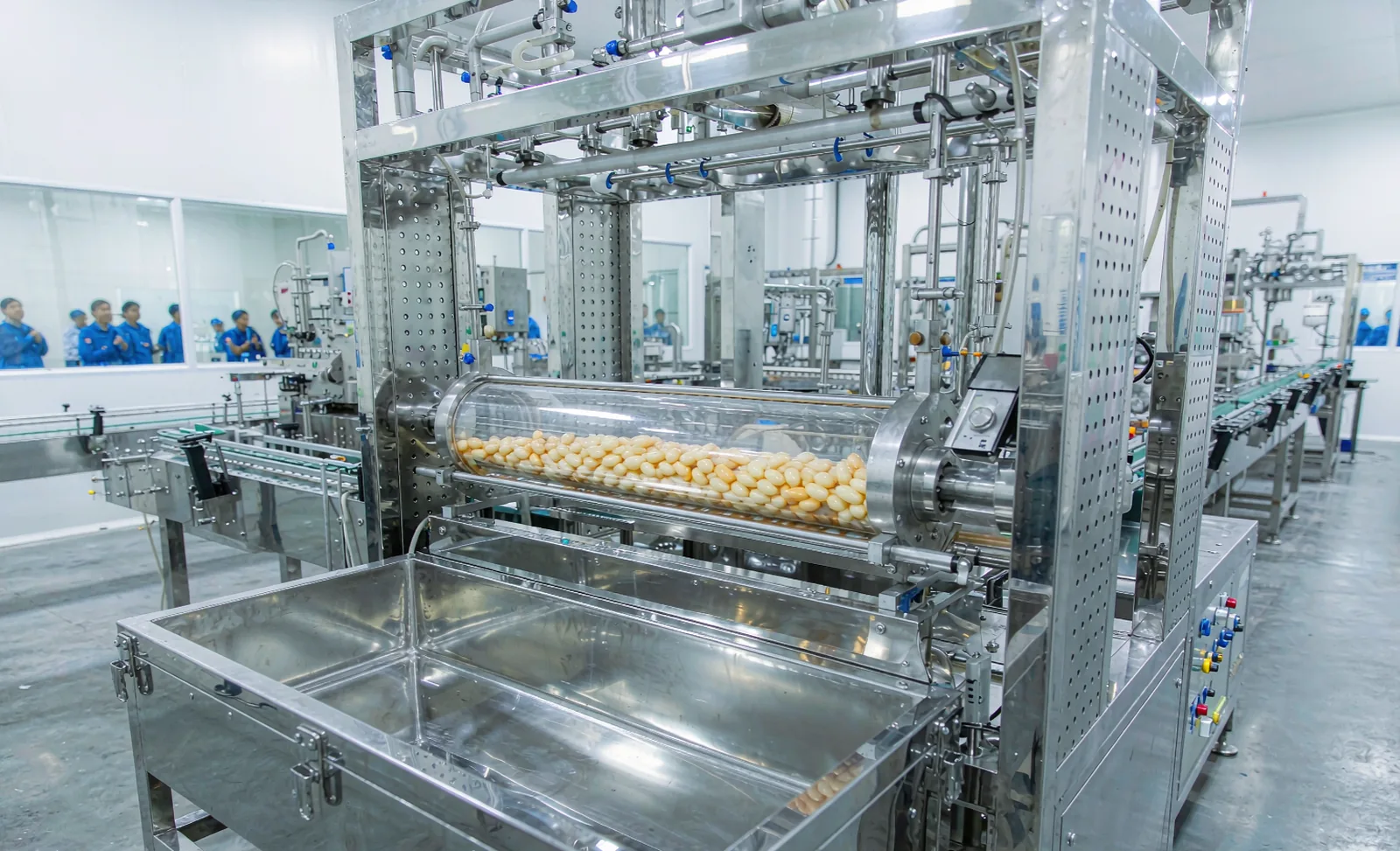
- Encapsulation or conversion cost. Machine time, capsule shells or softgel gelatin, yield loss, line efficiency.
- QC and release. Identity, HPLC potency, micro, and heavy metal testing per batch, plus documentation.
- Packaging. Bottle, cap, induction seal, desiccant, label, carton — deceptively variable.
- Overhead and margin. Project management, storage, and the CM's margin — usually where negotiation headroom actually lives.
Ask each shortlisted CM to quote the buildup line by line. Vendors who resist usually hide either an inefficient ingredient purchase or an aggressive margin.
Encapsulation Format and Packaging Economics
Format moves both MOQ and unit cost. Two-piece hard capsules are the most flexible — standard tooling, straightforward blending, the widest choice of CMs, and lower MOQs through competition. Softgels suit PS oil/paste forms and premium positioning but need softgel-specific lines with higher minimum runs and typically a 10–30% conversion premium for a comparable dose. Brands starting at low volumes often launch in hard capsules and migrate formats at scale.
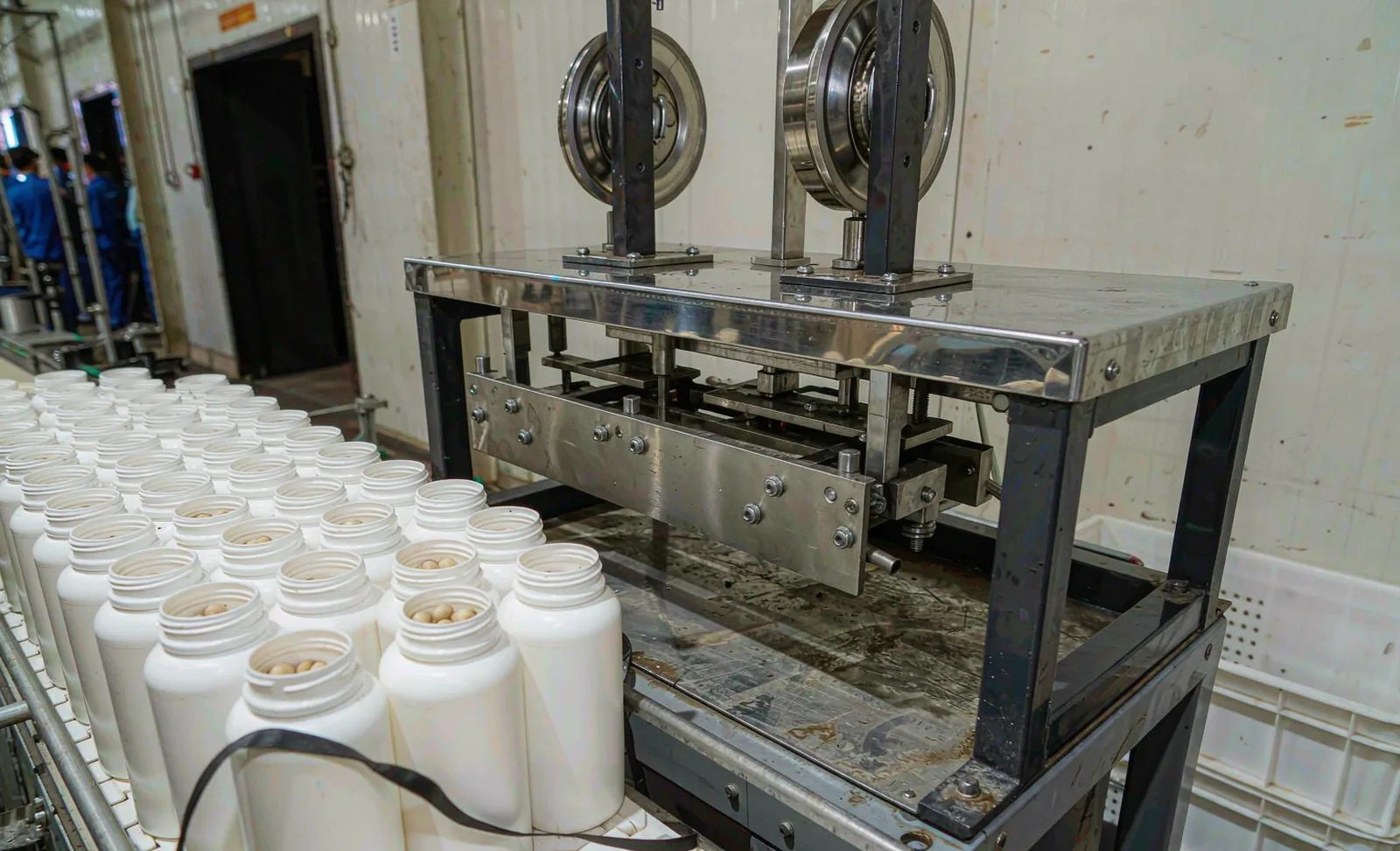
Packaging determines whether a tier step is worth taking. Deviating from the assumed bottle size, label method, or carton configuration reappears in the price, and count-per-bottle changes packaging cost non-linearly. For PS specifically, opaque bottles, induction seals, and desiccants are oxidation controls, not cosmetic upgrades — cutting them to save cents is a quality decision disguised as a procurement one.
How to Negotiate MOQs and Price
Effective negotiation restructures the deal rather than haggling the headline number. The levers that work:
- Aggregate annual volume. A committed 400,000-unit year with scheduled releases buys better terms than four separate 100,000-unit orders from the same line.
- Ask for ingredient pass-through transparency. An index clause — adjusting the ingredient line on documented market movement while holding conversion fixed — protects both sides.
- Trade MOQ against inventory. If the MOQ exceeds your cash capacity, ask whether the CM will hold finished goods from a larger batch and release on a drawdown schedule — then price the financing cost.
- Reduce SKU fragmentation. Multiple flavors, counts, and label languages fragment batches; consolidating SKUs often beats any discount you could negotiate.
- Benchmark the ingredient line. Arrive knowing the market range for your PS assay grade, so you can distinguish an ingredient cost problem from a conversion cost problem.
- Negotiate the long tail. Payment terms, tooling amortization, artwork charges, and price-validity windows often hold more value than a final 2% on unit price.
Hidden Costs Buyers Forget to Budget
The quote is not the cost. Items that routinely surprise first-time PS brands:
- Setup and tooling. Formulation transfer, blending validation, capsule tooling or softgel dies, first-article runs — one-time charges, or worse, embedded in Tier 1 pricing only.
- Stability and validation studies. Accelerated and real-time stability for a new formulation, plus method transfer if your lab differs from the CM's.
- Artwork and regulatory support. Print plates per SKU and labeling review, billed per revision.
- Freight and storage. Quotes are typically ex-works or FOB origin; freight, duties, and warehouse fees are yours.
- Rework and yield thresholds. Know where manufacturing losses stop being the CM's problem and become a change order on your account.
- Price validity windows. Ingredient-driven quotes often expire in 30 days; a long validity period is a concession worth asking for.
The discipline that prevents surprises: request an "all-in landed cost per bottle at my forecast volume" model from each CM. Two quotes with identical unit prices can differ by 15% once the hidden lines are visible.
FAQ
Q1: What is a typical MOQ for phosphatidylserine capsule manufacturing?
For a 100–300 mg PS capsule product, minimums commonly start around 25,000–50,000 units for hard capsules, with softgel formats typically requiring larger runs due to line and tooling economics. Treat any figure as a starting point — annual volume commitments can move the floor.
Q2: Why is PS more expensive to manufacture than most herbal supplements?
Phosphatidylserine is a high-cost phospholipid-derived active whose raw material share of unit cost far exceeds typical botanical extracts. Ingredient economics set the MOQ floor and dominate per-unit price.
Q3: Can I negotiate a lower MOQ as a new brand?
Sometimes. Options include a higher pilot-tier unit price, stock formulations instead of custom blends, a longer production slot, or CM-held inventory from a bigger batch — each trades cash against margin.
Q4: What price should I benchmark the PS ingredient line against?
Cost per kilogram of actual phosphatidylserine at your required assay grade, origin, form, and documentation scope — plus a price-validity window or index clause for longer contracts.
Q5: Are annual volume commitments worth signing?
Usually, provided your forecast is honest and the contract includes rolling forecasts, release scheduling, and a quality-remedy clause. The pricing benefits are real; the risk is committing to volumes your sell-through cannot support.
Conclusion
PS manufacturing quotes are arithmetic, not mystery: MOQs come from ingredient lots, changeovers, and fixed batch costs; price comes from the raw material line, conversion format, and packaging; margin hides in the unitemized parts of the buildup. Start your next RFQ with the structure above — dose, format, assay grade, origin, annual forecast, packaging — and require every shortlisted CM to quote on an identical frame. Send Nutranexa your product concept and forecast, and we will return a fully itemized quotation with MOQ tiers, ingredient cost transparency, and a documentation pack built for your target markets.
Sources
- eCFR — 21 CFR Part 111, Current Good Manufacturing Practice for Dietary Supplements (contract manufacturing responsibilities): https://www.ecfr.gov/current/title-21/part-111
- U.S. Food and Drug Administration — Dietary Supplements: https://www.fda.gov/food/dietary-supplements
- FDA — Contract Manufacturing Arrangements for Drugs: Quality Agreements (principles transferable to supplement quality agreements): https://www.fda.gov/regulatory-information/search-fda-guidance-documents/contract-manufacturing-arrangements-drugs-quality-agreements
- European Commission — Food Supplements: https://food.ec.europa.eu/food-safety/food-supplements_en
- NIH Office of Dietary Supplements — Dietary Supplements background: https://ods.od.nih.gov/
Recommended next steps
- Review the Phosphatidylserine product page.
- Compare Soy PS and Sunflower PS.
- Check manufacturing proof and Quality & R&D.
Contact sales for product documents
Share source preference, application, country, and annual quantity.
Contact Sales