
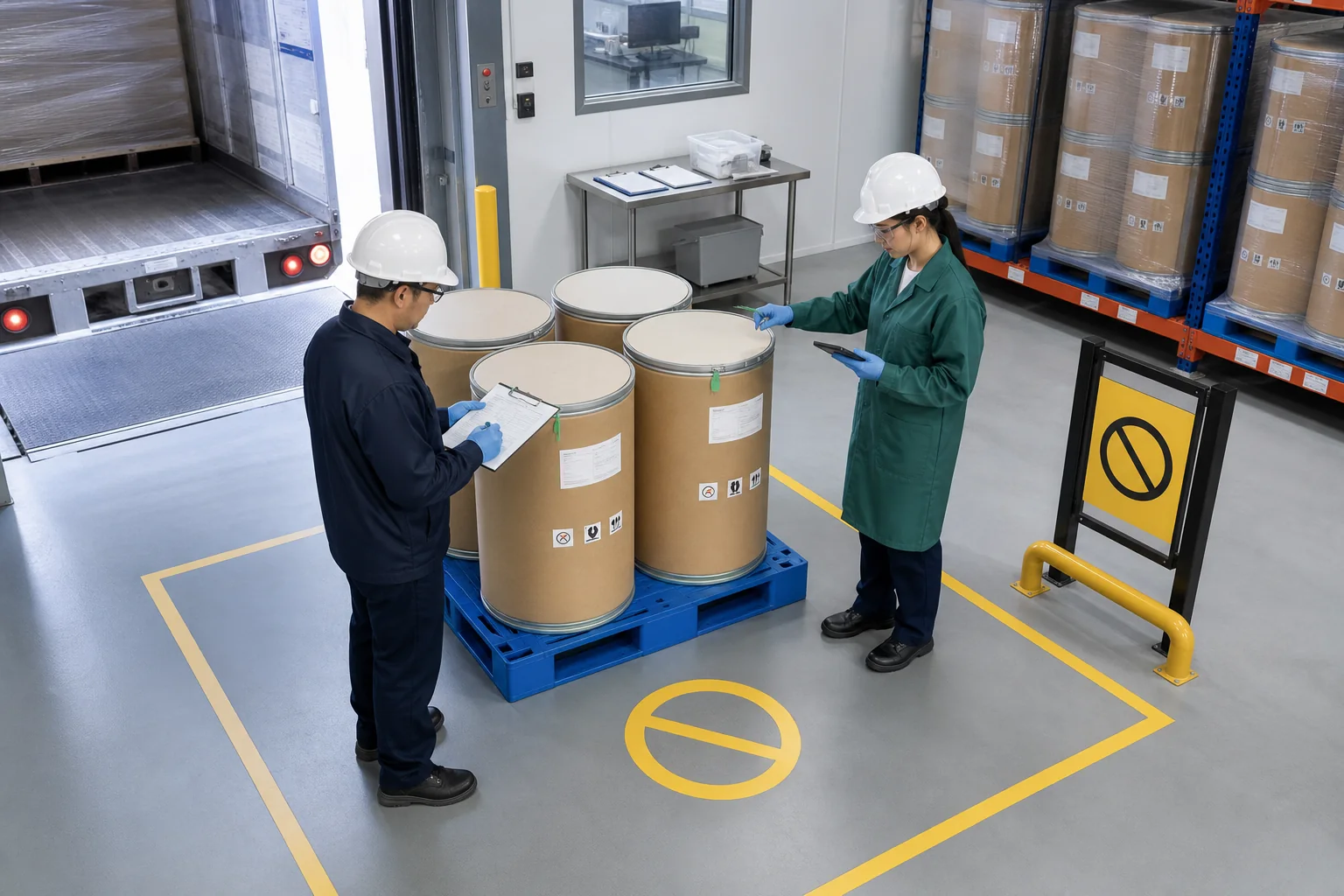
For many ingredient buyers, the sourcing process feels complete when the shipment leaves the supplier. In practice, the next risk point is the receiving dock. If phosphatidylserine arrives with unclear labels, mismatched lot references, damaged drums, or incomplete documents, the issue immediately shifts from procurement to warehouse, QA, and production planning.
That is why phosphatidylserine incoming inspection needs its own operating logic. Even if the supplier was approved earlier, the buyer still needs to confirm that the physical goods received are the same goods that were quoted, documented, and shipped.
The goal is simple: turn one arriving shipment into one controlled inventory event. Buyers should know what to verify on arrival, what to quarantine, what to escalate, and what must be true before release for use or resale.
This article explains how B2B buyers can structure that workflow. It is written for real procurement and QA teams, not for consumer readers. It focuses on shipment receipt, document matching, lot traceability, and warehouse-release discipline.
Where Nutranexa is mentioned, only verified site facts are used. The current Nutranexa site identifies the company as Shandong Baianrui Biopharmaceutical Co., Ltd., founded in 2013, with a 110,000+ m2 campus and visible manufacturing, cleanroom, lab, and equipment imagery. The site shows phosphatidylserine as a lead product, public reference COA visibility for PS 20% sunflower model PP201 and PS 50% model PP501, and document categories such as business license, food production license, food additive item details, FDA food facility registration, Halal, and Kosher. Buyers should still request current lot-specific shipment files and confirm final applicability before release, use, or resale.
Why Incoming Inspection Matters More Than Many Buyers Expect
The first warehouse touchpoint often decides whether the rest of the order runs smoothly. If receiving, QA, and purchasing treat arrival as a routine unloading task, they can miss details that later matter during production release, customer audit, or complaint handling.
Phosphatidylserine is especially sensitive to this process because buyers often distinguish between general PS, soy phosphatidylserine, and sunflower phosphatidylserine. They may also buy to a target content range, packaging expectation, or customer document requirement. A shipment can be broadly acceptable and still be wrong for the exact PO if one of those details drifts.
Incoming inspection is therefore not just a warehouse step. It is the point where the buyer confirms continuity between five things:
- The purchase order
- The shipped goods
- The labels and lot numbers
- The document set
- The intended internal use or customer allocation
If those five elements are aligned, the lot can move forward confidently. If they are not aligned, the buyer needs quarantine and escalation before any further handling.
What Should Happen Before the Truck Is Unloaded
Keep the shipment in controlled receiving status
The shipment should enter a receiving or quarantine status before anyone treats it as available inventory. That means the warehouse team knows the drums are not to be consumed, repacked, or reallocated until the review is complete. This sounds simple, but it is one of the most common process gaps in busy facilities.
Gather the document set before warehouse put-away
The receiving team should have access to the basic document package before final put-away wherever possible. For phosphatidylserine, this usually includes the purchase order reference, packing list, shipping marks, invoice references where relevant, and the COA or batch-linked quality file used for internal release review. Depending on the buyer workflow, the team may also need the current specification, packaging confirmation, or market-facing certificate copies already agreed in the transaction.
This prevents the warehouse from storing material first and discovering later that the label wording or lot reference does not match the commercial file set.
Decide who owns QA, warehouse, and purchasing sign-off
An incoming inspection process fails when no one is clearly accountable. Warehouse may count drums. QA may review the COA. Purchasing may compare the PO. But if no one owns the final release decision, the lot can remain undefined or get used too early.
Before the first shipment arrives, buyers should define:
- who checks packaging and visible condition
- who verifies labels and lot numbers
- who reviews the COA and release file set
- who decides quarantine versus release
- who communicates any deviation back to the supplier
That role clarity matters more than adding extra forms.
The 10-Point Phosphatidylserine Incoming Inspection Checklist
1. Confirm the shipment matches the purchase order
Start with the commercial baseline. The receiving team should confirm that the arriving shipment corresponds to the exact PO or booking expectation: product name, source route if specified, quantity, drum count, and any agreed shipment identifiers.
This is where buyers detect the simplest but most disruptive errors. A warehouse may receive "phosphatidylserine" and assume the job is done, while the PO actually required sunflower-source phosphatidylserine. Product-family similarity should never replace item-level verification.
2. Check drum count, packaging condition, and pallet presentation
Count the drums and compare them against the packing list and PO expectation. Then inspect visible packaging condition: crushed drum walls, punctures, loose lids, wet cartons, broken palletization, missing stretch wrap, or signs that labels may have detached during transit.
Nutranexa's current site states that phosphatidylserine bulk packing is 25 kg net per drum with a 25 kg MOQ for PS product lines. Buyers should still verify the actual transaction packaging, labels, pallet configuration, and drum quantity against the quoted shipment because final export preparation is confirmed before order.
3. Verify labels, product naming, source wording, and lot traceability
The label review is a core release step. Buyers should compare the drum labels against the PO, packing list, and COA. Check whether product naming is consistent, whether any source wording matches what was ordered, whether lot numbers are readable, and whether the label format supports internal traceability.
The main risk here is ambiguity. If the label says only "PS" but the PO and internal project are source-specific, clarification may be required before release. If multiple lots are present, they should be segregated in receiving records.
4. Match COA, packing list, and batch details
The COA should not be reviewed in isolation. Buyers should confirm that the lot number on the COA corresponds to the lot on the drums and that the product description is commercially consistent with the shipment documents.
Nutranexa's public PS COA examples show the type of fields buyers often want to see during incoming review: product name, product model, lot number, manufacture or test date, report date, test basis QB/T 5821-2023, and result fields such as phosphatidylserine content, moisture, peroxide value, acetone insoluble, heavy metals, cadmium, and Salmonella. Those public examples are useful for understanding the reporting style, but release decisions should rely on the current lot-specific files tied to the shipment actually received.
5. Review storage and handling instructions before put-away
Once the shipment passes the first identity and packaging checks, the warehouse should confirm how the material should be stored internally. The receiving team should not guess. Use the current specification, label instructions, or supplier guidance already approved for the order.
6. Separate visible transport damage from material questions
Not every issue means the material is unusable, and not every acceptable-looking drum should be released automatically. Buyers should separate transport-condition questions from product-identity questions. A damaged outer drum may trigger a packaging deviation review even if the COA matches, while a perfect-looking pallet may still require quarantine if the lot number on the COA does not match the labels.
7. Hold a quarantine status until release conditions are met
Every lot should remain in quarantine or pending QA status until the defined release checklist is completed. That usually includes document matching, label review, packaging review, and any buyer-required internal sampling or testing.
8. Define when in-house testing is required
Not every buyer uses the same release model. Some rely on document matching plus supplier qualification for routine lots. Others require internal identity confirmation, selected analytical checks, retained samples, or customer-specific release testing before use.
The important point is to decide this in advance. For phosphatidylserine, buyers should define whether internal testing is required for:
- first orders from a supplier
- source changes such as soy versus sunflower
- new customer programs
- deviations in labeling or packaging
- higher-risk or audit-sensitive accounts
That decision should be part of the receiving SOP, not a last-minute debate on the warehouse floor.
9. Record deviations before contacting the supplier
If something is wrong, document it clearly before escalation. Record photos, affected drum count, lot numbers, pallet position, document mismatch details, and the exact nature of the issue. A vague complaint such as "labels seem different" slows resolution. A precise note such as "three drums on pallet two show lot number X while COA shows lot number Y" allows the supplier to respond meaningfully.
10. Release only the exact lots that pass review
The final release step should be lot-specific. If one lot passes and another lot has a mismatch, do not release the full shipment out of convenience. Update inventory status at the lot level and keep clear records of what was accepted, what remains on hold, and what was escalated.
How Verified Nutranexa Facts Fit This Receiving Workflow
Buyers evaluating Nutranexa can connect several verified site facts to their incoming inspection process. The current site identifies Shandong Baianrui Biopharmaceutical Co., Ltd. as the company entity, shows factory, workshop, cleanroom, and laboratory visuals, and states that the business was founded in 2013 on a 110,000+ m2 campus.
For document matching, the Quality & R&D page is especially relevant. It publicly shows document categories buyers often use during supplier and receiving review: business license, food production license, food additive item details, FDA food facility registration, Halal, Kosher, TDS or SDS request paths, and source-specific allergen or GMO statement request paths. The same page also shows PS COA samples for sunflower model PP201 and general PS model PP501, including batch-style analytical reporting fields buyers often compare during receipt review.
Nutranexa's product and manufacturing pages also state that phosphatidylserine products are commonly packed at 25 kg net per drum with MOQ 25 kg and that final labels, inner packing, palletizing, and export shipping details are confirmed before order. Buyers should use that as a baseline expectation, then verify the exact transaction details on arrival.
FAQ
How should buyers perform phosphatidylserine incoming inspection after shipment arrival?
Start with shipment identification and quarantine. Then compare the PO, drum count, label wording, lot numbers, packing list, and COA before releasing the goods for storage use, production, or resale.
What documents should match a phosphatidylserine shipment before warehouse release?
At minimum, buyers usually compare the purchase order reference, packing list, drum labels, and current lot-specific COA. Some workflows also require the current specification, certificate copies, or market-specific files already agreed for the order.
Should a phosphatidylserine shipment be released immediately if the packaging looks fine?
No. Good physical condition does not replace document matching. Labels, lot numbers, and release files should still be checked before the shipment is moved from quarantine to approved stock.
When should supplement manufacturers do in-house testing on imported PS?
That depends on the buyer's SOP, customer requirements, and supplier-qualification model. Many teams define extra testing for first orders, source changes, deviations, new customer programs, or higher-risk accounts.
What is the biggest receiving mistake on bulk phosphatidylserine shipments?
Treating all drums as automatically usable inventory before lot-by-lot review is complete. That creates traceability, release, and customer-service risk if a mismatch is discovered later.
How can Nutranexa support a smoother receiving process?
Buyers can request the exact document pack needed before dispatch, including the current specification, lot-linked COA, packaging confirmation, and any required certificate copies so warehouse and QA teams know what to match on arrival.
Conclusion
Phosphatidylserine incoming inspection is the bridge between international shipment and controlled inventory. Buyers who manage this step well reduce avoidable delays, release errors, traceability gaps, and confusion between warehouse, QA, and purchasing.
The best receiving workflow is straightforward: quarantine first, match documents to the physical shipment, verify labels and lot numbers, separate damage issues from document issues, define when internal testing applies, and release only the exact lots that have passed review.
Étapes suivantes recommandées
- Passez en revue le Phosphatidylserine page produit.
- Comparer Soy PS et Sunflower PS.
- Vérifier preuve de fabrication et Qualité & R&D.
Contacter le service commercial pour obtenir les documents produits
Partagez la préférence de source, l'application, le pays et la quantité annuelle.
Contacter le service commercial