
Two phosphatidylserine quotations can carry the same assay, the same specification, and the same unit price, and still deliver different products. The difference is usually packaging, and it surfaces weeks later as a moisture result or a peroxide value that drifted in transit.
PS powder is hygroscopic and the polyunsaturated chains in the molecule oxidise readily. That is why packaging belongs on the specification sheet, alongside the assay and heavy-metal limits, rather than in an email about logistics.
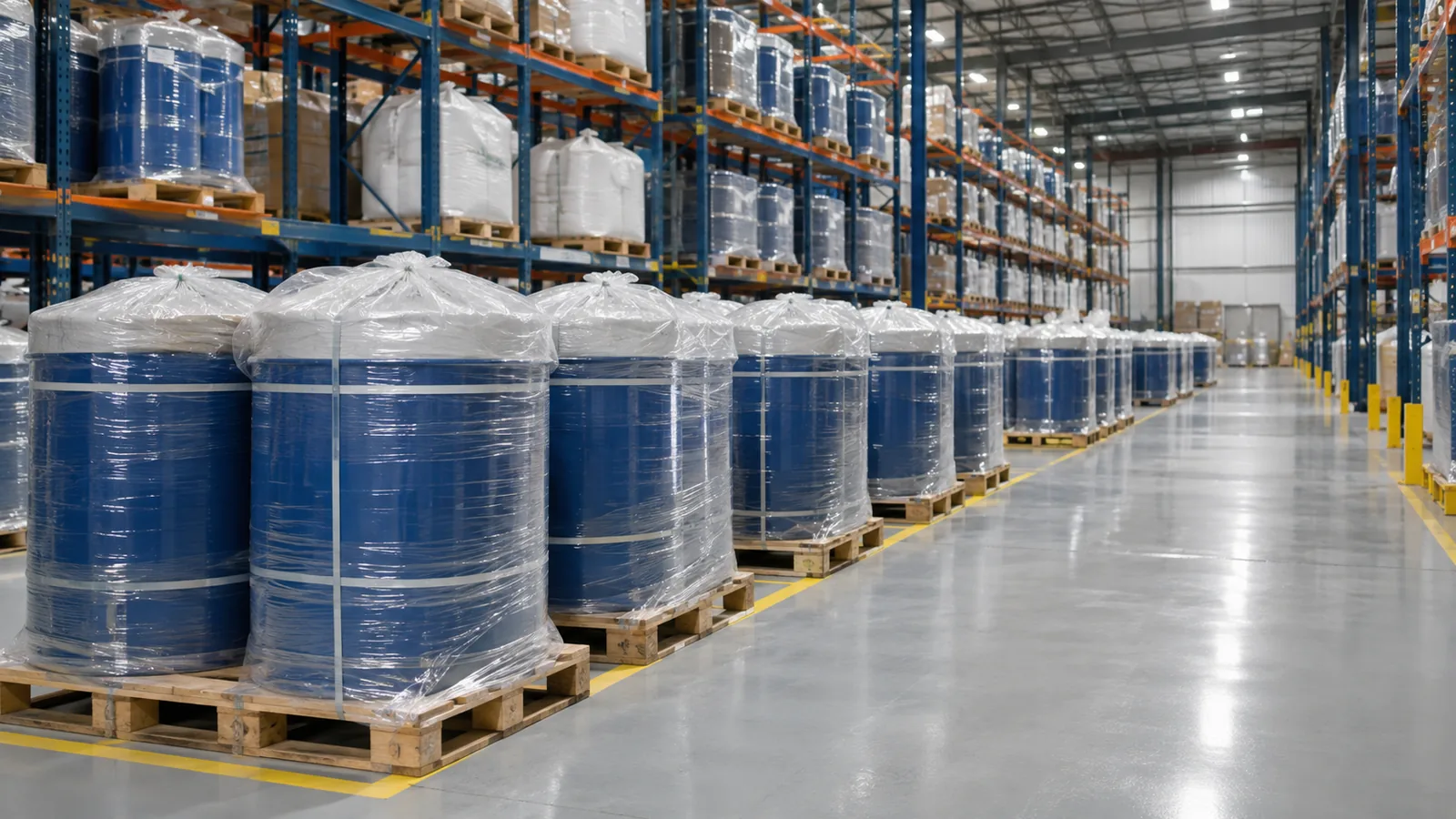
This guide sets out the configurations in common use, what each protects against, how they behave on a pallet and in a container, and what receiving should check first.
Why Packaging Is a Stability Control, Not a Shipping Detail
Every PS specification contains a moisture limit and a peroxide value limit, and both move after the powder leaves the dryer. Moisture migrates in wherever the barrier or the seal is weak, and once free water is present the powder cakes and loses dispersibility. Oxidation proceeds whenever oxygen sits in the headspace, accelerating with temperature, metal traces, and exposed surface area.
So decide backwards from the shelf-life claim. If a supplier warrants 24 months at ambient and the material crosses an ocean and sits two hot weeks in a container yard, the barrier carries that claim. Packs must also survive handling, since PS is a fine powder with poor flow. Four things are then balanced — barrier, mechanical integrity, unit-of-use convenience, and freight efficiency.
Option 1 — Fibre Drum with Polyethylene Liner
This is the default for most bulk PS, typically 20 to 25 kg net: a fibreboard body with a lid containing one or more polyethylene liners.
Its strengths are mechanical: the drum stacks well, tolerates strapping, resists puncture, and every warehouse knows how to handle it. Its weakness is barrier performance — polyethylene transmits oxygen far more than foil laminate does, and liners are gathered and tied rather than hermetically sealed, which matters over a long shelf life or a humid transit.
Specify the drum where the route is short, logistics are climate-controlled, and throughput consumes a drum in days. It needs help for long sea freight, hot destination climates, claims beyond 24 months, or tight peroxide limits.
Option 2 — Aluminium Foil Barrier Bag
A multi-layer laminate — PET or nylon for puncture resistance, aluminium foil as the barrier layer, polyethylene as the sealant — heat-sealed into a bag gives the strongest moisture and oxygen protection of the standard options. Specify it for humid climates, long transit, or a tight peroxide limit.
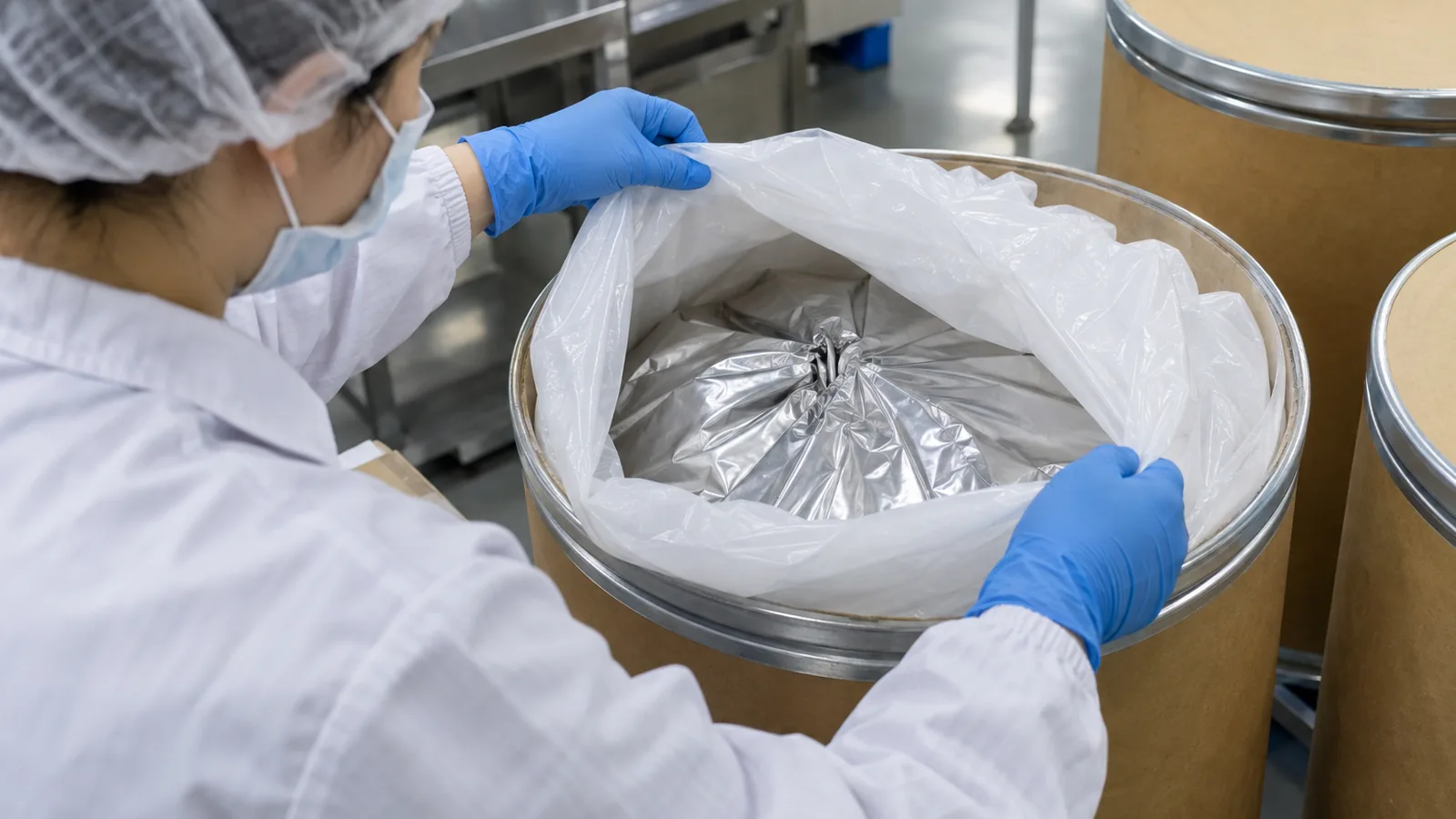
Foil bags are usually combined with headspace control: nitrogen flushing before the final seal, plus a food-grade desiccant for margin on moisture. Sealed correctly, this pack holds low water activity for a long time even under poor ambient conditions.
The trade-offs are real. Bags alone do not stack or take a strap, so they ship inside an outer container; they cost more than a bare liner; and every seal is a potential leak point, so integrity verification becomes routine rather than occasional.
Option 3 — Bag-in-Drum Hybrids and Smaller Unit Packs
The most common industrial answer combines both: a foil barrier bag, heat sealed and often nitrogen flushed with a desiccant, inside a fibre drum. The drum supplies stackability and mechanical protection; the bag supplies the barrier.
Sizing deserves thought. A plant using 5 kg at a time should not open a 25 kg drum repeatedly, because every opening exposes the remainder to humidity. Splitting the pack — four barrier bags inside one drum — often costs less than the material lost to caking and failed retention samples.
Ask how the partially used remainder should be stored, and build that into the goods-in procedure. Every contact material needs documented food-contact status for the relevant market.
Sealing, Headspace Treatment, and Desiccants
Details decide whether a good film performs. Heat seals should run on validated parameters — temperature, dwell time, pressure — with seal width stated. Ask how often integrity is tested and by which method; vacuum decay, dye penetration, or bubble testing on a defined sampling rate are all defensible.
Nitrogen flushing is only useful if the bag holds it, so specify a target residual oxygen level and require it to be measured and recorded; an unmeasured flush is a claim, not a control. Desiccant sachets must be food-grade, labelled, and reconciled on the packing list, because one that migrates into a scoop is a foreign-body incident.
Units should carry product name, lot number, net weight, production date, retest date, storage condition, and supplier identification matching the COA — mismatched labelling between drum and paperwork is a common cause of a hold at goods-in.
Palletisation, Unitisation, and Container Loading
European buyers typically receive on 1200 × 800 mm Euro pallets or 1200 × 1000 mm industrial pallets; North American networks are built around the 48 × 40 inch pallet. Confirm footprint, pallet height, gross weight, and drums per pallet in the purchase specification so racking plans and freight quotes use the same numbers.
For export, wood packaging material generally must meet ISPM 15 — heat-treated or fumigated wood bearing the recognised mark. Non-compliant pallets cause customs delay and sometimes re-palletisation at the importer's cost.
Container loading is about moisture as much as space: a sealed container crossing a temperature gradient condenses internally, so container desiccant, dry pallets, and air gaps matter. Unitisation should include wrap or hood, top and bottom sheets, corner protection, and strapping.
Choosing a Configuration: Route, Volume, and Downstream Process
Work through four questions. How long is the route and how hot is it — plan for the worst month, not the average. What must the end-of-shelf-life peroxide number be, working backwards from the claim. How quickly the pack is consumed, since one emptied in days favours convenience while one partially used for weeks favours smaller barrier bags. And what happens downstream, because powder holding even modest moisture flows and blends differently.
Then write the answers into the specification: primary and secondary pack, unit size, barrier layers, seal method, headspace target, desiccant policy, pallet footprint, drums per pallet, strapping, container desiccant, and labelling content.
Incoming Inspection and Acceptance Criteria
Inspect pallets before unloading — wrap intact, no leaning or crushed layers, no wet base — then each unit: lid seated and locked or taped as specified, no punctures, tears, creased seals, staining, prior opening, or corrosion. Verify lot number and net weight against the COA and packing list, and reconcile the desiccant count.
Sample from the top, middle, and bottom of the drum, because moisture gradients are rarely uniform, and test moisture and peroxide value against the specification.
If a unit fails, quarantine the full pallet rather than releasing the good drums. Photograph before moving anything, and notify the supplier with lot data before disposition.
الأسئلة الشائعة
Q: What is the standard packaging for bulk phosphatidylserine?
A: A fibreboard drum of roughly 20 to 25 kg net with a polyethylene liner. For long sea freight or humid destinations, buyers typically specify a heat-sealed foil barrier bag inside the drum, nitrogen flushed with a food-grade desiccant.
Q: Which matters more for PS stability — moisture or oxygen protection?
A: Both, and they are linked. Moisture drives caking and flow loss, oxygen drives peroxide value drift, so a tight peroxide limit needs an oxygen barrier plus headspace control rather than a thicker liner.
Q: Should every bulk PS shipment use nitrogen flushing?
A: Only where it earns its cost — long routes, hot or humid destinations, long declared shelf life. Specify a measurable residual oxygen target and evidence it is checked.
Q: How much fits per pallet and per container?
A: It depends on unit size, drum dimensions, and pallet footprint, so confirm it in writing per configuration. Agree drums per pallet, gross weight, total height, and pallets per container so quotes and racking use the same figures.
Q: What should the receiving team check first?
A: Pallet wrap and stability, then unit-by-unit closure and damage, then lot and weight against the COA and packing list, then moisture and peroxide value on top, middle, and bottom samples.
الخاتمة
Bulk phosphatidylserine packaging is a stability decision expressed in cardboard, film, and strapping. The right configuration follows from arithmetic — route length, peak temperature, end-of-shelf-life peroxide target, and how quickly the pack empties.
Buyers who put those answers in the purchase specification are quoted accurately and rarely meet a moisture problem in production. Those who accept a supplier default discover the difference at goods-in or, worse, at blend uniformity testing.
Nutranexa supplies phosphatidylserine in fibre drums with liners, foil barrier bags, and bag-in-drum hybrids, and states the full configuration in the quotation so it transfers directly into your receiving procedure.
المصادر
- European Union — Regulation (EC) No 1935/2004 on materials and articles intended to come into contact with food: https://eur-lex.europa.eu/legal-content/EN/TXT/?uri=CELEX%3A32004R1935
- European Union — Regulation (EU) No 10/2011 on plastic materials and articles intended to come into contact with food: https://eur-lex.europa.eu/legal-content/EN/TXT/?uri=CELEX%3A32011R0010
- European Commission — Food Safety portal, including food contact materials and import requirements: https://food.ec.europa.eu/index_en
- U.S. Food and Drug Administration (FDA) — Food programme home page, including food ingredients and packaging: https://www.fda.gov/food
- International Plant Protection Convention (IPPC) — international standards for wood packaging material (ISPM 15): https://www.ippc.int/
- International Chamber of Commerce — Incoterms rules: https://iccwbo.org/business-solutions/incoterms-rules/
الخطوات التالية الموصى بها
- قم بمراجعة Phosphatidylserine صفحة المنتج.
- قارن Soy PS و Sunflower PS.
- يفحص إثبات التصنيع و الجودة والبحث والتطوير.
اتصل بالمبيعات للحصول على مستندات المنتج
مشاركة تفضيلات المصدر والتطبيق والبلد والكمية السنوية.
اتصل بالمبيعات