
Softgels are the most consumer-friendly delivery format for phosphatidylserine — they mask the powder's taste, standardise dosing, and position well in cognitive-health ranges. They are also the format where ingredient choice and manufacturing execution interact most tightly, because a softgel fill is a formulated suspension that must stay uniform from mixing tank to finished shell for the whole shelf life.
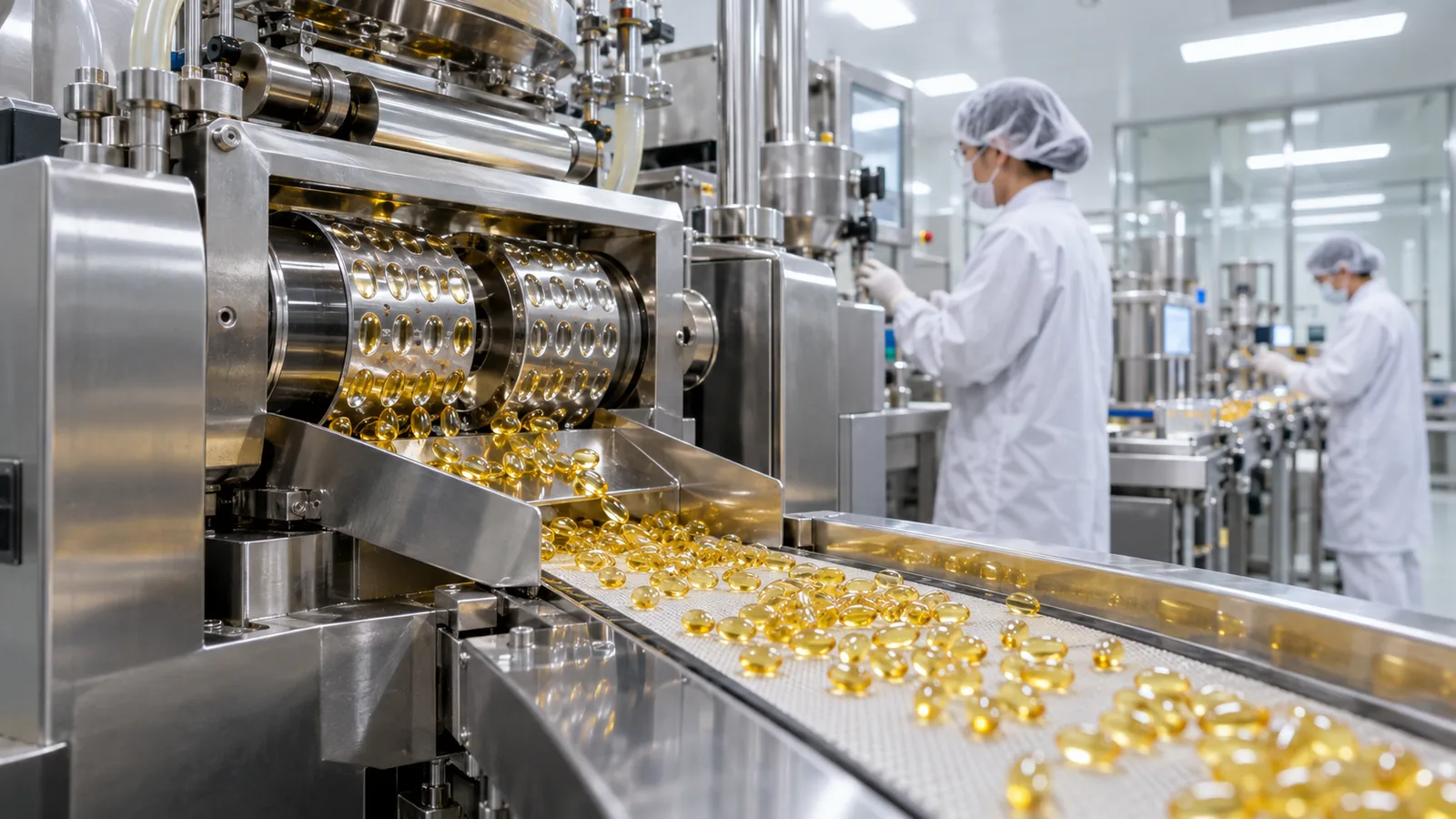
Most PS softgel problems trace back to decisions made before any equipment ran: which raw material form was purchased, which carrier oil was chosen, and what the supplier's specification actually guaranteed. This article walks through those decisions in the order an OEM project meets them.
Choosing the Raw Material Form for Softgel Production
Commercial PS arrives in three forms, and the choice shapes the whole project.
Neat PS powder — the high-assay phospholipid fraction, often waxy or free-flowing depending on grade — offers the cleanest label and tightest assay control, but phospholipid powders are hygroscopic and static-prone, and must be dispersed into the fill matrix at the filler. PS standardised on a carrier — a free-flowing powder on a soluble carrier or a viscous paste in an oil base — trades a small assay ceiling for handling simplicity: dispersion behaviour is already engineered.
The deciding variables are the target dose per softgel, the fill volume the shell size allows, label constraints on carriers, and the filler's equipment. High doses in small shells push toward neat or high-concentration powder; low doses with fast transfer runs favour standardised forms. Whatever the choice, the specification must state the assay basis of the delivered form so fill-weight calculations convert correctly to milligrams of actual PS.
Carrier Oil Compatibility and Suspension Design
PS is amphiphilic — a phospholipid that neither fully dissolves nor cleanly suspends in most oils — so the carrier decision is a compatibility decision, not a flavour decision.
Common carriers are medium-chain triglycerides, soybean or sunflower oil, and blends with small proportions of thickening or suspending agents. The formulation targets two behaviours at once: enough viscosity that particles do not sediment during the fill's residence time in tanks and lines, and enough shear-thinning that metering and dosing discs work as designed. The practical rule: rheology targets belong in the specification, and the proof trial belongs at the actual filler, because dosing-disc behaviour is equipment-specific.

Encapsulation: Fill Uniformity, Viscosity, and Seams
On the line, PS's temperature sensitivity shows up quickly. Heated fills holding phospholipid suspensions fluid will, if run hot, change viscosity during the run and drift fill weights; held too cool, rheology stiffens and dosing suffers. The operating window is therefore a joint specification between ingredient supplier and filler.
Fill uniformity is checked the practical way — in-process fill-weight monitoring against control limits — but acceptance criteria should trace back to the label claim calculation, including the assay of the delivered PS form. Seam and shell integrity matter more for PS than for oil-soluble vitamins, because the fill's water activity and amphiphilic character interact with the gelatin shell over time. A pilot run with planned sampling — beginning, middle, and end of batch — catches drift a single spot check misses.
Fill Stability: Oxidation, Sedimentation, and Shelf Life
PS's fatty acid chains are largely unsaturated, which is what makes oxidation the dominant stability risk. Three controls do most of the work. Oxygen minimisation: nitrogen blanketing during fill preparation and encapsulation, deaeration where equipment allows, and barrier packaging — blister laminates or bottles with desiccant and, where appropriate, oxygen scavengers. Antioxidant strategy: tocopherols or rosemary extract, within the label constraints the market imposes. Temperature discipline: cool, dry storage, validated rather than assumed.
Sedimentation is the second risk: a fill that passes a mixing-tank check can still stratify over weeks. The stability protocol should include content uniformity across finished units — first-drawn and last-drawn units, and units from different package positions — not just a pooled assay. A shelf-life claim supported by real-time data on the packaged format is the only kind that survives customer and regulator scrutiny.
The Supplier-to-Filler Handover Documentation
The OEM handover fails most often on paper, not chemistry. From the supplier, the package is specific: technical data sheet and full specification with assay basis stated; method-referenced COAs for each delivered lot; allergen and GMO declarations matching the declared source; heavy metals, micro, and residual solvent results against specification; a process summary for the filler's supplier-approval file; change-control notification terms; and lot-level traceability identifiers for batch genealogy. From the filler back to the brand: the master manufacturing record, in-process fill-weight data, the stability protocol and results, and batch genealogy linking finished lots to ingredient lot codes — the linkage FSMA 204 traceability and every customer audit will request.
Reconcile the three specifications before the pilot: the supplier's powder spec, the filler's incoming material spec, and the label claim calculation must agree on assay basis, moisture tolerance, and storage conditions. Mismatches found at reconciliation cost an email; mismatches found after a failed batch cost a campaign.
SSS
Q: Should we buy PS powder or a standardised form for softgels?
A: It depends on dose and process. High doses and tight label constraints favour neat powder dispersed on site; standardised powders and pastes simplify the filler's dispersion step and improve lot-to-lot consistency. Decide jointly with the encapsulation plant against their equipment.
Q: What is the biggest stability risk for PS softgels?
A: Oxidation of the unsaturated fatty acid chains. Nitrogen blanketing, barrier packaging with desiccant or scavengers, appropriate antioxidants, and cool dry storage address it — and the shelf-life claim should rest on real-time stability data for the packaged product.
Q: What documents must the ingredient supplier provide to the encapsulation plant?
A: At minimum: specification with stated assay basis, lot COAs with method citations, allergen and GMO declarations, contaminant results, a process summary for supplier approval, change-control terms, and lot-level traceability identifiers so finished-batch genealogy can be built.
Sonuç
A PS softgel succeeds or fails at its interfaces: the raw material form against the fill design, the fill design against the encapsulation equipment, the packaged product against its shelf-life claim, and — most invisibly — the documents travelling between supplier, filler, and brand. Buyers who bring the form choice, the rheology targets, and the documentation list into the OEM conversation before the pilot get accurate quotations and boring batches.
Kaynaklar
- U.S. FDA — Current Good Manufacturing Practice for Dietary Supplements (21 CFR Part 111): https://www.fda.gov/food/current-good-manufacturing-practice-cgmp-dietary-supplements
- U.S. FDA — Final Rule: Requirements for Additional Traceability Records for Certain Types of Foods (FSMA 204): https://www.fda.gov/food/food-safety-modernization-act-fsma/final-rule-requirements-additional-traceability-records-certain-types-foods
- International Council for Harmonisation (ICH) — stability testing guidelines: https://www.ich.org
- European Commission — Food Safety portal, food supplements rules: https://food.ec.europa.eu/index_en
- European Union — Regulation (EC) No 178/2002 on general food law: https://eur-lex.europa.eu/legal-content/EN/TXT/?uri=CELEX%3A32002R0178
Önerilen sonraki adımlar
- Gözden geçirin Fosfatidilserin ürün sayfası.
- Karşılaştır Soy PS ve Ayçiçeği PS.
- Kontrol Üretim kanıtı ve Kalite ve Ar-Ge.
Ürün belgeleri için satış görüşüne ulaşın
Kaynak tercihini, başvurunu, ülkeyi ve yıllık miktarı paylaşın.
İletişim Satışları