
Buyers comparing phosphatidylserine offers usually sort by origin and assay first — soy or sunflower, 50% or 70% — and only then notice the quotes differ in something more consequential: physical form. The same PS molecule arrives as a free-flowing powder or as a viscous paste, and that difference decides your capsule weights, your blending behavior, your gummy process, and how much of your production line's tolerance the ingredient will consume. Choose the wrong form and no assay certificate saves you. This guide compares the two commercial forms, explains the physical specifications that actually predict manufacturing performance, and closes with the spec lines to write into your next RFQ.
The Two Commercial Forms of PS
Powder PS is produced by adsorbing concentrated phospholipid onto a carrier — commonly a food-grade carbohydrate or protein-based carrier — and milling to a controlled particle size. It is the dominant commercial form, sold in assay grades of roughly 20%, 50%, and 70% PS, packaged in fiber drums with foil liners, typically 10–25 kg net.
Liquid and paste PS is the concentrated phospholipid itself — viscous, sticky, honey-like at room temperature — sold usually at 20% PS in oil-type systems or as high-concentration pastes. It flows (slowly), pumps warm, and sets semi-solid when cool.
The chemistry is the same; what differs is everything around the molecule. Powder trades a carrier and a milling step for dosability and flow. Paste offers a carrier-free, sometimes higher-purity form at the cost of handling complexity. Neither is better — each maps cleanly onto certain dosage formats and badly onto others.
Powder PS: Particle Size, Bulk Density, and Flowability
Three physical properties predict how powder PS behaves in production:
Particle size distribution. Powder PS is commonly milled to pass specific sieve cuts, with typical offers ranging from coarse granulations (95% through a 20-mesh sieve) to fine milled powders (95% through an 80-mesh or finer screen). Finer particles disperse and blend more uniformly but pack tighter and can bridge or clump in humid rooms; coarser granulations flow more freely but can segregate in blends with fine excipients. The match to your blend's other components matters more than any absolute number.
Bulk density. Typical tapped bulk densities for PS powders run around 0.3–0.6 g/mL depending on grade and carrier. This number drives capsule sizing directly: at 0.4 g/mL, a 400 mg fill of a 50% PS blend needs a size 0 capsule; at 0.55 g/mL the same fill fits a size 1. Discovering bulk density late means changing capsule sizes — and artwork — after quoting.
Flowability. Powder PS is hygroscopic and inherently cohesive; without attention it cakes, bridges in hopper outlets, and feeds unevenly into capsule dosators. Practical levers: flowing agents in the blend (colloidal silica at 0.5–1% is common), controlled room humidity during processing (below roughly 40–50% RH for open handling), and granulation for direct-compression tablet work. Quantify expectations with standard tests — angle of repose, Carr index, or Hausner ratio — and require the supplier to state the test method alongside the number, because values without methods cannot be compared between suppliers.
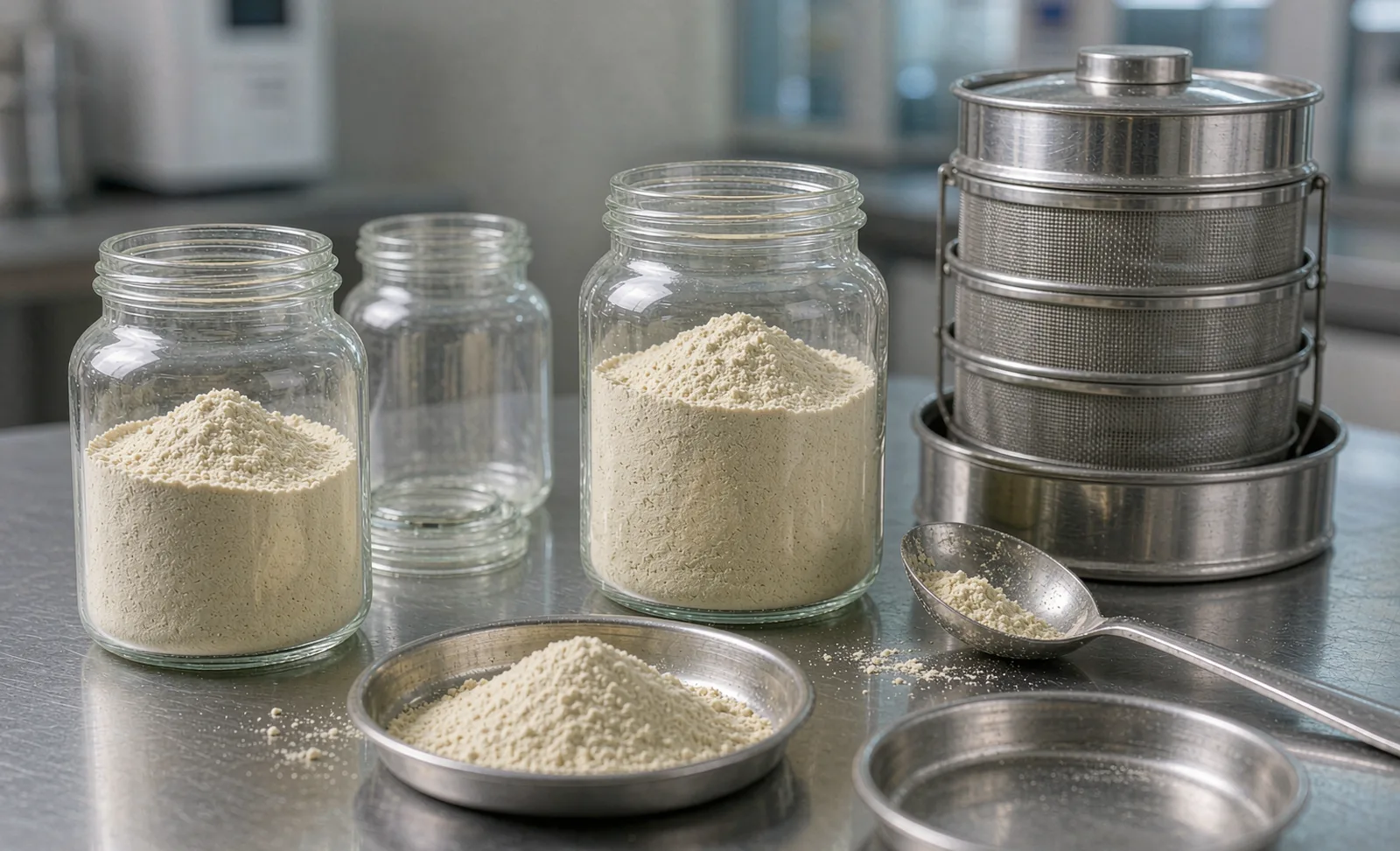
A useful acceptance practice: run a small blend-uniformity and capsule-weight-variation trial on first-article material before committing the full order. Two days of pilot work prevents a 300 kg mispurchase.
Liquid and Paste PS: Where It Wins
Paste PS earns its place in four scenarios:
Softgels. PS pastes feed encapsulation machines directly into fill matrices — no powder dispersion step, no carrier contributing to fill weight. For high-PS softgel products, paste is usually the technically correct form.
Gummies. Phospholipids disperse more readily into pectin or gelatin masses from a paste than from a dry powder, where they can clump. For PS-fortified gummies, suppliers commonly recommend paste or pre-dispersed forms.
Fat-based matrices. Bars, bites, and lipid spreads incorporate paste PS homogeneously where powder would sit inertly in the matrix.
Carrier-sensitive claims. Paste contains no carbohydrate carrier, which simplifies certain label stories and maximizes PS per gram of formulation space — relevant for gummies, where the load per piece is tight.
The costs: paste requires heated storage and pumping in cool climates, warm-up before dispensing, nitrogen-headspace packaging to protect against oxidation, and dose control by weight rather than volumetric feeding. Plan for 40–50°C warming jackets or water baths on the filling line, and expect higher viscosity in cold warehouses to slow batch prep.
Matching Form to Dosage Format
Format-by-format guidance from typical OEM practice:
- Two-piece capsules: powder, milled to a moderate cut, with attention to bulk density against your capsule size. Paste is impractical without specialized liquid-fill encapsulation.
- Direct-compression tablets: powder with fine particle size and a granulation step or a well-designed excipient system; cohesive powders alone compress inconsistently. Confirm flowability numbers against your press feed system.
- Softgels: paste, or powder only if the manufacturer has a suspension-fill process validated for phospholipids.
- Gummies: paste or pre-dispersed PS; powder requires careful premixing and risks visible specking.
- Powdered drink mixes and sticks: fine-milled powder for dispersion; expect some suspension aid (gum or lecithin-adjacent carriers) to keep PS distributed in the glass.
- Functional foods: depends on the matrix — pastes for fat-based systems, powders for dry blends.
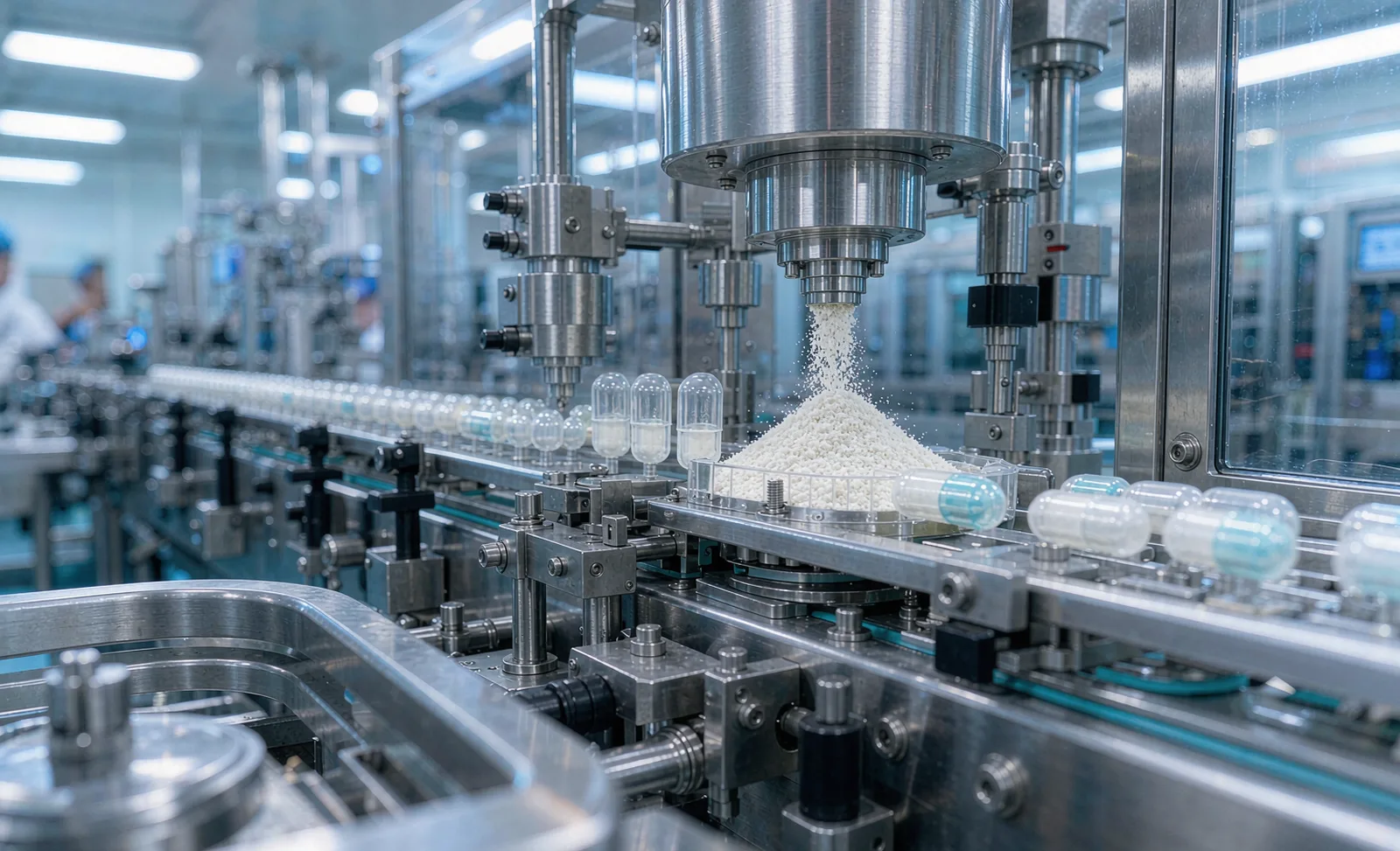
When your contract manufacturer's equipment dictates the answer, obtain their process requirements in writing and convert them into ingredient spec lines — the manufacturer's line capabilities, not the ingredient datasheet, should close the powder-versus-paste debate.
Handling, Storage, and Stability Differences
Powder PS stores and ships more forgivingly: sealed drums with liners at cool room temperature, 24–36 month typical shelf life, standard ambient freight. Its enemy is humidity — once a drum is opened, hygroscopic pickup begins, so weigh-and-discard practices for partial drums should be standard.
Paste PS is more demanding: cooler storage (commonly 2–10°C or cool room per supplier recommendation), nitrogen-flushed containers, and tighter oxidation monitoring — expect peroxide-value limits on the spec and occasional batch re-testing on long storage, and heavier freight per unit of PS since there is no lightweight carrier. Specify storage conditions on the PO and hold suppliers to the stated retest dates.
Spec Lines to Write Into Your RFQ
Convert this guide into requirements. For powder PS, specify:
- Assay (PS % by HPLC) and grade; carrier identity and level.
- Particle size: target distribution and test method (e.g., "95% through 60 mesh, sieve method stated").
- Bulk density: tapped density range with method.
- Flowability: angle of repose or Carr index target with method, or an agreed flowing-agent allowance in your blend.
- Moisture and water activity limits; peroxide value limit.
- Packaging: drum size, liner type, nitrogen flush if offered.
For paste PS, specify:
- PS content and matrix description; no carrier confirmation where relevant.
- Viscosity or consistency descriptor with test temperature.
- Peroxide value and free fatty acid limits; antioxidant system if any.
- Packaging: container size, headspace gas, storage temperature range.
For both, require the CoA to report the same methods as the specification, and require a retain sample agreement for your own verification testing.
Perguntas frequentes
Q: Is liquid PS more bioavailable than powder PS?
Not meaningfully. PS is a phospholipid absorbed via digestive processing; the carrier form does not change the molecule, and published research spans both forms. Choose form for manufacturing performance, not absorption claims.
Q: What particle size should I specify for capsules?
Match your blend: a moderate cut that blends uniformly with your excipients and flows through your dosator. Typical capsule-grade PS powders specify 95% through 40–80 mesh. The safest specification is one validated with a blend-uniformity trial on first-article material rather than copied from a datasheet.
Q: Why is my PS powder clumping in the blender?
Powder PS is hygroscopic and cohesive. Common causes: ambient humidity above roughly 50% RH during open handling, too-fine particle size without a flowing agent, and material exposed after drum opening. Colloidal silica at 0.5–1%, humidity control, and closed transfer all help.
Q: Can I use paste PS in two-piece capsules?
Not directly — paste cannot be dosed on standard capsule-filling equipment. If your brand story requires carrier-free PS in a two-piece format, discuss liquid-fill hard capsule options with your manufacturer; otherwise use powder.
Q: Does the carrier in powder PS appear on my label?
Yes. The carrier is part of the ingredient and must be declared where labeling rules require component disclosure — relevant for allergen review if the carrier is protein-based. Confirm carrier identity in the spec before finalizing artwork.
Conclusão
The powder-versus-paste decision is a manufacturing decision, and it should be made with your production line's requirements on the table — not after the ingredient has arrived. Powder PS with a well-written particle-size, bulk-density, and flowability spec runs cleanly through capsules, tablets, and dry blends; paste PS is the technically correct choice for softgels, gummies, and fat-based matrices. The properties that matter are mundane and measurable, which is exactly why they belong in your RFQ alongside assay and price. Send Nutranexa your dosage format, target dose, and line constraints, and we will recommend the form, grade, and physical specification — with first-article samples for your pilot trial — before you commit a single production batch.
Fontes
- Food and Drug Administration dos EUA — Suplementos Alimentares: https://www.fda.gov/food/dietary-supplements
- U.S. Pharmacopeia — Dietary Supplements Compendium (excipient and testing standards): https://www.usp.org/dietary-supplements
- NSF International — Dietary Supplement Certification: https://www.nsf.org/testing/health-sciences/dietary-supplements-certification
- Comissão Europeia — Suplementos Alimentares: https://food.ec.europa.eu/food-safety/food-supplements_en
- Escritório de Suplementos Alimentares do NIH — Contexto de Suplementos Alimentares: https://ods.od.nih.gov/
Próximas etapas recomendadas
- Revise o Phosphatidylserine página do produto.
- Comparar Soy PS e Sunflower PS.
- Verifique prova de fabricação e Qualidade e P&D.
Entre em contato com o departamento de vendas para obter documentos do produto
Compartilhe preferência de fonte, aplicação, país e quantidade anual.
Contato de vendas