
Sunflower phosphatidylserine is bought for what it is not: not soy-derived, not genetically modified, not dependent on a supply chain that raises allergen questions in finished product labelling. That is a legitimate reason to choose it — and a claim set that collapses under scrutiny unless the buyer understands how the material is made.
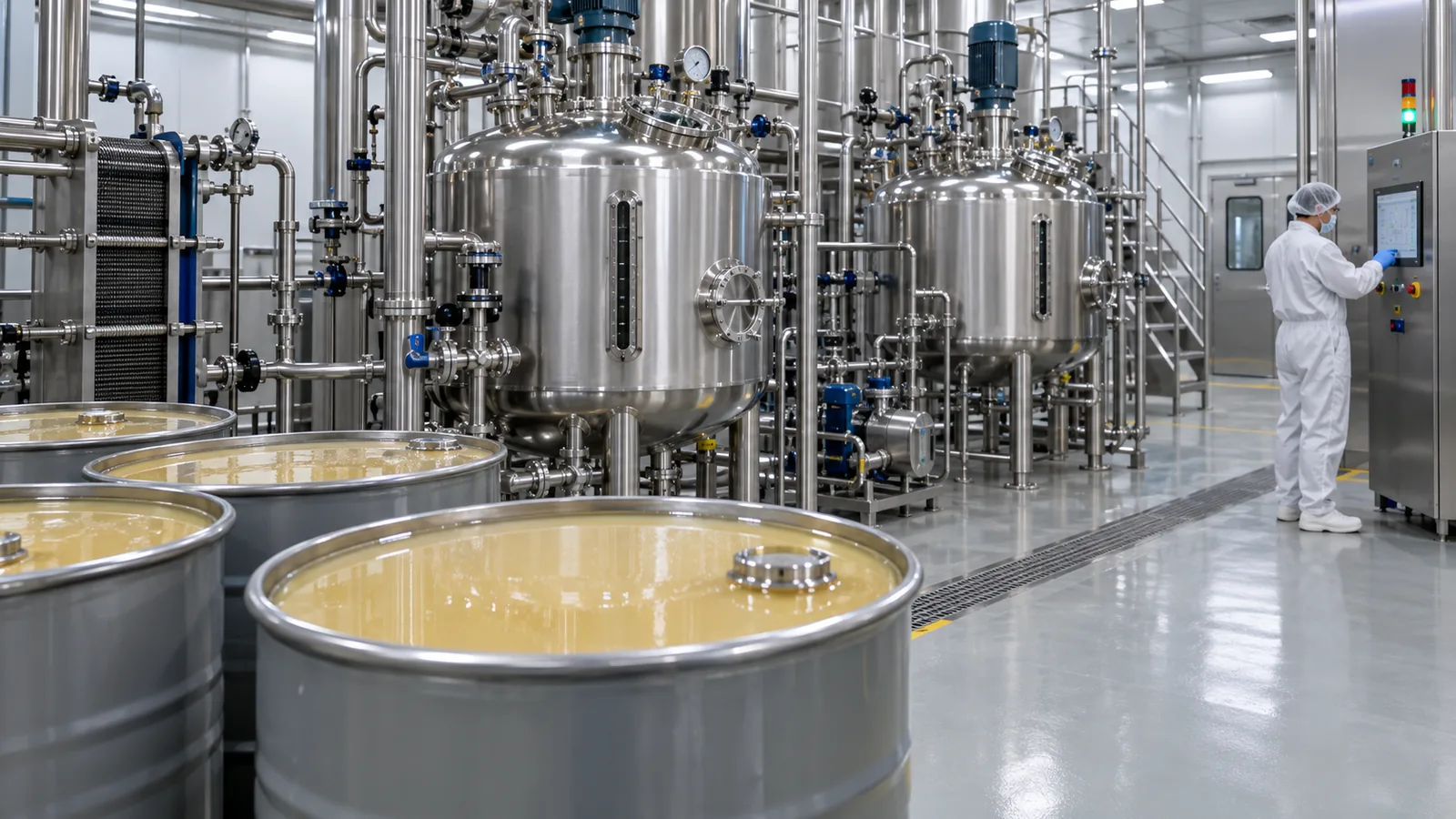
Commercial sunflower PS is not extracted from sunflower: it is built enzymatically from sunflower lecithin, as phospholipase D transfers the phosphatidyl group from phosphatidylcholine to L-serine. What buyers care about — residual enzyme, residual substrate, solvent use, allergen carryover, batch consistency — follows from how that conversion and its downstream purification are run.
This guide walks the route and the questions worth asking at each step.
The Process Route in Overview
The route starts with sunflower lecithin, a phosphatidylcholine-rich phospholipid fraction obtained during sunflower oil refining. Its quality sets the ceiling: fatty acid profile, incoming oxidation status and available phosphatidylcholine all carry through to the finished powder.
The conversion step uses phospholipase D. In the presence of L-serine, the enzyme catalyses transphosphatidylation — it cleaves the head group from phosphatidylcholine and transfers the phosphatidyl moiety to serine, yielding phosphatidylserine and free choline. Commercial PLD is produced by microbial fermentation, and the reaction runs under controlled pH and temperature, often with calcium as a cofactor, in a biphasic or dispersed system that brings substrate and serine phase into contact.
Downstream is where plants differ most. The enzyme is inactivated, the mass separated and washed to remove choline, unreacted serine and enzyme residues, and any purification solvents removed. The material is then dried, milled, sieved, blended to a target PS content and packed under nitrogen.
Process Control Points Buyers Should Verify
Ask for the process description first, then test it against the batch record. The control points worth verifying are the incoming lecithin specification and its oxidation status; the reaction parameters — pH, temperature, calcium level, substrate ratio and reaction time — recorded as values rather than ranges; and the conversion endpoint, usually tracked by residual phosphatidylcholine.
Then ask what happens after the enzyme stops. Inactivation temperature and hold time should be recorded, because insufficient inactivation leaves active enzyme in the powder and excessive heat drives oxidation. Drying deserves particular attention, since this step most often consumes the oxidation budget before the drum is closed.
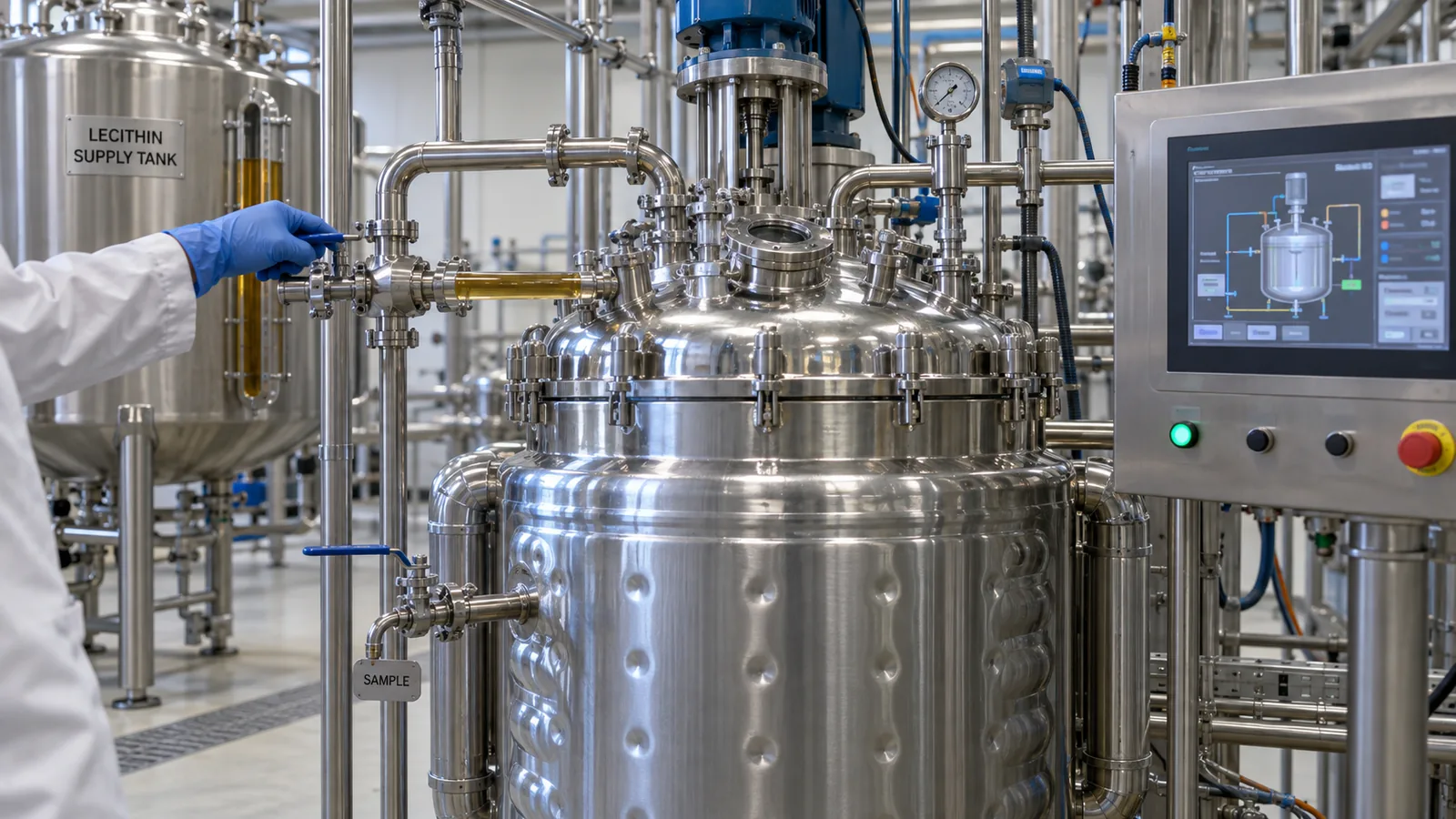
Finally, ask which of these are in-process controls with recorded results and which are finished-product tests only. A plant that stops the reaction on measured conversion rather than on the clock hits a narrow assay range more reliably.
Non-GMO and Soy-Free: What the Evidence Must Show
Two claims are usually bundled together, and they need different evidence. Non-GMO rests on the crop and on identity preservation: sunflower is not a commercial genetically modified crop, so the claim rests on documentation that the lecithin came from non-GM sunflower under an identity-preserved supply chain. In the EU, GM food and feed authorisation and labelling sit under Regulation (EC) No 1829/2003; in the US there is no equivalent federal GM labelling rule, so the claim is largely documentary.
Soy-free is an allergen claim, and it must be proven at the plant as well as on paper. Ask for three things: a written allergen statement naming soy; the segregation or changeover evidence, because lecithin plants frequently handle both soy and sunflower; and a finished-lot test result, since demonstrating absence requires a validated method with a stated detection limit.
EU allergen information obligations sit in Regulation (EU) No 1169/2011; US major allergen declaration sits under the Food Allergen Labeling and Consumer Protection Act framework. A supplier statement with no supporting test result and no changeover record is a marketing sentence, not evidence.
Residual Enzyme, Solvent and Reagent Control
"Enzyme-derived" describes the conversion step, not the whole process. Is the enzyme removed or inactivated, and how is that demonstrated in the batch record? Is there a test for residual enzyme protein or activity, and what is the limit? Is the enzyme of food-grade origin and appropriately specified?
Solvent is the second question. Some routes use organic solvents during extraction or purification, in which case the specification must list residual solvents with limits and the COA must report results. Other routes are designed to avoid them. Either is acceptable, but "enzyme-derived" should never be read as solvent-free — check the specification rather than the brochure.
Reagents are the third. L-serine should be specified for identity, purity and the correct L-enantiomer, since the biological activity of the product depends on it. And ask about residual choline, the co-product of the reaction: not a contaminant as such, but a persistently high or drifting level suggests variable washing.
Batch-to-Batch Consistency: Which Indicators Matter
Consistency is not a promise, it is a distribution, visible only if you ask for data across lots rather than a single COA. Request actual results for the last ten lots against each key parameter, not the specification ranges, and check clustering and drift.
The parameters that matter most: PS assay by the declared method; residual phosphatidylcholine, which reports conversion completeness; moisture, which relates to stability and flow; peroxide value at release, which reports the lot's thermal and oxygen history; and particle size with bulk and tapped density, which determine how the powder runs.
Ask for a coefficient of variation on assay and moisture, and how out-of-trend lots are handled — whether there is a defined response when a result is in specification but outside the historical pattern. That response, more than the range on the specification sheet, is what separates a controlled process from a capable one.
What to Put in a Technical Questionnaire
A good questionnaire asks for evidence rather than assurances. Include the source and grade of the incoming lecithin, the enzyme identity and its food-grade status, the declared reaction and purification steps, whether solvents are used and which, and the residual enzyme, solvent and choline limits with results.
Add the claim documentation: non-GMO statement with supply-chain evidence, allergen statement naming soy with segregation and finished-lot test results, and the regulatory framework the plant works to. Add the consistency request: ten consecutive lots of results on assay, residual phospholipid profile, moisture, peroxide value and particle size.
Close with change control. Ask what would trigger a customer notification — a change of lecithin supplier, enzyme supplier, solvent, drying profile or packaging — and how much notice buyers receive. For a material this specification-sensitive, that answer predicts the relationship better than any COA.
Perguntas frequentes
Q: How is sunflower phosphatidylserine produced?
A: Phospholipase D converts phosphatidylcholine in sunflower lecithin into phosphatidylserine by transferring the phosphatidyl group to L-serine; the enzyme is then inactivated, the mass washed, and the product dried, milled and packed under nitrogen.
Q: What evidence supports a non-GMO sunflower PS claim?
A: Documented identity preservation of the incoming lecithin plus supplier declarations, under the applicable framework: EU labelling under Regulation (EC) No 1829/2003, or documentary evidence for the US market.
Q: What proves a phosphatidylserine lot is soy free?
A: A written allergen statement naming soy, segregation or validated changeover records where soy is also handled, and a finished-lot result from a validated soy protein method with a stated detection limit.
Q: Which indicators show real batch-to-batch consistency?
A: PS assay by the declared method, residual phosphatidylcholine, moisture, peroxide value at release, and particle size with bulk and tapped density — reviewed across ten consecutive lots, not as specification ranges.
Conclusão
Sunflower phosphatidylserine is a manufactured phospholipid, not an extracted one, and the buyers who get the best out of it treat the manufacturing route as part of the specification. Phospholipase D conversion is well established and repeatable; the variables that matter come after the reaction — inactivation, washing, drying and packing.
The verification list is short and cheap to request: a process description, ten lots of results, claim documentation supported by testing, and a change-notification commitment. Suppliers running a controlled process answer it in a day.
Fontes
- European Commission — Regulation (EC) No 1332/2008 on Food Enzymes: https://eur-lex.europa.eu/legal-content/EN/TXT/?uri=CELEX%3A32008R1332
- European Commission — Regulation (EC) No 1829/2003 on Genetically Modified Food and Feed: https://eur-lex.europa.eu/legal-content/EN/TXT/?uri=CELEX%3A32003R1829
- European Commission — Regulation (EU) No 1169/2011, Food Information to Consumers (allergen information): https://eur-lex.europa.eu/legal-content/EN/TXT/?uri=CELEX%3A32011R1169
- U.S. Food and Drug Administration (FDA) — Food Allergen Labeling and Consumer Protection Act (FALCPA): https://www.fda.gov/food/food-allergensgluten-free-guidance-documents-regulatory-information/food-allergen-labeling-and-consumer-protection-act-2004-falcpa
- National Institutes of Health (NIH), PubMed — Literature on phospholipase D and phosphatidylserine conversion: https://pubmed.ncbi.nlm.nih.gov/?term=phospholipase+D+phosphatidylserine
Próximas etapas recomendadas
- Revise o Phosphatidylserine página do produto.
- Comparar Soy PS e Sunflower PS.
- Verifique prova de fabricação e Qualidade e P&D.
Entre em contato com o departamento de vendas para obter documentos do produto
Compartilhe preferência de fonte, aplicação, país e quantidade anual.
Contato de vendas