

A phosphatidylserine tender looks like a pricing exercise until the responses arrive. Then it becomes a documentation exercise. Three suppliers quote within a few percent on a per-kilogram basis, and the decision turns on something more mundane: which one attached a specification that names its analytical methods, which one provided a certificate of analysis for a real lot rather than a template, and which one answered the logistics questions instead of leaving them blank.

For US and European buyers, that shift is not pedantry. Under US dietary supplement GMP and EU food law, the buyer owns supplier verification, traceability, and specification control, and a tender response is the cheapest place to collect that evidence. For suppliers, the same document set is the difference between being shortlisted and being filtered out by a compliance screen before a human reads the price.
This guide covers both sides: what buyers should require and how to score it, and how suppliers build a defensible pack once rather than per enquiry.
Why Phosphatidylserine Tenders Stall Before Price Is Discussed
Most stalled tenders fail on completeness, not competitiveness. Two of five responses arrive with no specification, a COA with no lot number, or a price valid for seven days when the award takes six weeks. A committee cannot compare what it cannot normalise, so the round extends or restarts.
Phosphatidylserine makes this worse because the material is specification-sensitive. Buyers are not purchasing a generic phospholipid powder; they are purchasing a defined assay range by a stated method, plus limits on peroxide value, moisture, heavy metals, residual solvent, and microbiology, plus physical parameters such as particle size and bulk density that determine how the powder runs on a blender or capsule filler. At the same price, two quotes can describe different products if the assay basis differs. A tender should therefore ask for the specification before the price.
The Document Set a Compliant Response Contains
Specification sheet and declared analytical methods
The specification is the anchor document. It should identify the material unambiguously — product name, grade, source (soy or sunflower), form, and any carrier in a diluted grade — then list each parameter with its limit and test method. Limits without methods are hard to audit, because results from different methods are not always comparable. For phosphatidylserine, expect assay by a named method, peroxide value, moisture or loss on drying, individual heavy metals, residual solvent where a solvent process is used, microbiology, and physical descriptors. Where the material is a diluted powder, the carrier and nominal PS percentage belong on the specification, not in an email.
Certificate of analysis and lot traceability
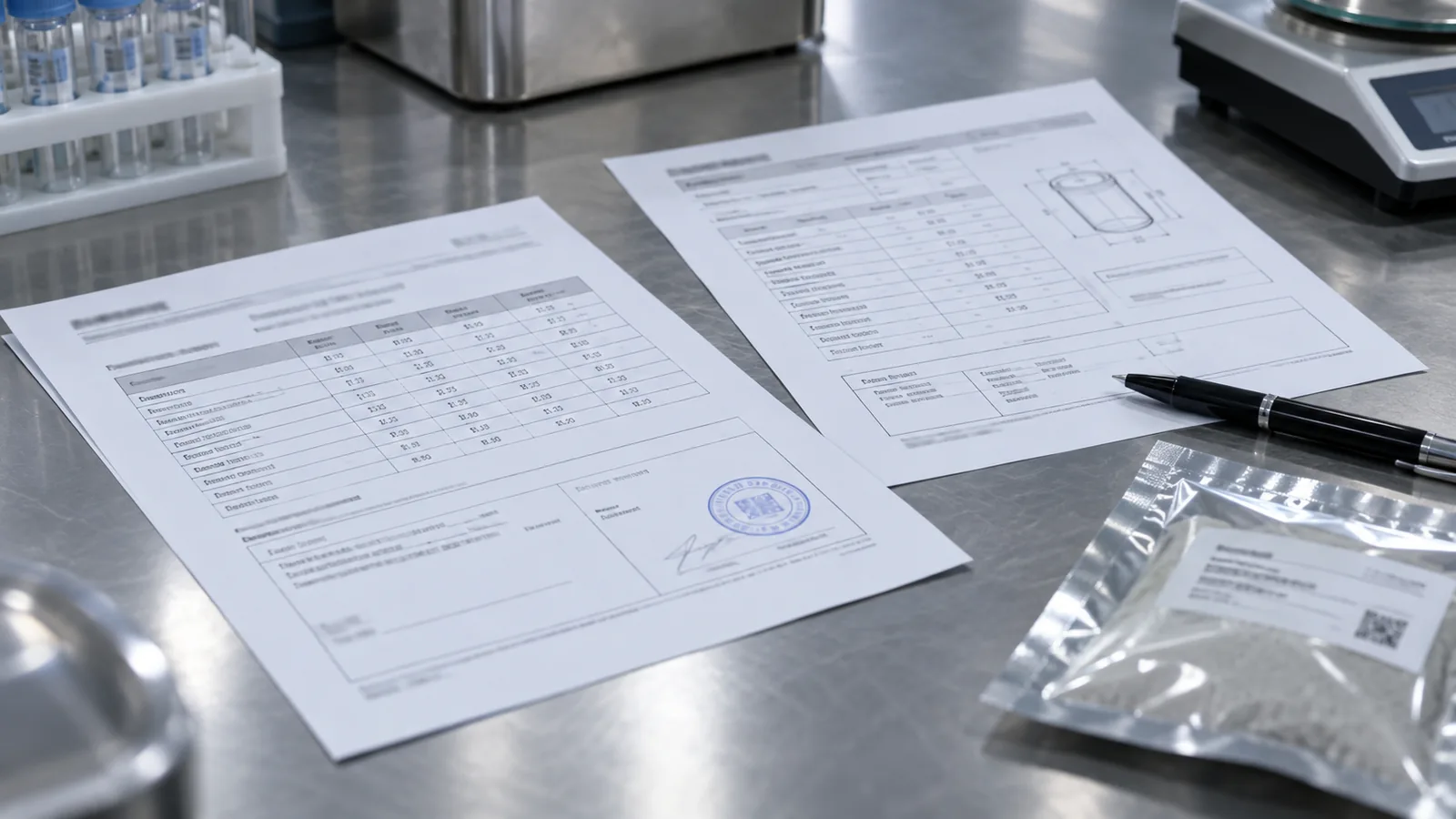
A COA is batch-specific evidence, not a marketing sheet: lot number, production or retest date, test date, results against each parameter, and an authorised release record. Buyers should ask for the COA of a real recent lot, and should put traceability questions in the tender itself — how a lot is defined, how sub-lots and rework are handled, how long retention samples are kept, and what happens if incoming test disagrees with the supplier's COA.
GMP, HACCP, and food safety management evidence
Ask which framework the supplying plant operates under, and its scope. A recognised food safety management certificate — ISO 22000 or a GFSI-benchmarked scheme — plus HACCP documentation and a statement of the regulatory framework gives procurement something to verify rather than believe. Scope matters more than the logo: a certificate covering blending and packing of food ingredients is relevant, one covering an unrelated line is not, and it must name the site that will actually produce the material.
Under US dietary supplement GMP the finished-product manufacturer carries supplier qualification and incoming-testing obligations; under EU general food law the operator carries traceability one step back and one forward, with hygiene requirements set by Regulation (EC) No 852/2004. Also request an allergen statement, GMO status where relevant to the source, residual solvent and irradiation statements, and a completed supplier questionnaire covering change control, complaints, and recall procedure.
Pricing Structure Buyers Can Actually Compare
A comparable price is a structured price. Ask every bidder for the same shape: unit price in a stated currency, the Incoterms rule with named place, quantity bands, packaging configuration with packaging stated as included or excluded, validity period, lead time from order confirmation, payment terms, and any surcharges or index adjustments.
Without that structure, bids are not comparable. One quotes FOB, another CIF, a third DAP; one price includes nitrogen-flushed foil drums, another a fibre drum with a basic liner. The first difference is freight and insurance. The second is a shelf-life and moisture-protection decision that surfaces months later as a peroxide value problem. Annual tenders should also ask for a volume-banded schedule and a variance mechanism, since a price that collapses when offtake runs below forecast triggers renegotiation by month four.
Logistics and Supply-Readiness Questions
Logistics readiness is where ingredient tenders are quietly won. Include questions on drum configuration, moisture and oxygen protection, palletisation and container utilisation, drum label content, shelf life and storage, and whether the supplier supports split shipments or a call-off schedule. Ask which documents travel with the goods — COA per lot, packing list, commercial invoice, certificate of origin where relevant — and how a damaged or out-of-specification shipment is handled. Add capacity and continuity: confirmed annual capacity, the share this tender represents, lead time at the tender volume, and allocation policy when demand exceeds capacity.
How Suppliers Should Build a Reusable Tender Pack
Suppliers lose tenders by improvising. Maintain one pack: current specification, product dossier with regulatory and allergen statements, COA template plus real recent lot COAs, food safety and GMP evidence with scope, a standard packaging and logistics sheet, a pre-answered supplier questionnaire, and a pricing sheet with quantity bands and Incoterms options.
Then answer the buyer's actual questions in the buyer's format. Evaluation committees score compliance with the request, so a well-designed dossier with three blank mandatory fields fails the screen. Quote the assay basis the buyer specified, state deviations explicitly, and never leave a required field empty — write "not applicable, with reason" where that is honest. Price for the whole relationship: realistic validity, lead time from confirmation rather than enquiry, and a clear statement of what the drum price includes.
How Buyers Should Score and Shortlist Responses
Set the scoring before responses arrive. Use compliance and documentation as a pass/fail gate, then weight specification fit, quality evidence, total landed cost at the actual Incoterms, logistics readiness, and commercial terms. Normalise landed cost first — same delivery point, packaging differences noted — and treat payment-term value separately. Then shortlist two or three, request samples against the stated specification, and test before awarding. A tender that ends with a sample and a COA verification survives contact with production.
자주 묻는 질문
Q: What documents should a phosphatidylserine tender response include?
A: A specification listing each parameter with its test method, a batch-specific COA for a real recent lot, food safety and GMP evidence with site scope, allergen and regulatory statements, a packaging and logistics sheet, and a price stated with Incoterms, quantity bands, validity, lead time, and payment terms.
Q: Why do suppliers get filtered out before price is compared?
A: Most tenders apply a compliance gate first. A missing specification, a COA without a lot number, a certificate whose scope does not cover the producing site, an unpriced Incoterms term, or unanswered mandatory questions will disqualify a bid regardless of how competitive the number is.
Q: Which GMP or food safety certificates matter for bulk phosphatidylserine?
A: Recognised food safety management certification such as ISO 22000 or a GFSI-benchmarked scheme, plus HACCP documentation and a clear statement of the regulatory framework the plant works to. Check that the certificate names the site that will manufacture and pack the material.
Q: How should phosphatidylserine tender pricing be structured so bids are comparable?
A: Fix the currency, the Incoterms rule and named place, the quantity bands, the packaging configuration, the validity period, the lead-time basis, and the payment terms in the request itself. Then convert every bid to the same delivered basis before comparing.
Q: Should a tender require samples before award?
A: Yes. Shortlist two or three compliant bidders, obtain samples with COAs against the tender specification, run incoming tests and, if relevant, a small trial batch. Sample performance is the cheapest predictor of how bulk supply will behave.
Q: Can a supplier reuse one document pack for every tender?
A: Yes for the core pack — specification, dossier, certificates, logistics sheet, pre-answered questionnaire. But each response must be completed in the buyer's own format, with explicit answers to mandatory questions and clear statements of any deviation.
결론
A phosphatidylserine tender is a test of documentation discipline on both sides. Buyers who specify what they need, in what order, and how they will score it get comparable bids and a defensible award. Suppliers who maintain a current, honest, complete pack spend less time on paperwork and get shortlisted more often.
Price still matters. But in a specification-sensitive category it is the last comparison, not the first. The responses that survive the screen are the ones that let a quality reviewer reconstruct the product on paper before a kilogram ships.
출처
- U.S. Food and Drug Administration (FDA) — Current Good Manufacturing Practice for Dietary Supplements (21 CFR Part 111): https://www.fda.gov/food/current-good-manufacturing-practice-cgmp-dietary-supplements
- U.S. Food and Drug Administration (FDA) — Foreign Supplier Verification Programs (FSVP) for Imported Food: https://www.fda.gov/food/importing-food-products-united-states/foreign-supplier-verification-programs-fsvp-imported-food
- European Commission — Regulation (EC) No 178/2002, General Food Law: https://eur-lex.europa.eu/legal-content/EN/TXT/?uri=CELEX%3A32002R0178
- European Commission — Regulation (EC) No 852/2004 on the Hygiene of Foodstuffs: https://eur-lex.europa.eu/legal-content/EN/TXT/?uri=CELEX%3A32004R0852
- ISO 22000:2018 — Food Safety Management Systems: https://www.iso.org/standard/71726.html
- Codex Alimentarius — General Principles of Food Hygiene (HACCP), CAC/RCP 1-1969: https://www.fao.org/fao-who-codexalimentarius/codex-texts/codes-of-practice/en/
- International Chamber of Commerce — Incoterms Rules: https://iccwbo.org/business-solutions/incoterms-rules/
추천 다음 단계
- 검토 포스파티딜세린 제품 페이지.
- 비교 두두 PS 그리고 선바라기 PS.
- 체크 제조 증명 그리고 품질 및 연구개발.