

Two buyers can pay the same FOB price for identical phosphatidylserine powder and still see a 20% difference in what the pallet actually costs them. The gap is made at the border: tariff treatment, origin-based additional duties, entry fees and import VAT that never appear on a supplier quotation.

For a material typically bought in 25 kg drums at a few hundred dollars per kilogram of finished formulation value, duty and tax errors are not rounding errors. This article walks through the variables that move the number and gives a landed cost structure you can put in a spreadsheet.
Tariff Classification: Where the Duty Rate Comes From
Bulk phosphatidylserine is most commonly classified in heading 2923.20 — lecithins and other phosphoaminolipids — whether derived from soy or sunflower. The position matters because heading-level duty treatment in both the US HTS and the EU Combined Nomenclature is generally favourable for pure phosphoaminolipids.
Classification is still a live decision, not a formality. Formulated or admixed products — PS pre-blended with carriers, flow agents or other actives — can fall in different positions, including chemical mixtures or food preparation headings, and the duty outcome can differ materially. A specification change at the supplier, such as moving from pure powder to a standardised blend, should trigger a classification re-check, not just a quality review.
Practical rule: ask your broker for the ruling rationale in writing — heading, subheading, and why the exclusion notes do not apply — and keep it with the product file. If two brokers classify the same specification differently, stop and resolve it before entry, because reclassification after import is an audit finding, not a correction.
Country of Origin: The Biggest Variable in the Duty Bill
The base (MFN) rate on pure phosphoaminolipids is low in both markets. Origin is what changes the bill. Additional tariff measures apply by country of origin — not by ship-from country — and have included additional duties on goods of Chinese origin under US Section 301 measures, with rates that have ranged from 7.5% to 25% depending on the list and the policy cycle. Trade measures change frequently; treat the current rate as a broker-verified input, not a remembered one.
Three origin points matter for buyers:
- Origin is where the PS was manufactured (enzymatically converted, purified, dried), not where the soybeans or sunflower lecithin grew. A Chinese plant converting imported lecithin produces Chinese-origin goods.
- Transshipment does not reset origin. Routing through a third country with only storage or relabelling does not change the origin marking or the duty treatment.
- Supplier declarations of origin should be obtained in writing per lot or per contract, and reconciled with the certificate of origin your broker files. A mismatch between declared origin and manufacturing records is both a customs exposure and, under US UFLPA-type enforcement expectations, a supply chain due diligence question.
US Entry: Duties, MPF, HMF and Bond Costs
Even where the MFN duty rate is free, three cost lines appear on almost every US entry of bulk PS:
- Merchandise Processing Fee (MPF): an ad valorem fee on formal entries, currently 0.3464% of entered value with per-entry minimum and maximum caps that adjust annually.
- Harbor Maintenance Fee (HMF): 0.125% of entered value for ocean shipments, applied on the vessel portion of the move.
- Customs bond: a continuous bond sized to a multiple of your annual estimated duties, fees and taxes; imported food and supplement ingredients also carry FDA-related entry handling costs from your broker.
Where additional duties apply by origin, they ride on top and use the same entered value. Two levers can legitimately reduce the number: valuation structure — the first sale rule can permit duty to be assessed on the manufacturer's price rather than the resale price in multi-tier transactions, with documentation support — and duty drawback where imported PS is later exported in finished goods. Both need broker and counsel involvement; do not improvise them on a live entry.
EU Entry: Duty, Import VAT and Member-State Differences
EU entries trade fee complexity for tax complexity. Third-country duty on phosphoaminolipids under the Combined Nomenclature is commonly zero to low, but confirm the current TARIC rate for the exact code. There is no MPF/HMF equivalent; broker fees and, where used, temporary storage or customs warehouse charges are the main entry costs.
Import VAT is the number buyers forget. VAT is due at import at the member state's standard rate — roughly 19% to 27% across the EU — calculated on customs value plus duty plus transport to the EU border. For a B2B importer the cash cost is usually recoverable as input VAT, but it hits working capital between payment and reclaim, and deferred VAT or reverse-charge accounting schemes available in several member states can remove the cash-out entirely if you are registered for them. A buyer in Germany and a buyer in the Netherlands can pay identical duty on the same lot and very different amounts of float.
Building the Landed Cost Model
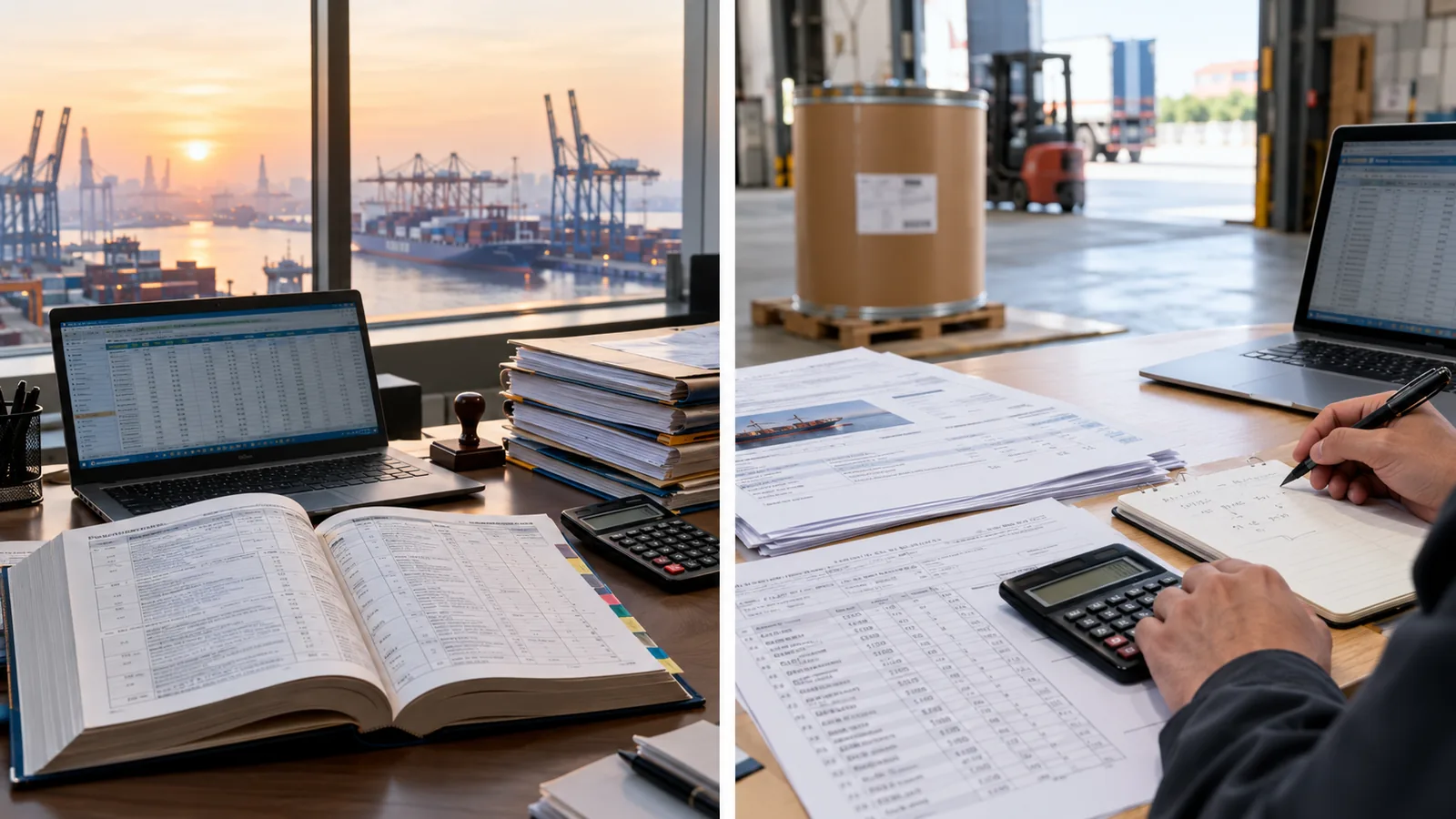
A defensible landed cost line for a PS shipment contains eight elements:
- Product cost at the agreed incoterm (EXW, FOB, CIF or DAP as quoted).
- Ocean or air freight to the destination port or airport.
- Insurance, if not included in the freight term.
- Duty: MFN rate plus any origin-based additional measures, on the customs value.
- Entry fees: MPF and HMF in the US; broker and storage fees in the EU.
- Import VAT (EU) — shown separately as recoverable, but still cash flow.
- Destination charges: terminal handling, drayage, customs brokerage line items, ISF or ICS2-related filing fees where applicable.
- Inland freight to your or your 3PL's warehouse.
Express duty as a percentage line and fees in absolute dollars or euros, because caps make fee percentages misleading on small entries. Model at your real shipment size: a single 500 kg air shipment and a 10-pallet ocean consolidation land at very different per-kilogram costs, and the ranking of two supplier quotes can flip once freight and fees are included.
Validating the Numbers Before You Book
Before the first PO with a new supplier or lane:
- Have the broker confirm classification and duty treatment in writing for your exact specification and declared origin.
- Ask the supplier for an origin declaration and check it against the manufacturing process you audited.
- Run the landed cost model on the quote, not on memory — request a broker's estimated entry summary for a representative shipment value.
- Re-verify tariff measures at each order. Additional-duty lists and rates have changed multiple times in recent years; last quarter's number is not evidence.
- Reconcile the first entry summary against the model after the first shipment closes and correct the template.
자주 묻는 질문
Q: What is the duty rate for phosphatidylserine in the US?
A: Pure phosphoaminolipids are commonly classified in HTS 2923.20 with a free MFN rate, but goods of Chinese origin may carry additional Section 301-type duties that change with policy. Confirm the current rate for your declared origin with your customs broker per shipment.
Q: Does EU import VAT apply to bulk phosphatidylserine?
A: Yes, at the member state's standard rate on customs value plus duty plus transport, typically 19–27%. Registered B2B importers generally recover it as input VAT, and deferred payment schemes in several member states can avoid the cash outlay.
Q: Does country of origin mean where the raw materials grew?
A: No. For PS, origin is where the material was manufactured — the enzymatic conversion, purification and drying. Routing through a third country for storage or relabelling does not change origin.
Q: What fees apply besides duty on a US entry?
A: The Merchandise Processing Fee (0.3464%, with annual min/max caps) on formal entries, Harbor Maintenance Fee (0.125%) on ocean freight, customs bond costs, and broker and FDA-related entry handling charges.
Q: How do I calculate landed cost for bulk PS?
A: Product cost at the quoted incoterm, plus freight and insurance, plus duty and origin-based additional measures, plus entry fees, plus destination charges and inland freight — with EU import VAT shown separately as a recoverable cash flow line.
결론
The quoted price of phosphatidylserine is not the paid price. Classification, origin, entry fees and import VAT decide the difference, and two of those — classification of blends and origin-based additional duties — move with trade policy and your own specification decisions.
The buyers who land PS predictably cheapest are not the ones who negotiate hardest on FOB; they are the ones whose landed cost model is checked by a broker before booking and reconciled after the first entry. Build the spreadsheet once, re-verify the tariff inputs every order, and the border stops being a surprise line item.
출처
- U.S. International Trade Commission — Harmonized Tariff Schedule of the United States (HTS), heading 2923: https://hts.usitc.gov/
- U.S. Customs and Border Protection — Merchandise Processing Fee and Harbor Maintenance Fee (Fees, 19 CFR 24): https://www.cbp.gov/document/guidance/information-notices-fees
- U.S. Customs and Border Protection — Section 301 trade remedies and country of origin: https://www.cbp.gov/trade/remedies/301-certain-products-china
- European Commission — TARIC database, Combined Nomenclature and duty rates: https://ec.europa.eu/taxation_customs/dds2/taric/taric_consultation.jsp
- European Commission — Regulation (EU) No 952/2013, Union Customs Code: https://eur-lex.europa.eu/legal-content/EN/TXT/?uri=CELEX%3A32013R0952
추천 다음 단계
- 검토 포스파티딜세린 제품 페이지.
- 비교 두두 PS 그리고 선바라기 PS.
- 체크 제조 증명 그리고 품질 및 연구개발.