
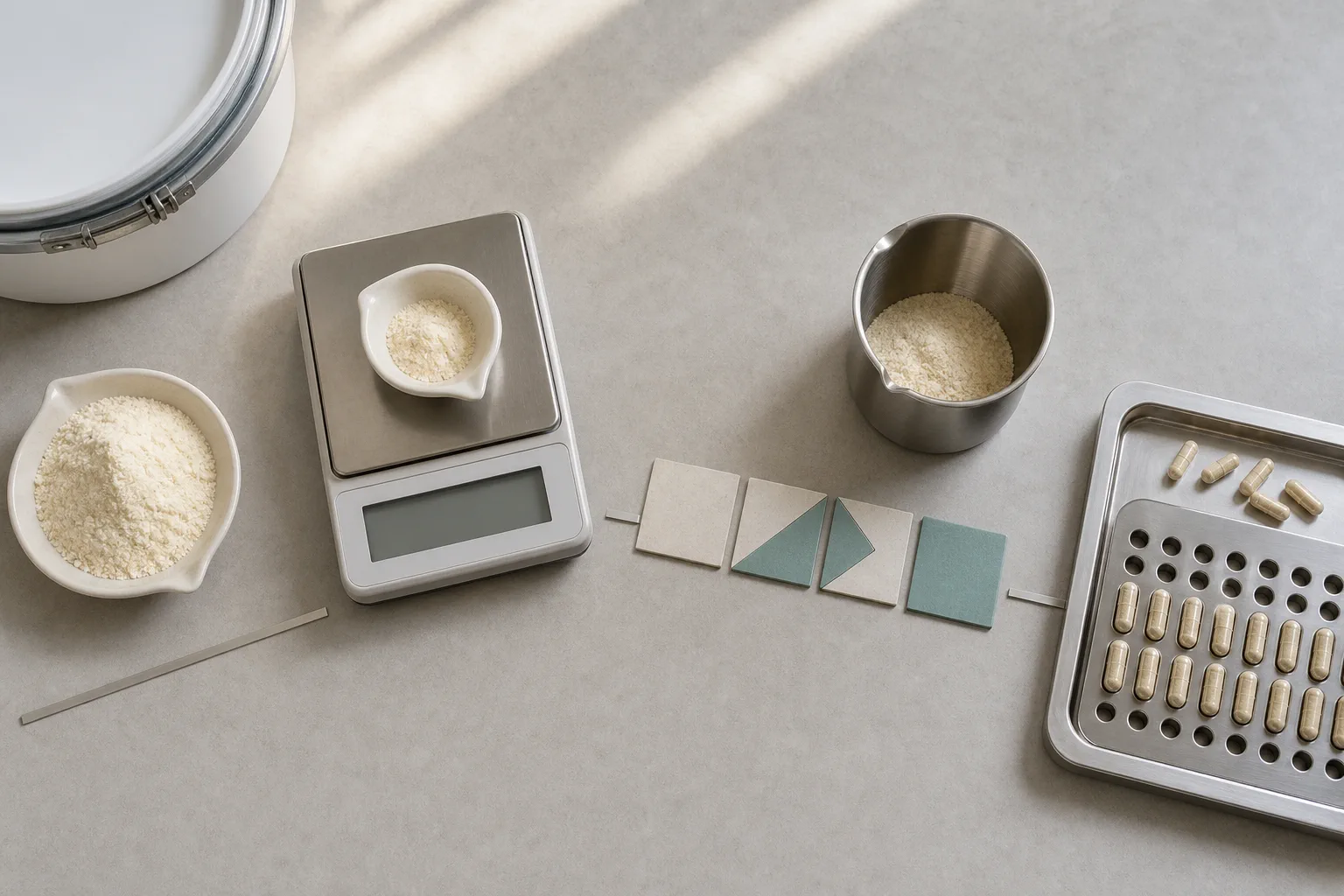
Una fórmula de suplemento de fosfatidilserina puede parecer completa sin dejar de confundir dos cantidades diferentes: el peso del polvo del ingrediente suministrado y la cantidad de fosfatidilserina que aporta ese polvo. En un proyecto de fabricación europeo, esa confusión puede extenderse desde la especificación de compra hasta la hoja de lote, la etiqueta, el fabricante contratado, la solicitud de laboratorio y la liberación del producto terminado.
La respuesta directa es: Calcula la entrada teórica de ingredientes dividiendo la cantidad objetivo total de fosfatidilserina en el lote por la fracción acordada del ensayo del material suministrado exactamente. Luego se trata la pérdida de procesos, la variación analítica, el control del peso de relleno y cualquier ajuste justificado como decisiones separadas y documentadas. No sustituyas un peso genérico de "polvo PS", un resultado de COA de muestra de otra vía, ni una tabla de tolerancia de vitaminas y minerales para un cálculo y validación específico del producto.
Esta guía conecta Fosfatidilserina, fuente de PS de soja y PS de girasol con registros europeos de formulación de suplementos. No recomienda una dosis al consumidor, ni prescribe un exceso ni reemplaza la revisión del mercado objetivo.
La respuesta corta
Construye el cálculo a partir de cinco entradas controladas:
- la cantidad prevista de PS por porción diaria o unidad terminada
- el número planificado de unidades o porciones vendibles
- El producto y la ruta exacta del proveedor
- El valor del ensayo y la base de declaración autorizados por el procedimiento del fabricante
- factores aprobados por separado para muestreo, procesamiento, rendimiento y liberación
En su forma más simple:
Masa teórica de los ingredientes de PS = masa total objetivo de PS dividida por la fracción de ensayo de ingredientes
Si un ingrediente tiene un 20% de PS, la fracción del ensayo es 0,20. Los compradores deben evaluar el ingrediente completo y la matriz en lugar de tratar el resto como un relleno intercambiable.
Por qué el peso en polvo y la cantidad de PS no son lo mismo
El ensayo es el puente entre las dos cantidades
Una RFQ podría solicitar "100 kg de fosfatidilserina", mientras que una formulación podría requerir "100 mg PS por cápsula". Esas frases no establecen si el primer número significa 100 kg de polvo de ingredientes comerciales o 100 kg de equivalente activo de PS. Los documentos comerciales y técnicos deben utilizar términos inequívocos.
Una descripción de compra debe identificar el ingrediente, origen, código de producto, base de ensayo, envase y cantidad comercial. La formulación debe indicar por separado la contribución requerida de PS y la entrada calculada. Diferentes grados de ensayo requieren distintos pesos y pueden cambiar el espacio de las formas de dosificación y el comportamiento de procesamiento.
La fuente y la matriz deben permanecer unidas al número
No separes un resultado del ensayo del producto que describe. Las rutas de soja y girasol requieren revisión específica de la fuente, y el mismo ensayo principal no establece composición, propiedades físicas, documentos o adecuación de aplicación idénticas.
Por tanto, el registro de cálculo debe llevar una línea de identidad rastreable:
La entidad legal del proveedor → ruta fuente → código de producto → revisión de especificaciones → recibieron el lote → COA → fórmula de lote → lote terminado
Si algún elemento cambia, decide si es necesario recalcular, realizar trabajo de piloto, revisar la etiqueta o recalificar. El Guía europea de cambio de fuentes explica por qué cambiar de soja a girasol PS es más que una simple sustitución de nombre.
El cálculo del núcleo
Utiliza unidades de masa consistentes a lo largo de la ecuación.
- PS objetivo por unidad × Unidades planificadas = PS teórica total requerida.
- PS teórica total requerida ÷ Fracción de ensayo autorizada = ingrediente comercial teórico requerido.
- Convierta el resultado en la unidad utilizada por la escala por lotes y el registro de compras.
Un cálculo ilustrativo sencillo
Supongamos que un lote de desarrollo está diseñado para contener 100 mg de PS por cápsula y producir 10.000 cápsulas. El requisito teórico de PS es:
100 mg × 10.000 = 1.000.000 mg = 1 kg PS
Si el ingrediente comercial exacto está autorizado en la fórmula con una fracción de ensayo del 20%:
1 kg ÷ 0,20 = 5 kg de ingrediente comercial
Este ejemplo solo demuestra el balance de masa. No es una cantidad recomendada de ración, ni un resultado de lote de Nutranexa, ni un rendimiento garantizado, ni permiso para aplicar un valor del 20% a un producto no especificado. La hoja de cálculo real debe usar el valor controlado y la base aprobada para el material exacto citado.
Antes de escalar, haz una comprobación inversa:
Entrada de ingredientes comerciales × fracción del ensayo ÷ unidades planificadas = PS teórico por unidad
El resultado inverso debe volver al objetivo previsto antes de cualquier ajuste de proceso por separado. Verifica de forma independiente las conversiones de unidades, la colocación decimal y la versión de la fórmula.
No mezcles silenciosamente valores tal cual y de base seca
Un ensayo puede expresarse tal cual, en seca u otra base definida. Por tanto, la humedad puede influir en la interpretación, pero un comprador no debería "corregir" automáticamente un resultado de un proveedor sin conocer el método de especificación y la convención de cálculo.
Registra la base exactamente como se indicó. Si los resultados del proveedor, del producto entrante y del producto terminado utilizan bases diferentes, el laboratorio y el responsable de la calidad definan la regla de conversión y comparabilidad. Conservar el resultado original, la conversión aprobada, la fórmula y el revisor.
Un flujo de trabajo de siete pasos de ensayos a lotes
Congelar el objetivo del producto terminado
Los equipos regulatorios, de marca y de formulación deberían acordar primero qué declarará la etiqueta final, cómo se define la porción diaria, cuántas unidades producen esa parte y en qué mercados europeos se venderá el producto.
La Directiva 2002/46/CE exige que la cantidad de nutrientes u otras sustancias con efecto nutricional o fisiológico se declare numéricamente y por ración recomendada para su consumo diario. También establece que los valores declarados son valores medios basados en el análisis del producto realizado por el fabricante. Eso hace que el objetivo de etiquetas comerciales y el plan analítico formen parte del mismo problema de control.
Comienza con un concepto de producto aprobado y una revisión de mercado, no con un ensayo de proveedor usado para descifrar un número de etiqueta conveniente.
Bloquea la ruta exacta de ingredientes y la especificación controlada
Recopila la especificación actual, la evidencia disponible del COA, la información de origen y composición, detalles del embalaje y el contacto para el control de cambios. Confirma que el presupuesto, la muestra, la fórmula y la orden de compra describen el mismo material.
La especificación define los requisitos esperados; un COA informa de un lote concreto. Revisa la identidad, campos de calidad relevantes, métodos, unidades, límites y estado de la versión en conjunto utilizando el Guía de especificaciones de PS y Guía de revisión de COA.
Define qué valor de ensayo utiliza la fórmula maestra
En el archivo pueden aparecer tres números:
- una categoría nominal o comercializada
- un límite o rango de especificación
- un resultado medido de lote en el COA
No son automáticamente intercambiables. El procedimiento autorizado por el fabricante debe definir si la fórmula maestra utiliza una potencia estándar fija, un ajuste específico por lote, un valor de diseño conservador u otro enfoque validado. También debe definir cuándo un nuevo resultado desencadena el recálculo y quién aprueba el cambio.
Utilizar cada resultado de COA puede crear cambios en las fórmulas no revisadas; Usar solo un mínimo de especificación crea un problema de control diferente. Documenta la norma legal, la justificación y la relación con la aceptación del producto terminado.
Calcular la entrada teórica de ingredientes
Registrar los identificadores de fórmula y lote, objetivo y unidades, porción diaria, cantidad planificada, ensayo y base autorizados, masa calculada, capacidad de redondeo y escala, y comprobación independiente.
Mantener la máxima precisión y redondear solo bajo el procedimiento aprobado y la capacidad de pesaje. Conserva los valores sin redondear y emitidos.
Mantén el ajuste de potencia separado del ajuste del proceso
La división de ensayos normaliza la potencia de los ingredientes. No prueba lo que ocurre durante la dispensación, el tamizado, la transferencia, la mezcla, la encapsulación, la compresión o el envasado.
Cualquier aporte adicional destinado a abordar la pérdida o estabilidad de fabricación debe tener un nombre separado, justificación, base de evidencia, factor aprobado y límite superior. No ocultes ese ajuste cambiando la célula de ensayo. No inventes un porcentaje genérico a partir de otro ingrediente o producto. Un factor justificado debe provenir de la evidencia relevante en desarrollo, ampliación, estabilidad y análisis y debe mantenerse compatible con la seguridad, la precisión de las etiquetas, las afirmaciones y los requisitos nacionales.
Confirma la fórmula mediante pruebas piloto y producto terminado
La entrada calculada debe funcionar en la forma dosificativa real. Evaluar la capacidad de llenado, el comportamiento de la mezcla, el riesgo de segregación, la variación de peso, el rendimiento del proceso y el muestreo representativo del producto terminado bajo el equipo y la secuencia previstos.
El sitio Guía piloto de fluidez y uniformidad de mezcla PS cubre el manejo físico. Para el control analítico, defina un método adecuado para la matriz y la decisión. El Reglamento (UE) 2017/625 exige que los métodos utilizados en los controles oficiales sigan las normas aplicables de la Unión o enfoques adecuados reconocidos y validados, y establece que las muestras deben tomarse, manipularse y etiquetarse para preservar su validez legal, científica y técnica. Un fabricante comercial también debería ser capaz de explicar la idoneidad del método, el muestreo, las unidades, la incertidumbre y la interpretación del resultado.
Define la ubicación de muestreo, el recuento de unidades, la agrupación, la parte de prueba, las reglas de repetición y los disparadores de investigación antes del lanzamiento comercial.
Reconciliar y lanzar el lote comercial
Conciliar el lote de ingredientes y la cantidad emitida, las devoluciones, las unidades reales y el rendimiento, las comprobaciones en proceso, el muestreo y el análisis terminados, las desviaciones, la versión de la etiqueta, el mercado y el lanzamiento final.
Compara la producción real con la fórmula autorizada. No conviertas una diferencia de rendimiento en una suposición de potencia. Retener e investigar cuando los resultados o la conciliación no respalden la cantidad declarada.
Hoja de trabajo de revisión de ensayo a lote
| Campo controlado | Pregunta por cerrar | Señal de retener o escalar |
|---|---|---|
| Objetivo terminado | ¿Qué cantidad de PS se declara por ración diaria recomendada y por unidad? | El resumen de marca, la fórmula y la etiqueta usan cantidades diferentes |
| Identidad del ingrediente | ¿Qué fuente, código de producto, revisión de especificaciones y entidad proveedor se aplican? | Polvo genérico "PS" o discrepancia de fuentes |
| Valor del ensayo | ¿Qué valor nominal, específico o de lote está autorizado, en base a qué? | Número copiado de un COA de muestra no relacionado |
| Fórmula | ¿Son reproducibles las unidades, la conversión de fracciones, el resultado de máxima precisión y el redondeo? | Número manual sin ecuación o comprobación visible |
| Factor de proceso | ¿Hay algún ajuste adicional separado, justificado, acotado y aprobado? | Porcentaje de excedentes oculto o genérico |
| Escala y dispensación | ¿Puede la báscula seleccionada emitir con precisión la cantidad calculada? | El redondeo supera la capacidad del proceso |
| Pruebas finalizadas | ¿Son adecuados el muestreo y el método para la forma dosificada y la elección? | Una línea inexplicada de aprobado/suspenso |
| Reconciliación | ¿Se alinean los ingredientes, el rendimiento, las unidades, los resultados y la versión de la etiqueta? | Pérdida no resuelta, franquía o desajuste de versión |
¿Necesitas la ruta exacta de PS antes de calcular?
Nutranexa puede confirmar la especificación específica de ruta disponible y la evidencia de COA para un presupuesto, junto con la línea base de compra PS de un MOQ de 25 kg y 25 kg netos por tambor. Uso Contactar con Ventas Identificar la ruta de soja o girasol, la categoría objetivo, la forma de dosificación prevista, el mercado de destino y la solicitud de documentos. Tu fabricante debería entonces autorizar el valor de la fórmula, el plan piloto, el método analítico y los criterios de liberación para el producto final.
Etiquetas y Límites de Control Europeos
La Directiva 2002/46/CE vincula la cantidad declarada con la parte diaria recomendada y el análisis del fabricante. El Reglamento (UE) nº 1169/2011 prohíbe información engañosa, ordena los ingredientes por peso utilizado y puede exigir declaraciones cuantitativas de ingredientes cuando un ingrediente es nombrado, enfatizado o caracterizado.
La guía de tolerancia de la Comisión proporciona tablas específicas de suplementos alimentarios para vitaminas y minerales. No los copies como tolerancia universal de PS. La fosfatidilserina es una "otra sustancia" en este contexto, que requiere una revisión específica de producto y mercado.
Otras sustancias no están completamente armonizadas de la misma manera en toda la UE, y los Estados miembros pueden requerir la notificación de productos. Confirma las normas nacionales de composición, notificación, idioma y etiqueta.
Si PS se destaca mediante una reclamación, el Reglamento (CE) nº 1924/2006 añade condiciones separadas. El cálculo no demuestra que la redacción esté autorizada; Usa el Guía europea de reclamaciones sanitarias de PS.
Lista de Transferencia de Adquisición a Producción
- Prepara y compra la orden, nombra el ingrediente comercial exacto y la fuente.
- La revisión actual de la especificación se aprueba antes de que se emita la fórmula maestra.
- COA, lote de ingredientes, etiquetas de tambor recibidas y coincidencia interna de códigos de materiales.
- La fórmula indica el objetivo de PS y la entrada de ingredientes comerciales como campos diferentes.
- Se autorizan el valor del ensayo, la base de reporte y la regla de selección.
- El cálculo preserva las unidades y muestra una comprobación independiente.
- Cualquier ajuste de proceso o estabilidad es independiente de la normalización de la potencia.
- El trabajo piloto cubre la forma dosificada real, el equipo y la secuencia.
- El muestreo y el método de prueba del producto terminado se definen antes del lanzamiento.
- La etiqueta, la fórmula y la solicitud de laboratorio utilizan la misma ración diaria y las mismas unidades.
Para la producción externalizada, incluye estos campos en el Traspaso contrato-fabricante en lugar de enviar un número de ensayo independiente por correo electrónico.
Errores comunes en cálculos y revisiones
- Tratar el peso comercial de los ingredientes como peso puro de PS.
- Escribir "20" en una fórmula que espera la fracción "0,20."
- Mezclando miligramos, gramos y kilogramos sin una conversión visible.
- Utilizar un COA de una fuente, código de producto o muestra histórica diferente.
- Aplicar una corrección de base seca a un resultado tal cual, o al revés.
- Cambiar la fórmula por lotes para cada COA sin un procedimiento autorizado de ajuste de potencia.
- Ocultando la pérdida de proceso o el ajuste de estabilidad dentro del valor del ensayo.
- Copiando los rangos europeos de tolerancia a vitaminas y minerales a PS.
- Lanzar un lote cuando la conciliación, las pruebas terminadas y la versión de etiqueta no coinciden.
Cómo encajan los datos verificados de Nutranexa en el flujo de trabajo
Nutranexa fue fundada en 2013 y opera un campus de 110.000+ m2. Su principal enfoque exportador incluye Europa y Norteamérica. El sitio web presenta rutas PS generales, de origen soja y de girasol, especificaciones disponibles y pruebas de COA, imágenes de fábricas, envases y despachos, y cooperación en investigación y desarrollo.
Estos datos apoyan la identidad del proveedor, la selección de rutas, los documentos y la planificación del embalaje. El comprador y el fabricante siguen siendo propietarios de la fórmula, el piloto, el plan analítico, la etiqueta y la decisión de lanzamiento.
Fuentes
- Directiva 2002/46/CE sobre suplementos alimentarios — texto consolidado
- Reglamento (UE) nº 1169/2011 sobre información alimentaria para consumidores
- Directrices de la Comisión Europea sobre tolerancias a los valores nutritivos declarados en las etiquetas
- Comisión Europea: suplementos y sustancias alimentarias distintas de vitaminas y minerales
- Reglamento (UE) 2017/625, Artículo 34 sobre muestreo y métodos de laboratorio
- Reglamento (CE) nº 1924/2006 sobre afirmaciones sobre nutrición y salud
Preguntas frecuentes
¿Cómo calculo la cantidad de polvo de ingredientes PS necesario para un lote?
Multiplica la cantidad prevista de PS por unidad por el número planificado de unidades, mantén la consistencia de las unidades de masa y divide la masa total objetivo de PS por la fracción autorizada del ensayo del ingrediente exacto. Por ejemplo, el 20% se introduce como 0,20. El resultado es la introducción teórica de los ingredientes comerciales antes de cualquier ajuste de proceso justificado y aprobado por separado.
¿Debe el cálculo usar el mínimo de especificación o el resultado actual del COA del lote?
No existe una elección universal. El procedimiento controlado del fabricante debe definir si la fórmula maestra utiliza una potencia estándar, un resultado específico por lote, un valor de diseño conservador u otra regla validada. La decisión debe coincidir con la base del ensayo, el proceso de control de cambios, la evidencia del producto terminado y el objetivo de etiqueta. No cambies los valores informalmente de un lote a otro.
¿Puedo usar la tabla europea de tolerancia a vitaminas y minerales para la fosfatidilserina?
No como tolerancia universal a PS. La guía de la Comisión establece tolerancias específicas a suplementos alimentarios para vitaminas y minerales. La PS es otra sustancia, por lo que el fabricante debe obtener asesoramiento regulatorio específico para el mercado y definir una especificación adecuada para el producto, un método analítico, un tratamiento de incertidumbre, un objetivo de etiqueta y una norma de liberación.
¿Demuestra el cálculo de entrada que las cápsulas terminadas contienen la cantidad declarada de PS?
No. Establece un balance de masas teórico. La dispensación, transferencia, mezcla, variación de relleno, muestreo, rendimiento del método analítico, rendimiento y estabilidad pueden afectar la evidencia disponible en el momento de la liberación y a lo largo de la vida útil. Siguen siendo necesarios trabajos piloto, controles en proceso, pruebas representativas de productos terminados y conciliación por lotes.
¿Qué debería enviar a un fabricante contratado con la especificación PS?
Envía la ruta exacta del proveedor y la fuente, código de producto, revisión controlada de especificaciones, COA disponible del lote, valor y base autorizados del ensayo, cantidad objetivo por unidad y porción diaria, tamaño del lote, regla de cálculo, política de ajuste, plan de muestreo y prueba, versión de la etiqueta, requisitos de embalaje y contactos de control de cambios.
Conclusión
Un lote defendible de fosfatidilserina comienza manteniendo tres registros distintos: la cantidad de PS prometida para el producto terminado, el ensayo del ingrediente comercial exacto y el ingrediente físico en masa entregado a producción. Conectarlos con una ecuación reproducible, luego mantener visibles los ajustes de proceso, el muestreo, la incertidumbre analítica, el rendimiento y la evidencia de liberación en lugar de ocultarlos en un solo porcentaje.
Para proyectos europeos, el cálculo también debe estar relacionado con la parte diaria recomendada, el análisis del fabricante, la presentación de la etiqueta, los requisitos de los Estados miembros y cualquier revisión separada de reclamaciones. Cuando la identidad, la base, la versión de la fórmula o la evidencia terminada no coinciden, se mantiene la decisión del lote y resuelve la cadena de registros.
Contactar con Ventas
¿Planeando una fórmula europea de suplementos? Contacta con Nutranexa Sales con el mercado de destino, preferencia por soja o girasol, grado objetivo, forma de dosificación, cantidad prevista y especificaciones solicitadas o evidencia de COA. Nutranexa puede confirmar la vía PS disponible, el MOQ de 25 kg, la línea base de tambor de 25 kg y la información de fabricación de apoyo para tu calificación y entrega de formulación.
Próximos pasos recomendados
- Revisa el Phosphatidylserine página del producto.
- Comparar Soy PS y Sunflower PS.
- Verificar prueba de fabricación y Calidad e I+D.
Comuníquese con ventas para obtener documentos de productos
Comparta preferencia de fuente, aplicación, país y cantidad anual.
Contactar con Ventas