
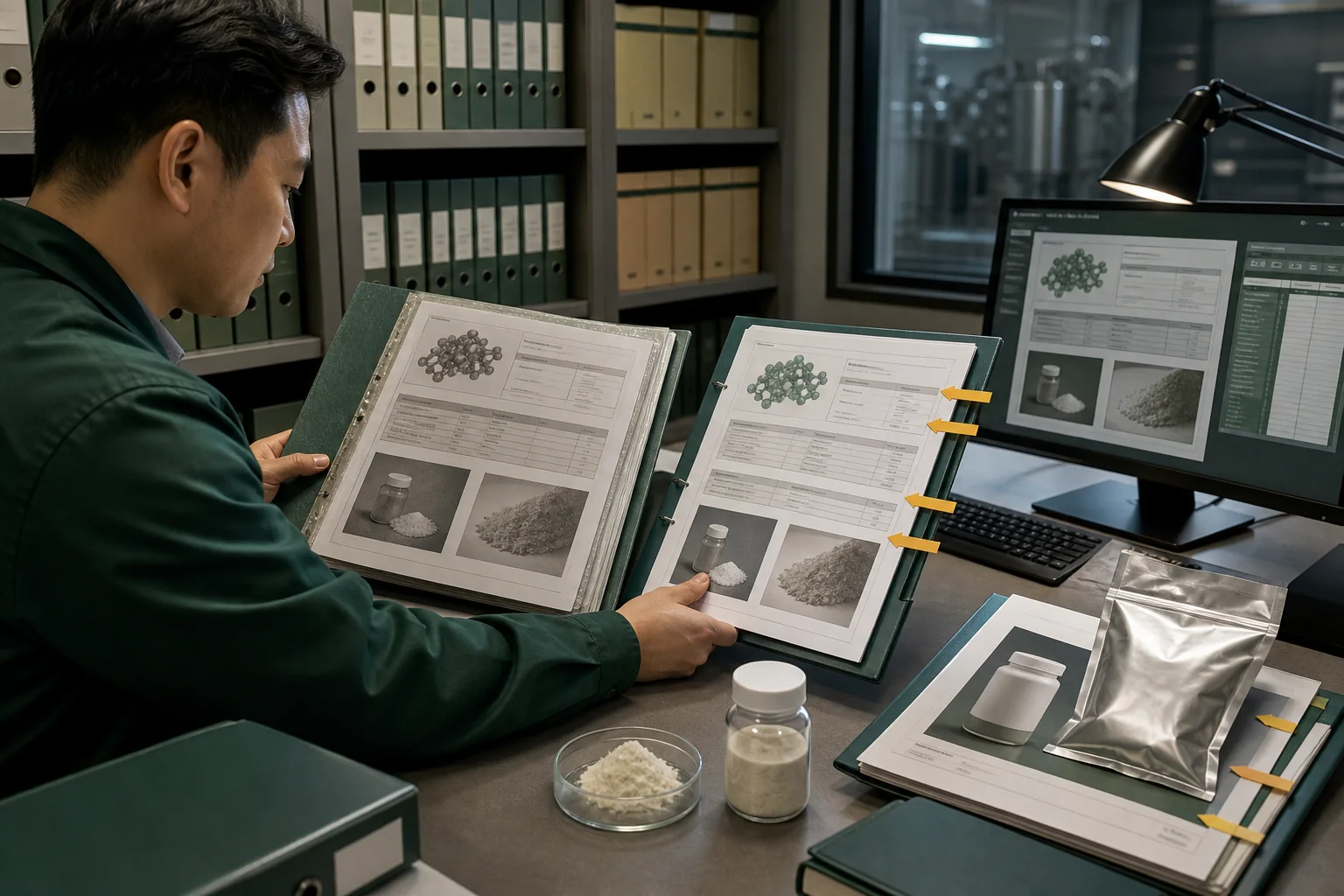
The first phosphatidylserine order usually gets the most attention. Procurement requests the specification. QA checks the COA format. Regulatory asks for certificates. Operations asks about packaging and timing. Everyone is alert because the supplier relationship is new. But once the first order is complete, many companies relax their controls and assume the next order can move faster with less review.
That assumption causes avoidable problems. Repeat ingredient orders can still be delayed by a changed product model, a new source preference, an expired certificate, a revised specification sheet, a new batch COA with a different reporting format, or shipment documents that no longer match the buyer's broker or warehouse requirements. The supplier may still be acceptable. The product may still be acceptable. But the document workflow may no longer be clean.
This is why phosphatidylserine repeat-order document review deserves a separate procurement framework. A repeat order is not only a price and quantity decision. It is a change-control event. Buyers need to confirm whether the exact commercial item, its supporting documents, and the release workflow still match what was previously approved internally.
For overseas supplement brands, contract manufacturers, distributors, and functional food importers, this is especially important because the purchase decision often sits across several teams: sourcing, QA, regulatory, planning, finance, and logistics. If one team assumes "same as last time" while another team sees a document change too late, the shipment can stall.
Where relevant, this article uses verified Nutranexa facts from the current website only. Nutranexa identifies itself as the international brand of Shandong Baianrui Biopharmaceutical Co., Ltd., founded in 2013, with a 110,000+ m2 campus in Yanggu County, Shandong. Its public site also shows factory, cleanroom, lab, and equipment imagery; R&D cooperation references with East China University of Science and Technology; sample COA visibility for PS 20% sunflower model PP201 and PS 50% model PP501; and public document references including business license, food production license, food additive license details, FDA food facility registration, Halal, and Kosher files. Buyers should still request current, transaction-specific documents before quotation, PO release, or shipment.
Why Repeat Orders Still Create Procurement Risk
Repeat orders feel safer because the supplier has already passed the first screening round. That comfort is useful, but it can hide real operational drift. A phosphatidylserine reorder can fail for reasons that did not exist on the first PO:
- the brand team may now require sunflower-source positioning instead of soy-source acceptance
- the contract manufacturer may have updated its vendor onboarding checklist
- the destination market may now require different supporting files
- the warehouse may want revised pack labeling or pallet information
- the QA team may expect the latest current-batch COA rather than an old sample pack
These are not theoretical problems. They happen because repeat orders sit in a different business context from first orders. The buyer might be scaling up. A new customer may be involved. The material may be shipping to a different country. The previous documentation may still be useful, but it is no longer sufficient evidence on its own.
The right mindset is simple: a repeat order should be easier than a first order, but not automatic. Buyers should preserve the speed advantage of an existing supplier relationship while still checking for changes that affect product identity, document validity, and shipment release.
What Should Trigger a Fresh Document Review Before Reordering
Not every reorder needs a full supplier requalification. But every reorder should trigger a structured document checkpoint. The question is how deep that review needs to be.
Product source or model changes
If the product source changes, the review must restart at the product level. For phosphatidylserine, this matters immediately when a buyer moves between soy phosphatidylserine and sunflower phosphatidylserine, or when the project changes from one commercial grade to another. A team that approved one source or model cannot assume approval for another source or model without checking the supporting documents again.
Nutranexa's public site already separates general PS, soy PS, and sunflower PS buyer paths, and its COA sample visibility references different product models including PP201 and PP501. That is enough reason for buyers to write the quoted source and model explicitly into their internal review sheet rather than using a generic "PS powder" label.
Batch timing and document validity windows
Certificates, registrations, and batch documents do not all operate on the same timeline. A business license may stay stable while a current batch COA changes every production lot. A certificate may remain valid in principle but still need scope confirmation for the exact product being purchased. A facility registration file may cover a date range that needs to be current when the order ships.
The repeat-order mistake is using "we have it on file" as the only control. The better control is "we have the current version, and we checked that it still applies to this order."
Destination-market or customer requirement changes
Sometimes the supplier has not changed at all. The buyer has. A new distributor, private-label client, co-manufacturer, or import broker may ask for a different file set or a different document naming standard. That alone is enough to reopen the document pack.
For example, a US-focused supplement buyer may treat one document set as sufficient, while a European importer or a contract manufacturer serving multiple customer accounts may request extra confirmations around source, allergen, packaging, or certificate scope. The repeat-order review should therefore compare the order context, not only the supplier folder.
The 8-Point Repeat-Order Change Control Checklist
The most effective process is not a giant audit. It is a short and disciplined checklist that procurement and QA can both use. Below is a practical repeat-order framework for phosphatidylserine purchases.
1. Confirm the quoted item is the same item internally approved
Start with the simplest question because it prevents the most downstream confusion: is the quoted item exactly the one your team thinks it is?
Check:
- product name
- source designation
- model or grade
- target assay range where relevant
- intended application
- destination market
If even one of those elements changes, treat the reorder as a controlled variation rather than a routine repeat. Many document mistakes begin because procurement is discussing one grade while QA's last approval file relates to another.
2. Compare the current specification against the previously approved version
A specification should not be archived and forgotten after the first order. On repeat business, compare the current specification line by line against the last internally approved version.
Review:
- product identity wording
- assay or content presentation
- test items and methods
- microbiology line items
- heavy metal presentation
- storage or shelf-life wording
- packaging references
- revision dates or document version markers
The goal is not to reject every difference. The goal is to detect differences early, record them, and route them to the right internal owner before the PO is locked.
3. Review the COA as a batch document, not a marketing sample
This is one of the most common repeat-order failures. Teams rely on the first COA sample they received months ago and forget that the real shipment decision depends on the current batch documentation.
A sample COA is useful for understanding the supplier's reporting style and typical test items. It is not a substitute for the batch-linked COA tied to the actual order. Buyers should confirm:
- batch or lot number
- manufacture, test, and report dates
- product model
- key analytical items
- pass/fail interpretation
- consistency with the current specification
Nutranexa's public Quality & R&D page is useful here because it openly shows sample COA structures for PP201 and PP501, including assay, moisture, peroxide value, acetone insoluble, heavy metals, microbiology, and Salmonella fields. That gives buyers an evidence-based starting point for document expectations. But the same page also makes the correct procurement point: sample COA data is batch-specific, and the current batch COA should be confirmed before quotation or shipment.
4. Recheck certificate scope, validity, and product applicability
A certificate file is only valuable when it is both current and applicable. Buyers should not stop at "certificate received." They should confirm:
- validity period
- document owner or issuing body
- named company identity
- exact product applicability or scope statement
- whether the certificate is relevant to the destination market or customer request
Nutranexa's current public materials reference business license, food production license, food additive license details, FDA food facility registration, Halal, and Kosher files. Those are meaningful trust signals, but buyers still need to verify which file applies to which purchase scenario. A reorder review should therefore document not only that the file exists, but why it is being used for this order.
5. Confirm packaging and label details did not shift
Procurement teams sometimes treat packaging as a commercial footnote after the first order. That is risky. Packaging changes can affect receiving, sampling, storage, pallet handling, barcode capture, repacking, and internal release timing.
On repeat orders, confirm:
- pack size or unit count
- outer packaging style
- label language or field requirements
- pallet expectations if relevant
- storage wording
- whether reserve-sample handling changed
Nutranexa's public pages repeatedly note that current packaging details should be confirmed before quotation or purchase. Buyers should use that as a control principle. If packaging is not clearly restated on the repeat order, it has not been controlled well enough.
6. Align shipment documents with buyer and broker workflow
Even when product and QA documents are fine, import execution can still fail because the shipment document set is incomplete or inconsistent with the buyer's broker workflow. Repeat orders deserve a fresh logistics check covering:
- commercial invoice details
- packing list alignment
- consignee and notify party details
- document naming conventions
- pre-alert timing
- any destination-specific declarations handled outside the technical file pack
This is especially important when the material is not going to the same warehouse or when the buying entity changed after the first order. A reorder should confirm the receiving workflow, not assume it.
7. Record approved exceptions before PO or shipment release
Strong procurement teams do not chase perfect paperwork; they chase controlled decisions. If a document difference exists but is acceptable, record that acceptance explicitly. If a revised format is acceptable, record who approved it. If a file is pending but not critical for PO issue, record the due date and release condition.
Without that discipline, repeat orders become vulnerable to last-minute objections from QA, regulatory, or logistics because everyone assumed someone else had signed off.
8. Build a repeatable supplier scorecard for future cycles
The repeat-order review becomes much faster when buyers track supplier consistency across time. A short scorecard can record:
- whether current specifications matched previous versions
- whether batch COAs arrived on time
- whether certificate renewals were proactive
- whether packaging instructions were followed accurately
- whether shipment documents were clean on first submission
This turns supplier management into a measurable process instead of an email archive. It also makes supplier comparison more rigorous when a backup source is being evaluated.
How Nutranexa Facts Fit a Buyer Change-Control Workflow
Nutranexa's public site gives buyers a useful starting framework for repeat-order control because several facts are visible before direct inquiry:
- the company identity is presented as Nutranexa / Shandong Baianrui Biopharmaceutical Co., Ltd.
- the founding year shown publicly is 2013
- the manufacturing campus presented publicly is 110,000+ m2
- factory, cleanroom, lab, and equipment imagery are available for buyer review
- Quality & R&D content references cooperation with East China University of Science and Technology
- sample COA layouts for PS 20% sunflower model PP201 and PS 50% model PP501 are visible
- public document references include business license, food production license, food additive license details, FDA food facility registration, Halal, and Kosher materials
For a repeat-order buyer, these facts should not replace document control. They should support it. The practical use is to build a request list that asks Nutranexa for the current specification, the current batch COA, the certificate files relevant to the quoted product and destination market, and the packaging or storage details tied to the actual order. That keeps the conversation precise and prevents buyers from relying on generic historical files.
الأسئلة الشائعة
Do repeat phosphatidylserine orders need the same level of review as first orders?
Usually not the same depth, but they still need a controlled review. The goal is to confirm what changed, what stayed the same, and what remains valid for the current order.
What is the most important document for a repeat phosphatidylserine order?
There is rarely just one. Buyers usually need the current specification, the current batch COA, and any certificate or registration files relevant to the market and customer requirement. The key is that the documents match the exact product being reordered.
Can buyers rely on an old sample COA for repeat procurement approval?
No. A sample COA helps explain the reporting format, but repeat-order approval should use the current batch COA linked to the actual lot or shipment under review.
What changes should trigger escalation to QA or regulatory?
Any change in source, model, assay presentation, test method, certificate validity, packaging wording, or market-specific document expectation should be routed to the responsible internal reviewer before release.
How should buyers handle certificate files that exist publicly but may not match the transaction?
Use public files as preliminary trust signals only. Before PO issue or shipment release, ask for the current file set and confirm scope, validity dates, and applicability to the exact quoted product.
Conclusion
Repeat phosphatidylserine purchasing should be faster than first-order sourcing, but it should never run on autopilot. The best buyers treat each reorder as a small change-control event. They confirm the commercial item, compare the current specification, review the batch COA properly, recheck certificate scope and validity, and align packaging and shipment documents with the current receiving workflow.
That approach reduces avoidable delays without turning every purchase into a full requalification project. It also improves supplier accountability because changes are identified early, recorded clearly, and resolved before the order reaches the warehouse, customs broker, or contract manufacturer.
For teams buying PS repeatedly, document discipline is not bureaucracy. It is how repeat business stays reliable.
الخطوات التالية الموصى بها
- قم بمراجعة Phosphatidylserine صفحة المنتج.
- قارن Soy PS و Sunflower PS.
- يفحص إثبات التصنيع و الجودة والبحث والتطوير.
اتصل بالمبيعات للحصول على مستندات المنتج
مشاركة تفضيلات المصدر والتطبيق والبلد والكمية السنوية.
اتصل بالمبيعات