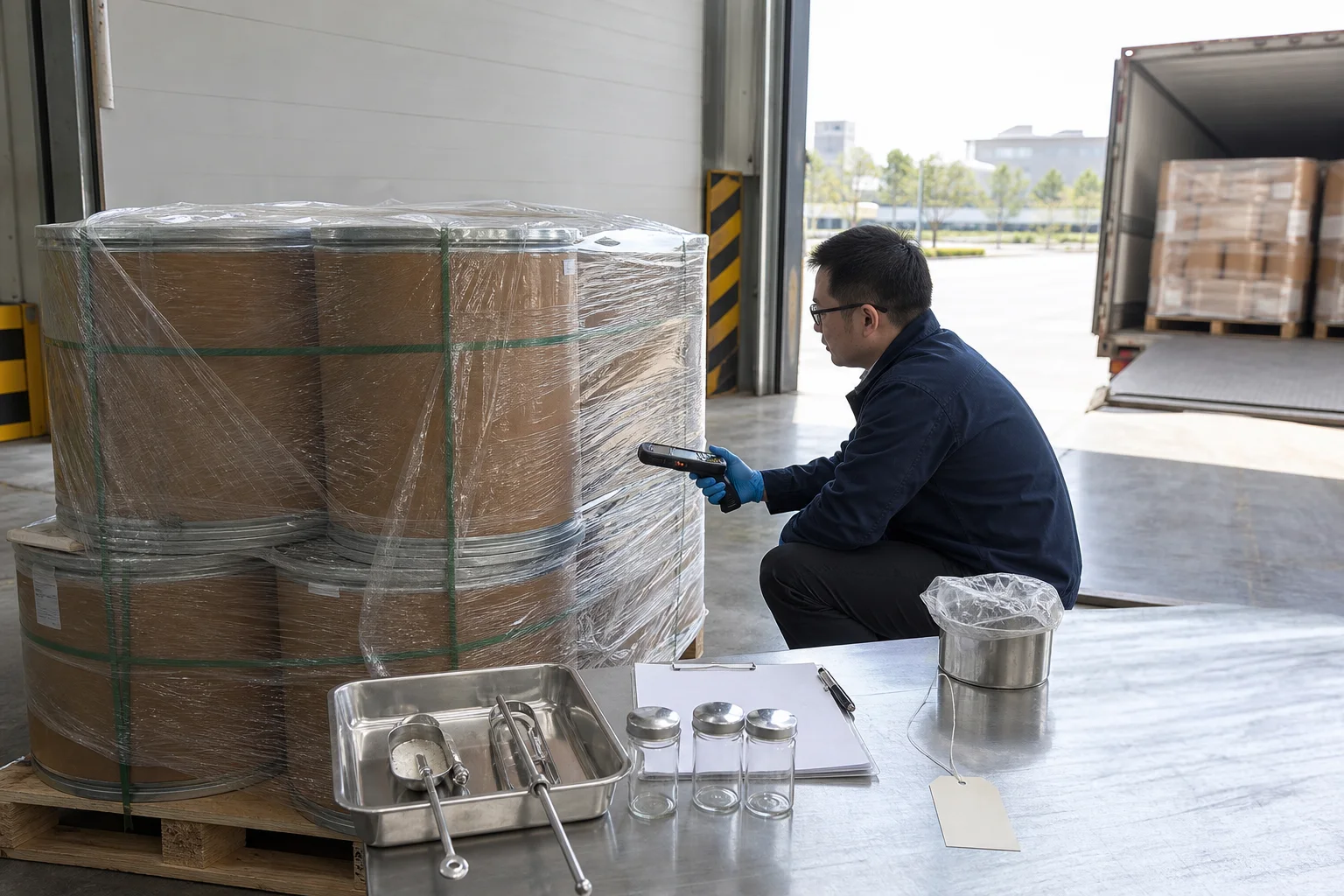
Receiving is the first physical control after a bulk PS shipment reaches the US warehouse. A useful sampling plan connects the sample to the lot and package, protects the material from contamination, defines the inspection and testing question, and keeps the shipment in quarantine until quality release. The plan should be written for the product and risk, not copied from a different powder with different packaging or hazard characteristics.
For US importers, warehouses, distributors, supplement manufacturers, and quality-control teams, whether the received PS lot is eligible for quality testing and release depends on evidence that is specific enough to the quoted material and practical enough for the team that will receive, formulate, release, or sell it. The buyer should separate three questions: what the law or customer requires, what the supplier controls, and what the importer or finished-product operator must decide. Keeping those questions separate prevents a generic statement from being treated as a product approval.
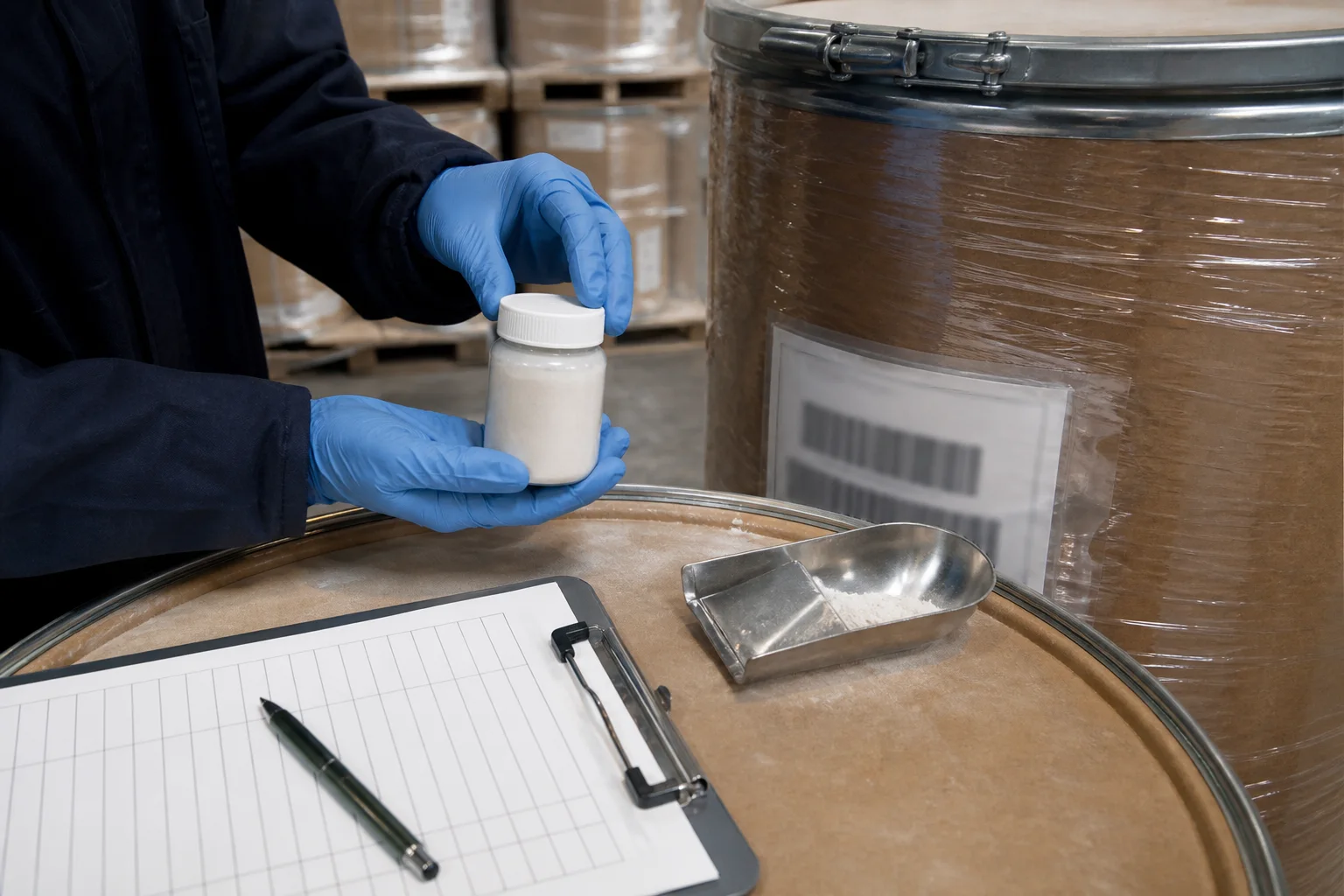
Direct answer: Place the shipment on hold or quarantine, verify the product and lot against the shipping file, inspect every package as required by the risk plan, define how many drums and increments represent the lot, use clean and suitable tools, create a composite or individual sample only when the approved method allows it, label and retain the sample, and document the quality release decision. Warehouse staff should not change the sample plan because a carrier is waiting.
Define the Review Before Requesting Evidence
Start with a written scope statement. Record the product name, soy or sunflower route, assay or grade as shown on the current controlled document, physical form, carrier or other declared components, manufacturing site, package, destination, and intended use. If any of these fields are unknown, the review is not yet about a defined PS lot. It is about an assumption, and assumptions should be visible before they enter a purchase order or customer file.
The scope also determines which evidence is relevant. Sampling procedure, lot and package map, receipt inspection, sample labels, chain of custody, test request, COA/specification, quarantine status, deviations, and release approval should be linked to the same product identity. A document from another grade, another source, or an earlier site may be useful background, but it should not silently become release evidence. Ask the supplier to identify the document owner, revision, effective date, and affected lots whenever the file is used for a commercial decision.
Why the Buyer Question Matters
The commercial risk is usually an evidence mismatch rather than a lack of paperwork. A buyer can have a specification, a COA, a transport record, and a supplier statement and still be unable to answer whether the received PS lot is eligible for quality testing and release because the records use different names or do not share a lot key. The review should therefore test the connections between documents, people, packages, and decisions, not count the number of attachments in an email.
The operational risk is also different from the legal risk. A rule may require a record, while the warehouse needs a label and the formulation team needs a grade-specific specification. Treating all three as one generic compliance request creates friction and encourages teams to copy old files. Use the buyer question as the organizing principle, then request only the evidence needed to reach a documented decision.
Evidence Review Table
| Review area | Evidence to request | Hold or clarify when |
|---|---|---|
| Quarantine | Physical or system status prevents unapproved use | Warehouse staff can pick the lot before quality release |
| Lot map | Drum, pallet, lot, package condition, and receipt quantity | Sample ID cannot be traced to a specific received lot |
| Sampling design | Risk-based selection, increments, composite rule, and tools | The operator samples one convenient drum without a rationale |
| Sample control | Clean container, label, seal, chain of custody, retain path | The sample is a loose bag with no lot or date |
| Disposition | Test review, deviation handling, and quality release | The receiving checklist is signed but no release decision exists |
A Practical Control Workflow
A practical control sequence for this topic is to receive and segregate the lot; verify labels and package condition; choose the approved sampling pattern; sample without contaminating the lot; seal and identify the sample; submit the test request; reconcile and release or hold the material. The sequence should identify a responsible person at each handoff. Procurement can define the commercial request, quality can define the evidence and release rule, regulatory can map the market requirement, and logistics can preserve the transport or package record. The same person may hold more than one role in a small organization, but the file should still show who made which decision.
Use a go, hold, or escalate logic. Go when the exact product is identified, the required evidence is current and lot-linked, and the responsible reviewer has approved the decision. Hold when a key field is missing, inconsistent, or unsupported. Escalate when the event may affect safety, regulatory status, customer release, or a wider set of lots. The logic should be agreed before an exception occurs, because pressure at the dock or production line is a poor time to invent a procedure.
When a supplier response is incomplete, write a focused question rather than asking for all compliance documents. Request the missing field, explain the decision it supports, and state whether the material remains on hold. This makes the supplier conversation more efficient and creates a useful audit trail. It also lets Nutranexa technical support respond to the exact quoted PS route instead of sending a generic document pack.
Review the evidence at the same time as the commercial milestone. A new source should be reviewed before the sample is approved; a shipment issue before receipt release; and a process or packaging change before the affected lot is used. If the review is postponed until a customer complaint or border question appears, the team may no longer be able to reconstruct the original assumption.
Buyer checklist
- Freeze product identity and source route before comparing documents.
- Record the exact grade, package, and lot identifier shown on the controlled file.
- Confirm destination market and intended application before choosing a comparison.
- Request the current specification and COA and check revision, date, and lot linkage.
- Name the quality owner and define go, hold, and escalate conditions.
- Keep supplier change and escalation contacts in the quality file.
- Record unanswered questions, not only the supplier's final answers.
- Reconcile the decision with the purchase order, receiving record, or production packet.
Need a product-specific review?
Send the destination, application, source preference, grade, annual quantity, and document question to Nutranexa Contact Sales. Buyers can also compare the PS product routes, review manufacturing information, and inspect the quality and R&D page before requesting a quotation.
Record Review and Release Discipline
The record should tell a reviewer what happened without requiring a private conversation with the original buyer. Include the request, product identity, documents reviewed, open questions, decision owner, decision date, and next review trigger. For this topic, retain receiving checklist, package count, sample increments, sample ID, operator and date, tool-cleaning record, environmental note where relevant, test result, deviation, and final disposition. The record can summarize confidential supplier evidence rather than copying every page, but it should make the source and revision of the summary clear.
If the decision depends on a test, sampling event, or physical inspection, preserve the relationship between the sample and the lot. Pass is not a useful record when the sample cannot be identified, the method or comparison is absent, or the report belongs to a different grade. If the evidence is qualitative, say what was observed and what limitation remains. A clear limitation is safer than an unsupported assurance.
Buyer Scenarios and Common Failure Modes
Consider a typical buyer handoff. Procurement sends the supplier a request, quality reviews the response, logistics receives the shipment, and a formulation or customer team asks whether the material is ready. The file succeeds when each team can see the same product identity and status. It fails when procurement uses a forecast name, the supplier uses a production code, logistics uses a pallet number, and quality receives a COA with no matching key. The corrective action is not more attachments; it is a controlled identity and handoff.
A second scenario is a change discovered after approval. The supplier may issue a revised document, a new packaging format, or a new test result. The buyer should compare the new evidence with the approved baseline and decide whether the event is routine, requires verification, or requires requalification. Do not let the presence of a current date make the change disappear. Date and revision show when a document exists; they do not show whether the approved product remains the same.
The most common avoidable mistakes are sampling only the easiest drum, pooling different lots, using an unlabelled scoop, opening every container without a plan, skipping quarantine because the supplier COA is present, or failing to retain a sample for investigation. Each one removes context from the final decision. Add a short exception field to the checklist so the reviewer can state what was not available, who accepted the limitation, and what follow-up is required. That is especially important when a distributor passes a file to a contract manufacturer or when a customer asks for evidence under a different market rule.
How Verified Nutranexa Facts Fit the Decision
Nutranexa was founded in 2013 and operates a 110,000+ m2 campus. The company focuses on phosphatidylserine, including soy PS and sunflower PS, and states that it supports overseas buyers with product specifications and COA evidence for review. Published commercial information states a 25 kg MOQ and 25 kg per drum for PS, with a primary export focus in Europe and North America.
Nutranexa also references R&D cooperation with East China University of Science and Technology and publishes factory, packaging, and dispatch imagery. These facts help a buyer start a supplier conversation and request the right evidence. They do not replace the current product-specific specification, batch document, destination-market review, or the buyer's own release decision. Ask for the exact grade, source, package, lot, and intended use in the inquiry so technical support can respond to the quoted item.
Часто задаваемые вопросы
Can a US warehouse release PS using only the supplier COA?
Only if the approved quality system explicitly allows that approach and supplier qualification supports it. Receiving identity, package condition, sampling, and internal release controls still need to be defined.
Should every drum be sampled?
The approved risk-based plan determines the pattern. Consider lot size, uniformity, supplier history, packaging, customer requirement, and testing purpose rather than using a universal rule.
Can different PS lots be combined into one sample?
Do not combine lots unless the approved method and quality procedure explicitly allow it. Separate lot identity is essential for a release or investigation decision.
What makes a sample representative?
The procedure should define selection, increments, tools, composite rules, container handling, and records. A sample is not representative merely because it was taken from a sealed drum.
What should happen if a drum is damaged?
Segregate and document it, inspect the affected package and surrounding lot, notify quality, and decide whether additional sampling or supplier/carrier investigation is required.
Buyer handoff: make the receiving record auditable
The receiving record should connect the purchase order, supplier lot, drum or pallet identity, package condition, seal or closure observation, sampling action, sample identifier, and document review. Record who performed the check, when it occurred, what was placed on hold, and which quality owner can release or escalate the lot. If a package is damaged, wet, opened, mislabeled, or inconsistent with the paperwork, preserve the evidence and keep the affected material separate until the decision is documented.
Use a sampling plan that matches the approved material and internal procedure. Do not change the number or location of increments informally because a delivery looks uniform, and do not combine lots without an approved rationale. Link retained samples and laboratory submissions to the same lot record. This gives the US buyer a defensible bridge from dock receipt to testing and release, while leaving the final disposition with the responsible quality system rather than assuming that the supplier's COA alone completes incoming inspection.
Conclusion
The safest way to handle phosphatidylserine warehouse receiving sampling plan is to define the exact material, connect the relevant evidence, and document the decision owner before the commercial milestone. Use the checklist to separate supplier evidence from importer or finished-product responsibility, keep unresolved gaps visible, and escalate when the evidence cannot support whether the received PS lot is eligible for quality testing and release. Nutranexa can provide product-specific discussion for soy PS, sunflower PS, and related documentation when the inquiry identifies the market, use, grade, source, quantity, and required files.
Источники
- FDA: Small Entity Compliance Guide for dietary supplement CGMP
- eCFR: 21 CFR Part 111, current good manufacturing practice
The sources above provide the external legal or technical context. This article is a buyer workflow, not legal advice. Confirm the final market decision with the responsible importer, quality, and regulatory professionals.
Рекомендуемые дальнейшие действия
- Просмотрите Phosphatidylserine страница продукта.
- Сравнить Soy PS и Sunflower PS.
- Проверять производственное доказательство и Качество и НИОКР.
Свяжитесь с отделом продаж для получения документации по продукту
Поделитесь предпочтениями источника, приложением, страной и годовым количеством.
Свяжитесь с отделом продаж