
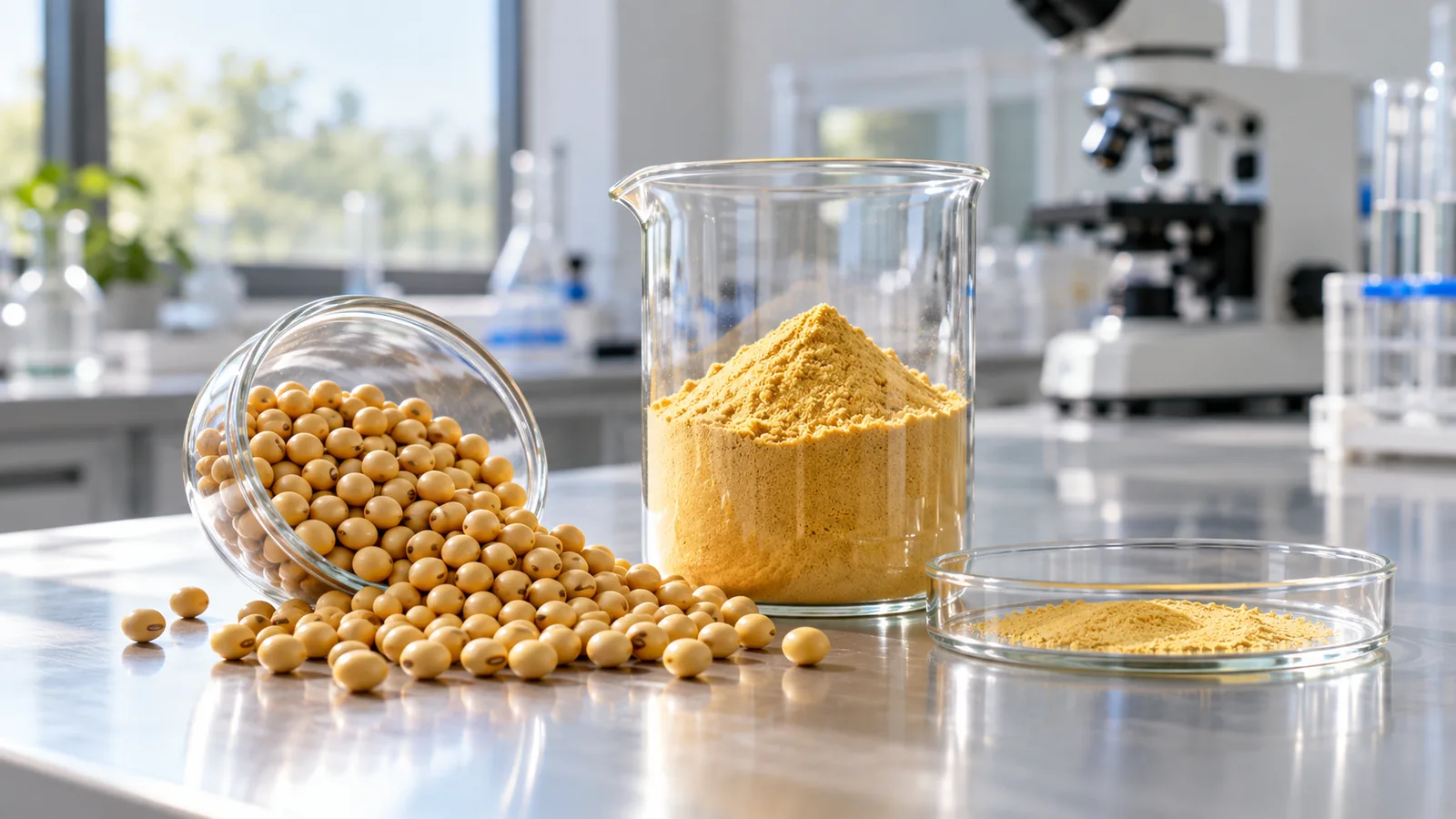
Phosphatidylserine has an ingredient-chain problem that is easy to underestimate: the vast majority of commercial PS is produced by enzymatic conversion of soy lecithin. That means every soy compliance question your customers, auditors, and regulators ask about soybeans now attaches itself to your PS purchase — genetic modification status, identity preservation, and allergen labelling.
Buyers discover the gap late. The formulation is final, the label says "non-GMO" or omits a soy statement, and only then does a retail auditor ask for the identity-preserved chain of custody — which the ingredient file does not contain. This article walks through how non-GMO status is actually proven for soy-derived PS, what US and EU allergen rules require, and where sunflower-derived PS changes the compliance equation.
Why Soy-Derived PS Raises Both Questions at Once
Soy sits in two regulatory categories simultaneously. As a crop, it is one of the world's most widely genetically modified commodities, so any non-GMO claim made about a soy-derived ingredient must be supported by evidence that GM material did not enter the supply chain. As a food, soy is a major allergen in both major regulatory systems, so ingredients derived from soy carry allergen-labelling consequences even after heavy processing.
Processing does not dissolve either obligation. Enzymatic conversion of lecithin to PS is a chemical transformation of the phospholipid molecule, but it does not "launder" the ingredient's origin: a non-GMO claim still traces back to the beans, and allergen analysis still asks whether soy proteins or markers remain in the finished material at levels that matter. Buyers who assume "highly refined" automatically solves the problem create the exact ambiguity that auditors and enforcement officers probe.
How Non-GMO Identity Is Preserved and Proven
Non-GMO status is a supply-chain property, not a test result on a single lot. Testing the finished PS for GM DNA or protein is weak evidence by itself, because the conversion and purification steps can degrade analytes to below detection while the feedstock was never identity-preserved at all. The credible evidence chain has layers. Identity preservation at the source: segregation of non-GMO soy from farm through crushing, degumming, and lecithin production, documented by lot-level traceability. Certification or verification schemes: third-party programs such as the Non-GMO Project in North America, or EU regimes built on Regulation (EC) No 1829/2003 thresholds and certified IP supply chains, provide externally audited assurance. Supplier declarations: a signed statement covering the seed source, segregation controls, and absence of GM feedstock, backed by the supplier's own supplier-management system. Lot testing where feasible: PCR screening on the lecithin feedstock or finished material, interpreted with the caveat above, adds a layer but should never stand alone.
For buyers, the practical requirement is to match the evidence to the claim on your label. A "made with non-GMO ingredients" claim carries a lower documentation burden than a certified non-GMO seal, which binds you to the certification body's standards, audits, and fee structure. Decide the claim first, then buy the evidence chain that supports exactly that claim.
Soy Allergen Obligations in the US and EU
In the United States, soy is one of the nine major food allergens under the FASTER Act amendments to the Food Allergen Labeling and Consumer Protection Act. A dietary supplement whose PS derives from soy must declare soy in the ingredient statement unless an exemption applies — and the relevant question for a refined phospholipid is whether soy protein residues remain at levels that trigger the requirement. FDA has signalled through guidance that highly refined derivatives may be evaluated case by case, but the burden of the evaluation sits with the brand, documented in the ingredient file, not in a supplier's silence.
In the European Union, Regulation (EU) No 1169/2011 lists cereals containing gluten, crustaceans, eggs, fish, peanuts, soybeans, milk, nuts, celery, mustard, sesame, sulphites, lupin, and molluscs as substances requiring emphasis in the ingredients list — and Annex II provides exemptions only for specific named derivatives, none of which covers phosphatidylserine. EU brands using soy-derived PS therefore need either a documented safety-based justification for non-declaration (a position many brands avoid) or straightforward soy declaration on the label.
The documentation to require from a PS supplier is consistent across markets: allergen status on the specification and COA, a statement of the manufacturing site's allergen handling matrix (what else runs in the facility), and, where the supplier claims protein removal, the analytical basis for that claim.

The Sunflower-Derived Alternative: Compliance Trade-offs
Sunflower lecithin is not a major allergen in either the US or EU lists, and sunflower is not a widely commercialised GM crop. Sunflower-derived PS therefore removes both conversations: no soy allergen declaration, and a materially simpler non-GMO position. That is why it has become the default choice for premium nootropic brands targeting allergen-sensitive positioning.
The trade-offs are commercial and technical, not just regulatory. Sunflower PS typically carries a price premium and has historically had a narrower supply base; oxidative stability and sensory characteristics differ and belong in your formulation review. Enzyme-derived sunflower PS production is now well established among specialised manufacturers, and the specification and COA expectations are the same as for soy-derived material. The right decision framework is claim-driven: if your brand position requires "no soy" on the label, sunflower PS is the clean answer; if soy declaration is acceptable, soy-derived PS at identity-preserved status is usually the more economical route.
Building the Evidence File Before Your Label Prints
Assemble the file as a set of named documents: signed non-GMO declaration covering the full chain; IP certificates or scheme membership for the feedstock; allergen matrix of the manufacturing facility; specification and COA showing allergen and GM-related tests where applicable; processing description supporting any refined-derivative position; and the analytical rationale for any "free from" language. Reconcile each document against the exact claim wording on your label — auditors compare them word by word. Do this before printing, not after an auditor's finding.
Часто задаваемые вопросы
Q: Is soy-derived phosphatidylserine GMO?
A: Not necessarily — it depends entirely on the feedstock and its segregation. Most commercial soy is GM, so soy-derived PS is only non-GMO if it was made from identity-preserved non-GMO soy lecithin and that status is documented. The conversion process itself has no effect on GMO status.
Q: Does my supplement need a soy allergen warning if it contains PS?
A: In the US, soy is a major allergen and a declaration is required unless your documented evaluation supports an exemption for the refined derivative — a position you should clear with your regulatory counsel. In the EU, soybeans are on the Annex II list and phosphatidylserine has no exemption, so soy-derived PS generally triggers soy declaration.
Q: Can PCR testing alone prove my PS is non-GMO?
A: No. PCR results are weak evidence because purification can degrade DNA below detection even when the original feedstock was GM. Use testing as one layer on top of identity-preserved sourcing and certification — never as the sole basis for a claim.
Q: Is sunflower-derived PS automatically allergen-free?
A: Sunflower is not on the US major-allergen or EU Annex II lists, so the soy declaration issue disappears. But "allergen-free" as a claim requires the whole facility's allergen matrix, not just the ingredient — cross-contact at the PS plant or your own contract manufacturer can still create exposure.
Заключение
Non-GMO and allergen status for phosphatidylserine are documentation outcomes, not marketing statements. Soy-derived PS can absolutely support both a non-GMO claim and a compliant label — but only with identity-preserved sourcing, scheme certification where the claim requires it, and a written allergen position backed by analysis. Where the claim demands it, sunflower-derived PS removes the soy allergen conversation entirely at a documented premium. Nutranexa supplies both soy-derived and sunflower-derived phosphatidylserine with complete non-GMO declarations, identity-preservation documentation, and facility allergen matrices — matched to whatever claim your market requires.
Источники
- U.S. FDA — Food Allergies and major food allergen labelling: https://www.fda.gov/food/food-labeling-nutrition/food-allergies
- USDA — National Bioengineered (BE) Disclosure Standard: https://www.ams.usda.gov/rules-regulations/be
- Non-GMO Project — Product Verification Program: https://www.nongmoproject.org
- European Commission — Regulation (EU) No 1169/2011 on food information to consumers: https://food.ec.europa.eu/food-labelling-and-nutrition/food-information-consumers-legislation_en
- U.S. FDA — Current Good Manufacturing Practice for Dietary Supplements (21 CFR Part 111): https://www.fda.gov/food/current-good-manufacturing-practice-cgmp-dietary-supplements
Рекомендуемые дальнейшие действия
- Просмотрите Phosphatidylserine страница продукта.
- Сравнить Soy PS и Sunflower PS.
- Проверять производственное доказательство и Качество и НИОКР.
Свяжитесь с отделом продаж для получения документации по продукту
Поделитесь предпочтениями источника, приложением, страной и годовым количеством.
Свяжитесь с отделом продаж