

A full container of phosphatidylserine can arrive with every drum sealed, every document in order, and still carry avoidable damage — crushed bottom-layer drums, moisture-affected product near the container walls, or a lot that spent an unplanned week in a hot terminal. The difference is usually loading discipline, and loading discipline is something a buyer can specify and verify.
Bulk PS is a low-density, hygroscopic powder shipped in fiber drums on pallets, which makes the container a quality-relevant environment: stacking height decides whether bottom drums deform, dunnage decides whether pallets shift, desiccant strategy decides whether condensation reaches the packaging, and a logger decides whether anyone can prove what happened. This guide walks the loading operation in the order it happens — packaging, stowage, moisture control, instrumentation, inspection, receipt — for a buyer who wants the requirements in writing before booking.
Why Container Loading Is a Quality Operation, Not a Warehouse Task
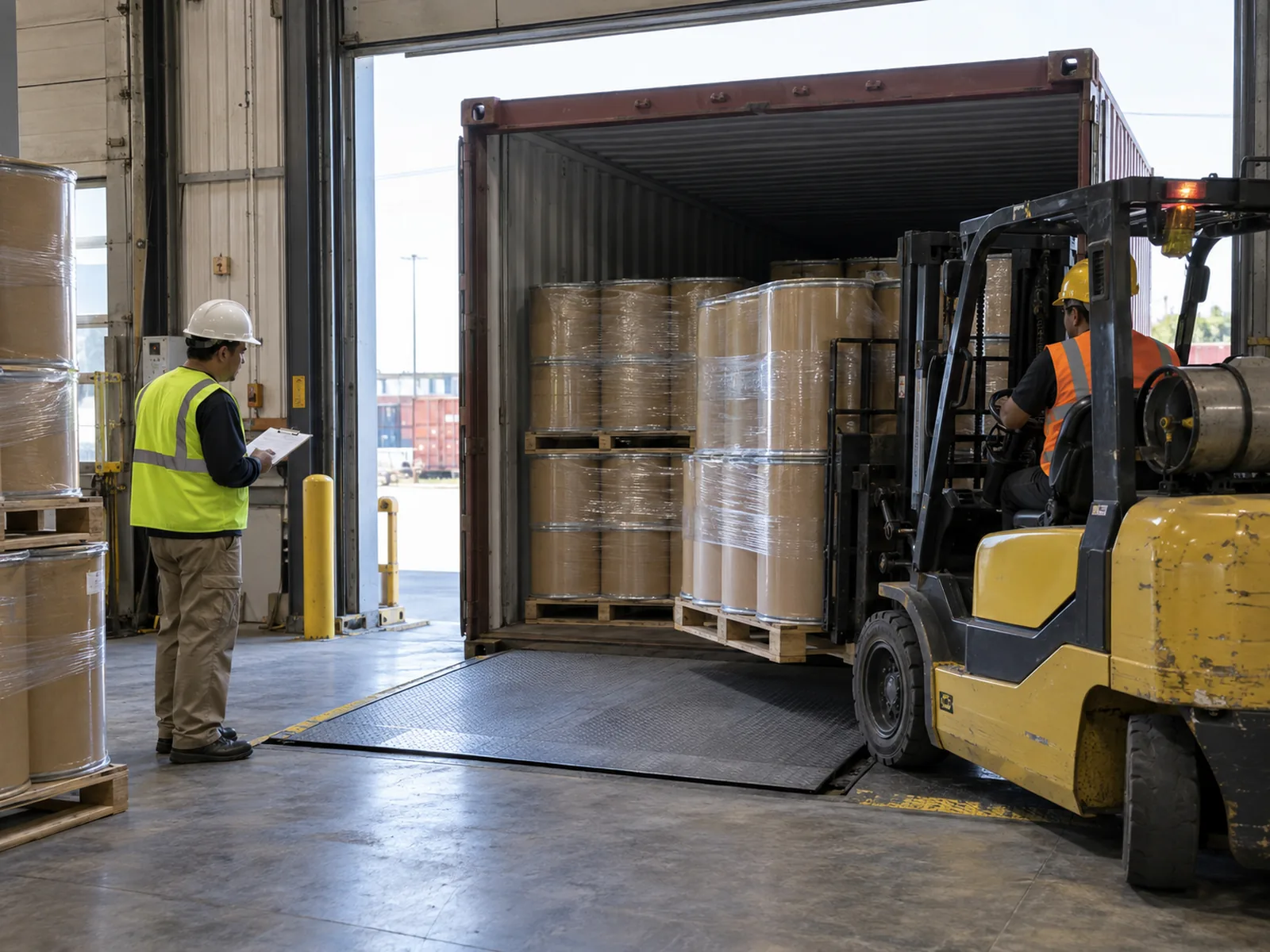
Once a container is sealed, its contents are unreachable until destination. Any defect introduced during stuffing — damaged liners, over-stacked pallets, insufficient dunnage, a wet or odorous box — is discovered weeks later by someone who cannot fix it cheaply. That is why loading needs a written procedure verified by a photographed checklist.
There is also a commercial dimension: when a claim arises, the party with photographs, a signed checklist, and logger data has a defensible position. Under the US FSMA Sanitary Transportation Rule, transport conditions form part of the food-safety record, and EU buyers running an ISO 22000:2018-aligned system are expected to control them as documented processes.
Fiber Drums and Pallet Configuration Before the Container Arrives
Drum specification and liner integrity
Specify the drum in the contract: fiber construction and wall thickness, liner material and thickness, closure type, and in-liner desiccant placement. Confirm liner seal integrity and closure condition before palletising.
Pallet pattern, height, and load stability
Palletise drums in a stable pattern with edge protectors, a top cap, and wrap tight enough to hold the load without crushing drums. Pallet height is the critical variable — stacking too high to fill the container deforms the bottom layer over a long voyage. Check the supplier's maximum pallet height and drum-per-pallet count against the drum's compression rating.
Estimating drum count per container
Estimates must come from pallet footprint and height, not a rule of thumb: combine palletised dimensions with the container's usable internal dimensions, then calculate pallets per container. Confirm against the packing list, since drum diameter and pallet height vary by specification.
Stowage Inside the Container: Sequence, Dunnage, and Weight Distribution
Loading sequence and weight distribution
Load from the front toward the doors, keeping weight low and distributed. Heavier pallets belong toward the front and centre; moisture-sensitive loads should not sit against side walls or at the doors, where temperature swing and condensation are greatest. Avoid mixed-height pallets in one bay.
Dunnage, airbags, and void filling
Voids are the enemy. Fill any gap between pallets and walls, between rows, or at the door end with dunnage, airbags, or blocking. Ask what the supplier uses, whether it is dry and suitable, and whether the stuffing plan is photographed. Wooden export dunnage must satisfy the destination's wood-packaging treatment rules.
Door-side restraint and load securement
The door end is where loads fall out during de-vanning. Require documented restraint — strapping, netting, or blocking — and a photograph of the door-end condition before closing. Confirm the floor is clean and dry.
Moisture Strategy: Liners, Desiccants, and Container Rain
Container selection and pre-loading inspection
Require a pre-loading inspection with a written result: no holes, no light leakage, no standing water, no residue, no pest evidence, no previous-cargo odour. Reject a box that fails — the check costs minutes and prevents the most common cause of arrival damage.
Desiccant sizing and placement
Container rain forms when warm humid air meets cooled steel and condenses, then drips onto packaging. Two defences apply: moisture-barrier inner liners with in-pack desiccant, and container desiccant sized to box, cargo, lane, and season, distributed along the length rather than bunched at the doors. Require the desiccant type, quantity, and placement in the loading procedure, and increase it for humid-season and tropical lanes. Where the facility allows, require covered stuffing so drums are not exposed to rain, and add an odour check before loading and at closing, since liners retain odour from previous cargo.
Instrumenting the Container: Temperature and Humidity Loggers
Logger count and placement
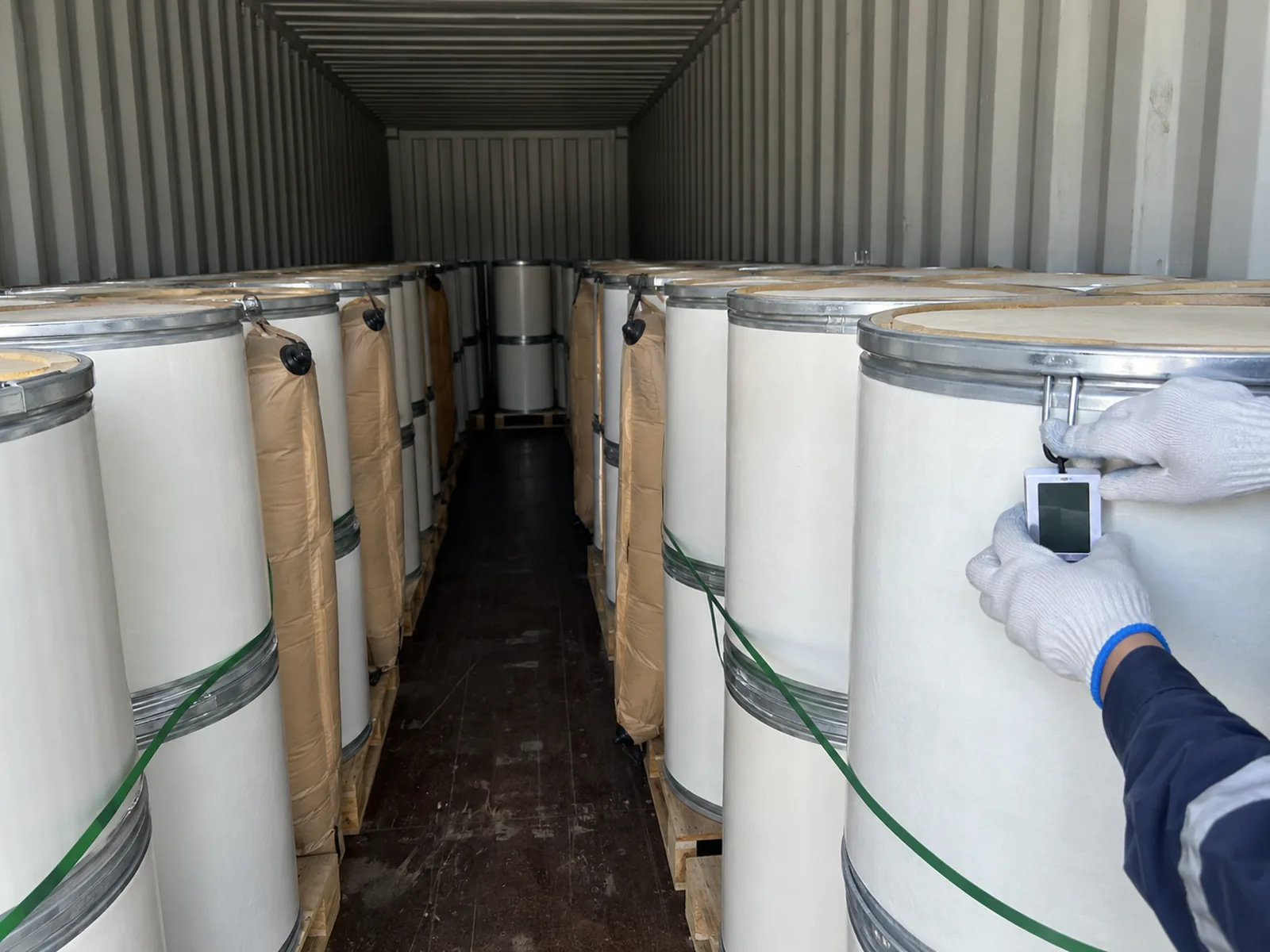
One logger is better than none, but two is the working minimum: one in the middle of the load at product level, and one near the doors or upper area to capture the ambient extreme. For multi-lot containers, add one per lot so lots can be released or quarantined independently.
Logger configuration and calibration
Require calibrated loggers with stated accuracy, an interval short enough to resolve a port stay, and alarm thresholds set before departure. Record serial numbers and calibration dates on the checklist; bracket stuffing, gate-in, vessel, discharge, and de-vanning.
Reading the data at destination
Review logger data against a written transport profile. Because PS degrades with cumulative heat, evaluate cumulative time above threshold bands rather than a single peak, as under ICH Q1A(R2). Pre-agree the decision tree: quarantine, test peroxide value and moisture, then release with justification or reject and claim.
The Container Loading Inspection Checklist Buyers Should Specify
- Container pre-inspection: clean, dry, odour-free, no light leakage, no pest or residue evidence.
- Drum count, lot numbers, and seal condition reconciled against the packing list.
- Pallet configuration: drum-per-pallet count, pallet height, wrap, edge protectors, top cap.
- Stowage plan: loading sequence, weight distribution, distance of sensitive pallets from walls and doors.
- Dunnage, void filling, and door-end restraint method.
- Desiccant type, quantity, and placement — in-pack and container level.
- Logger serial numbers, calibration dates, placement, and alarm thresholds.
- Photographic record: empty container, first row, mid-load, door end before restraint, sealed container with seal number.
- Seal number on the checklist, matched against the bill of lading.
- Covered loading with no rain exposure, plus loading date and time.
Arrival: Receiving Inspection and Deviation Handling
Receiving is the counterpart of loading. Check the seal number against shipping documents, photograph the container at first opening, and inspect for crushed drums, wet exteriors, torn wrap, and shifted pallets. File the logger curve with the goods-received record. Where damage exists, segregate pallets by position — top, wall-side, door-side — since position explains the mechanism. Sample under controlled humidity.
Часто задаваемые вопросы
How many fiber drums of phosphatidylserine fit in a 20-foot container?
It depends on drum diameter, pallet pattern, pallet height, and whether the load is palletised or floor-stuffed. Request the supplier's palletised dimensions and calculate pallets per container from usable internal dimensions, then confirm against the packing list.
Should phosphatidylserine containers be loaded floor-to-ceiling?
No. Over-stacking transfers the load onto the bottom layer and causes deformation over a long voyage with vibration. Use a pallet height validated against drum compression strength, with dunnage filling the remaining void.
How much container desiccant is needed?
Enough to control condensation for the box size, cargo, lane, and season — humid-season and tropical lanes need more than a temperate winter lane. Ask the supplier to state desiccant type, quantity, and distribution rather than accepting an unspecified "desiccant included".
Where should the data logger go in a container of PS drums?
Use at least two: one in the middle of the load at product level, and one near the doors or upper area to capture the ambient extreme. For multi-lot containers, add one per lot.
What should receiving do if drums arrive crushed or damp?
Photograph before unloading, keep the seal number and logger data, segregate affected pallets by container position, and quarantine the lot. Test peroxide value and moisture against the specification, then apply the pre-agreed release or rejection decision tree.
Заключение
Container loading is the last point at which a phosphatidylserine shipment can be protected cheaply. Packaging, pallet height, stowage, dunnage, desiccant, and logger placement can all be written into a purchase contract, verified with a photographed checklist, and reviewed at destination against data.
Buyers who specify these requirements reduce arrival damage and create the evidence that turns any dispute into a document review.
Источники
- U.S. Food and Drug Administration (FDA) — FSMA Final Rule on Sanitary Transportation of Human and Animal Food: https://www.fda.gov/food/food-safety-modernization-act-fsma/fsma-final-rule-sanitary-transportation-human-and-animal-food
- U.S. Food and Drug Administration (FDA) — Food Imports and Exports: https://www.fda.gov/food/food-imports-exports
- ICH Q1A(R2) — Stability Testing of New Drug Substances and Products: https://database.ich.org/sites/default/files/Q1A%28R2%29%20Guideline.pdf
- ISO 22000:2018 — Food Safety Management Systems: https://www.iso.org/standard/71726.html
- International Chamber of Commerce (ICC) — Incoterms Rules: https://iccwbo.org/
- International Maritime Organization (IMO): https://www.imo.org/
- Европейское управление по безопасности пищевых продуктов (EFSA): https://www.efsa.europa.eu/
Рекомендуемые дальнейшие действия
- Просмотрите Phosphatidylserine страница продукта.
- Сравнить Soy PS и Sunflower PS.
- Проверять производственное доказательство и Качество и НИОКР.
Свяжитесь с отделом продаж для получения документации по продукту
Поделитесь предпочтениями источника, приложением, страной и годовым количеством.
Свяжитесь с отделом продаж