Phosphatidylserine buyers in Europe and the United States often spend a lot of time on specifications, quotations, and source selection, then lose control at the last practical step: proving that the exact lot in the warehouse, on the packing list, and on the COA is the same commercial item that procurement and QA already approved.
That is a traceability problem, not a marketing problem. A phosphatidylserine lot can arrive with a clean appearance, acceptable packaging, and a familiar supplier name, yet still create release risk if the batch identity is fragmented across documents. One file uses a sample COA, another uses a quotation description, a third uses the drum count from the shipment, and none of them give QA a simple way to connect the lot under review to the approved item, supplier, and destination market.
For B2B ingredient buyers, this is where recall-readiness and commercial discipline meet. In the EU, Article 18 of Regulation (EC) No 178/2002 requires food business operators to be able to identify who supplied a food and to whom it was supplied. In the United States, the FDA's FSVP framework requires importers to maintain a documented supplier-verification program for each imported food and supplier, while dietary supplement CGMP expectations push teams toward lot-linked records and batch control. That does not mean every phosphatidylserine importer needs the same paperwork stack, but it does mean every importer needs a file that can connect the shipment, the product identity, and the approval decision without guesswork.
This article is written for ingredient importers, distributors, supplement manufacturers, private-label teams, procurement managers, QA reviewers, and regulatory or compliance coordinators handling phosphatidylserine for Europe and North America. It focuses on document control, shipment release, and supplier qualification. It does not offer legal advice or make medical treatment claims.
Where Nutranexa is referenced, only verified site facts are used. Nutranexa identifies the operating company as Shandong Baianrui Biopharmaceutical Co., Ltd., founded in 2013, with a 110,000+ m2 campus and a primary export focus on Europe and North America. The current site shows phosphatidylserine as a lead ingredient, provides separate buyer paths for Phosphatidylserine, Soja Phosphatidylserine, and Girassol Phosphatidylserine, and offers visible access to PS specifications, COA examples, packaging proof, and contact-based document support. Final release decisions should still depend on the current controlled files for the exact quoted product and lot.
The Short Answer Buyers Need First
If your team is releasing or requalifying a phosphatidylserine lot, the practical answer is simple: build one controlled lot file that matches the approved commercial item to the shipment identity, the COA identity, the pack count, and the downstream approval decision.
At minimum, that file should let you answer seven questions quickly:
- What exact phosphatidylserine route is under review?
- Which supplier and which commercial item does the lot belong to?
- Does the COA refer to the same lot or batch that is physically being moved or received?
- Do the drum labels, pallet count, and packing list point to the same shipment identity?
- Are the supporting specification and source-related files tied to the same product route?
- Were any mismatches or exceptions recorded before release?
- Who approved, conditionally approved, or blocked the lot?
If a buyer cannot answer those questions from one file set, the traceability workflow is incomplete even if the shipment looks normal.
What Traceability Means in US and EU Ingredient Workflows
EU buyers need one-step-back and one-step-forward clarity
EU traceability discussions often sound abstract until a buyer has to retrieve a file quickly. The practical reading of Article 18 is that a business should be able to identify from whom it received the food and to whom it supplied it. For phosphatidylserine teams, that translates into a release file that makes the supplier side and customer side legible without rebuilding the history by email.
In real commercial use, EU buyers usually need:
- a clear supplier identity
- a defined product route such as general PS, soy PS, or sunflower PS
- a lot or batch identity that can be connected to the shipment
- a record of where that lot is going next inside distribution or production
That is why traceability should not be treated as the same thing as specification review. Specification review answers, "Is this the product we meant to buy?" Traceability answers, "Can we prove which approved lot moved through which commercial path?"
US buyers need a supplier file that supports FSVP and quality review
US ingredient buyers face a slightly different practical pressure. The FDA's FSVP framework is built around risk-based supplier verification, documented procedures, supplier approval, verification activities, corrective actions, and periodic reevaluation. For dietary supplement ingredients and components, modified requirements may apply in some circumstances, but that does not remove the need for organized records. It increases the importance of tying supplier verification and product identity together correctly.
That matters for phosphatidylserine because import teams often split responsibilities across procurement, compliance, contract manufacturing, and warehouse operations. One group handles supplier approval. Another checks the lot on arrival. Another maintains the product record used in formulation or customer files. If those records do not point back to the same lot identity, the team may have technically "reviewed" the supplier without proving traceability for the shipped material.
The FDA's dietary supplement CGMP guidance is also useful here because it emphasizes lot, batch, or control identification as a way to support complete manufacturing history through distribution. Even when the finished product is not yet in consumer packaging, the buyer logic is the same: use a lot-linked record set that lets the business track what was reviewed, what moved, and what was released.
Continue the Checklist
Lock the exact commercial item first
Start with the product definition before opening the shipment paperwork. Record the commercial item exactly as approved:
- product route: phosphatidylserine, soy phosphatidylserine, or sunflower phosphatidylserine
- supplier name
- agreed grade or assay if applicable
- intended destination market
- intended use, such as further distribution or supplement manufacturing
This step prevents a common traceability failure: the warehouse receives a phosphatidylserine lot under a generic product name, while QA approved a source-specific route and procurement filed the PO under a shortened commercial code.
If the lot belongs to a soy or sunflower route, keep that source identity visible in the lot file from the start. Do not assume a generic "PS" folder is sufficient.
Match the COA to the lot that will actually move
The COA is often the first traceability checkpoint buyers think about, but it only works if it refers to the same lot that is being shipped, received, or released.
Use a simple review table like this:
| Checkpoint | What should match | Why it matters |
|---|---|---|
| COA lot or batch reference | Shipment lot identity | Prevents release based on the wrong document |
| Product name and source route | Approved commercial item | Stops source confusion across general, soy, and sunflower PS |
| Manufacture or test dates | The lot under review | Helps QA confirm the document belongs to the shipment period |
| Analytical scope | Current specification route | Avoids relying on a legacy or sample-only format |
| Document status | Sample, historical, or current lot | Keeps buyers from releasing against a non-current example |
This is where buyers should slow down. A sample COA is useful for understanding reporting style. It is not enough by itself to close traceability for a live lot unless the team has explicitly documented how current-lot evidence will be matched and approved.
Check drum, pallet, and quantity identity
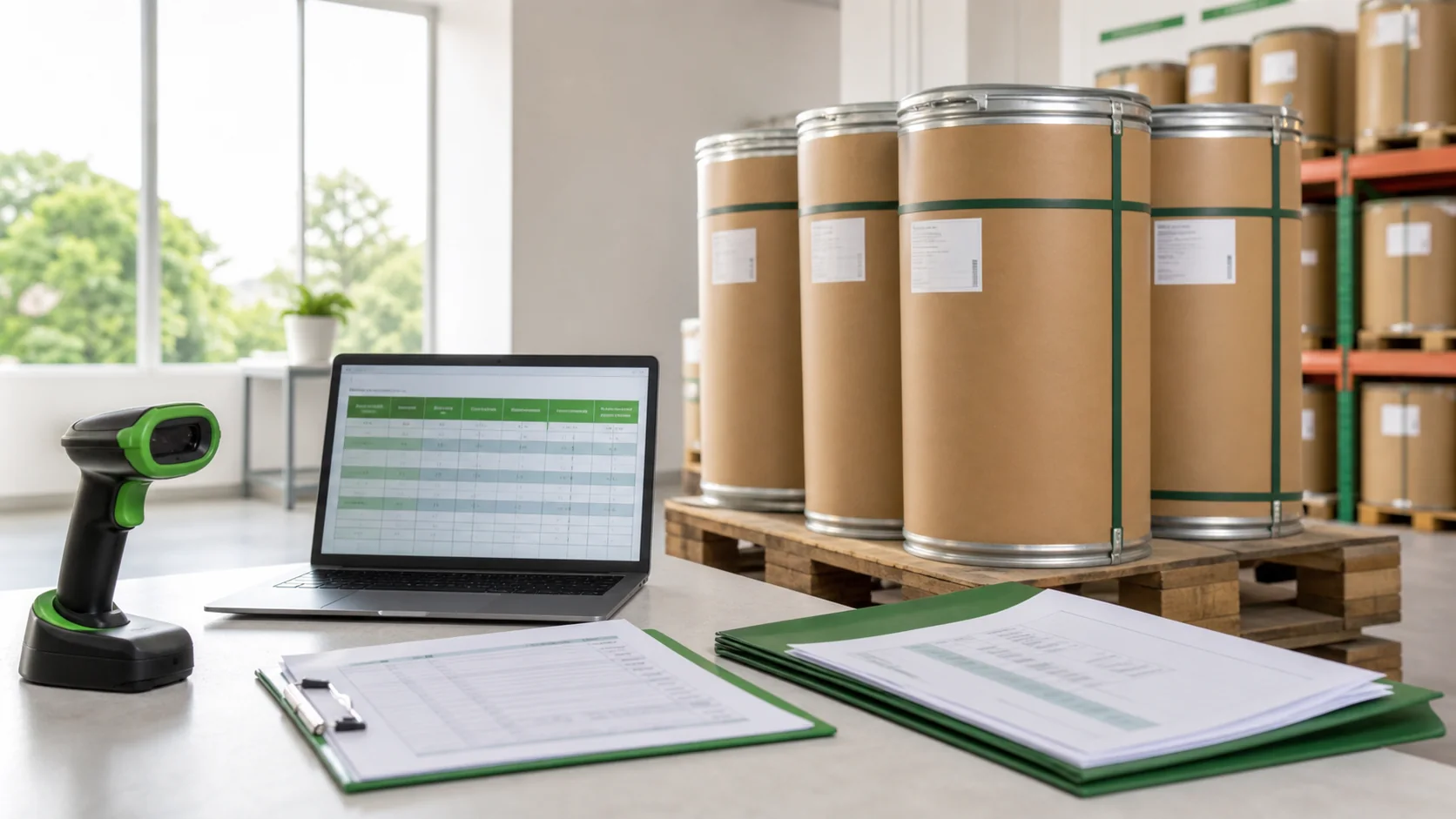
Lot traceability fails surprisingly often at packaging level. The COA may be correct, but the physical shipment details still need to line up with the controlled file:
- number of drums
- net weight per drum
- pallet count if relevant
- drum or pallet label references
- seal or dispatch-photo evidence if available
For phosphatidylserine, this is commercially useful because drum-count errors are easier to catch before release than after internal transfer. It is also where packaging proof becomes more than a marketing asset. If the supplier has visible packaging and dispatch references, they can support buyer review of what a standard shipment should look like before the lot reaches production or onward distribution.
Build the lot cross-reference sheet
Many teams keep the right records but still make traceability hard because the lot data is scattered. The fix is simple: build a one-page cross-reference sheet or digital equivalent.
That sheet should connect:
- internal item code
- supplier item name
- source route
- PO number
- shipment or packing-list reference
- COA reference
- lot or batch number
- quantity received or released
- destination warehouse, customer, or production job
This single sheet is often the difference between a file that is technically complete and a file that is operationally usable.
A Mid-Process CTA for Buyers Who Need Current Files
If your QA or procurement team is missing the current specification, a current-lot COA path, or packaging references for phosphatidylserine, request them before the lot reaches final release. Nutranexa's contact page can be used to ask for the current PS specification set, COA review support, and packaging evidence tied to the exact product route under discussion.
The fastest requests usually include the source route, destination market, estimated quantity, and whether the review is for first import, reorder, or warehouse release.
The Seven-Point Phosphatidylserine Traceability Checklist
Keep support files tied to the same commercial route
Traceability is not only about lot numbers. It also depends on whether the support documents in the approval file belong to the same commercial route as the lot being moved.
For example, a buyer may have:
- a current phosphatidylserine specification
- a sunflower PS COA example
- a soy-related customer questionnaire
- a general product quotation
Each document may be real, but the file is still weak if they do not describe the same route. The rule for buyers is simple: lot identity and support-document identity should point to the same commercial item. When they do not, record the gap and stop treating the file as fully traceable.
This is one reason separate product paths matter. Source-specific product pages, COA examples, and document request flows help buyers avoid mixing general PS, soy PS, and sunflower PS support materials in one release packet.
Record deviations before warehouse release
Do not hide traceability mismatches inside email chains. Put them into the lot file before release. Typical examples include:
| Mismatch type | Example | Correct response |
|---|---|---|
| Identity mismatch | COA lot differs from drum label lot | Hold release until the supplier clarifies which lot applies |
| Route mismatch | Specification says general PS but shipment is sunflower PS | Reconfirm the quoted item and update approval status |
| Quantity mismatch | Packing list shows 10 drums, receiving count shows 9 | Investigate before transfer or resale |
| Document-status mismatch | Team used a sample COA instead of current-lot support | Request current controlled evidence and log the exception |
This step protects both procurement and QA. It makes the release decision defensible, and it reduces the risk that a later complaint or audit turns into a reconstruction exercise.
Close the file with an approval decision
A traceability packet is incomplete until someone records the outcome. The decision should be short and explicit:
- released
- conditionally released pending one document
- held for clarification
- rejected or blocked
Add the approver, date, and the exact reason if the lot is not fully released. This sounds administrative, but it is the final link between the traceability evidence and the commercial action the business took.
Where Traceability Breaks Down Even When the Product Looks Fine
Most traceability failures are not dramatic. They come from small commercial shortcuts:
- The buyer relies on the last sample COA instead of the lot under shipment.
- The warehouse receives a generic PS label while QA approved a source-specific route.
- The packing list and drum count are checked, but no one ties them to the COA reference.
- The business has support files, but they belong to a different commercial item than the lot being moved.
- The team finds a mismatch but never records whether the lot was held, released, or conditionally accepted.
This is why traceability review should sit next to, not inside, incoming inspection. Incoming inspection looks at the material and shipment condition. Traceability review proves that the material under review is the exact lot the business intended to receive, store, release, or resell.
That distinction matters even more for cross-border work. EU buyers need supplier-to-customer clarity. US importers need a file that stands up to FSVP and internal quality review. Both groups benefit from one lot-centered packet rather than a loose bundle of documents.
How Verified Nutranexa Facts Fit This Workflow
For buyers evaluating Nutranexa in this context, the current site offers several verified facts that support a stronger phosphatidylserine traceability workflow.
The company identifies itself as founded in 2013 with a 110,000+ m2 campus, and its export positioning emphasizes Europe and North America. The site shows separate product paths for general PS, soy PS, and sunflower PS, which helps buyers keep route-specific files organized instead of collapsing them into one generic product record.
Nutranexa also presents visible PS COA and specification evidence, 25 kg MOQ information, standard PS packaging of 25 kg net per drum, and factory, packaging, and dispatch imagery. Those details are useful for traceability because they support three practical buyer tasks:
- matching the commercial item to the route under review
- checking whether drum-count and packaging expectations are consistent
- building a release file that is tied to real supplier documents rather than generic product copy
The current site also references R&D cooperation and a contact-based document workflow. For importers, distributors, and supplement manufacturers, that means traceability support does not need to stop at the public page. Buyers can request the current controlled file set for the exact PS route and commercial stage under review.
Fontes
- EUR-Lex: Regulation (EC) No 178/2002, including Article 18 on traceability
- FDA: FSMA Final Rule on Foreign Supplier Verification Programs (FSVP) for Importers of Food for Humans and Animals
- FDA: Final Rule on Foreign Supplier Verification Programs (FSVP) At-A-Glance
- FDA: Small Entity Compliance Guide for Dietary Supplement CGMP
- FDA: Guidance for Industry, Foreign Supplier Verification Programs for Importers of Food for Humans and Animals
Perguntas frequentes
What documents should a buyer request to prove phosphatidylserine lot traceability?
Buyers usually need the current specification, the lot-linked COA or documented current-lot COA path, the packing list, drum or pallet identity, quantity confirmation, and a short approval record that shows whether the lot was released, held, or conditionally accepted.
Is traceability review the same as incoming inspection?
No. Incoming inspection checks what arrived and whether the shipment condition is acceptable. Traceability review checks whether the approved commercial item, the COA, the lot code, the packaging identity, and the release decision all refer to the same phosphatidylserine lot.
Why should buyers keep general PS, soy PS, and sunflower PS files separate?
Because source route affects which specification, COA, and support files belong in the release packet. Mixing them weakens the approval record and makes later investigation harder.
Do US phosphatidylserine importers always follow the full standard FSVP path?
Not always. FDA materials explain that modified requirements may apply for certain dietary supplements and dietary supplement components in some circumstances. Even so, buyers still need organized records that tie supplier verification, specifications, and lot identity together.
What is the biggest traceability mistake procurement teams make?
The most common mistake is assuming that a familiar supplier and a clean-looking shipment are enough. In practice, the weak point is usually the mismatch between the lot on the COA, the lot on the packaging, and the commercial item that QA or regulatory teams previously approved.
Conclusion
Phosphatidylserine traceability is not a side task after inspection. It is the control that proves the exact lot under release is the exact commercial item your business approved.
The strongest workflow starts with the product route, matches the COA to the moving lot, confirms drum and quantity identity, builds one cross-reference sheet, keeps support files aligned to the same route, records deviations before release, and closes with a documented approval decision. That approach helps EU and US buyers reduce release delays, protect recall-readiness, and keep supplier qualification usable in real operations.
For buyers evaluating Nutranexa, the current site provides a practical starting structure through source-specific PS paths, visible COA and specification support, 25 kg-per-drum packaging evidence, export-market focus, and contact-based document follow-up. Final release should still depend on the current controlled lot file for the exact shipment and market.
Próximas etapas recomendadas
- Revise o Phosphatidylserine página do produto.
- Comparar Soy PS e Sunflower PS.
- Verifique prova de fabricação e Qualidade e P&D.
Entre em contato com o departamento de vendas para obter documentos do produto
Compartilhe preferência de fonte, aplicação, país e quantidade anual.
Contato de vendas