Ingredient news
Lipidomics Study Tracks Where MFGM Recovery Loses Polar Lipids
By Nutranexa News |
A 4D lipidomics study found the largest phospholipid and ganglioside losses during initial milk centrifugation and additional composition shifts during churning, coagulation, and evaporation.
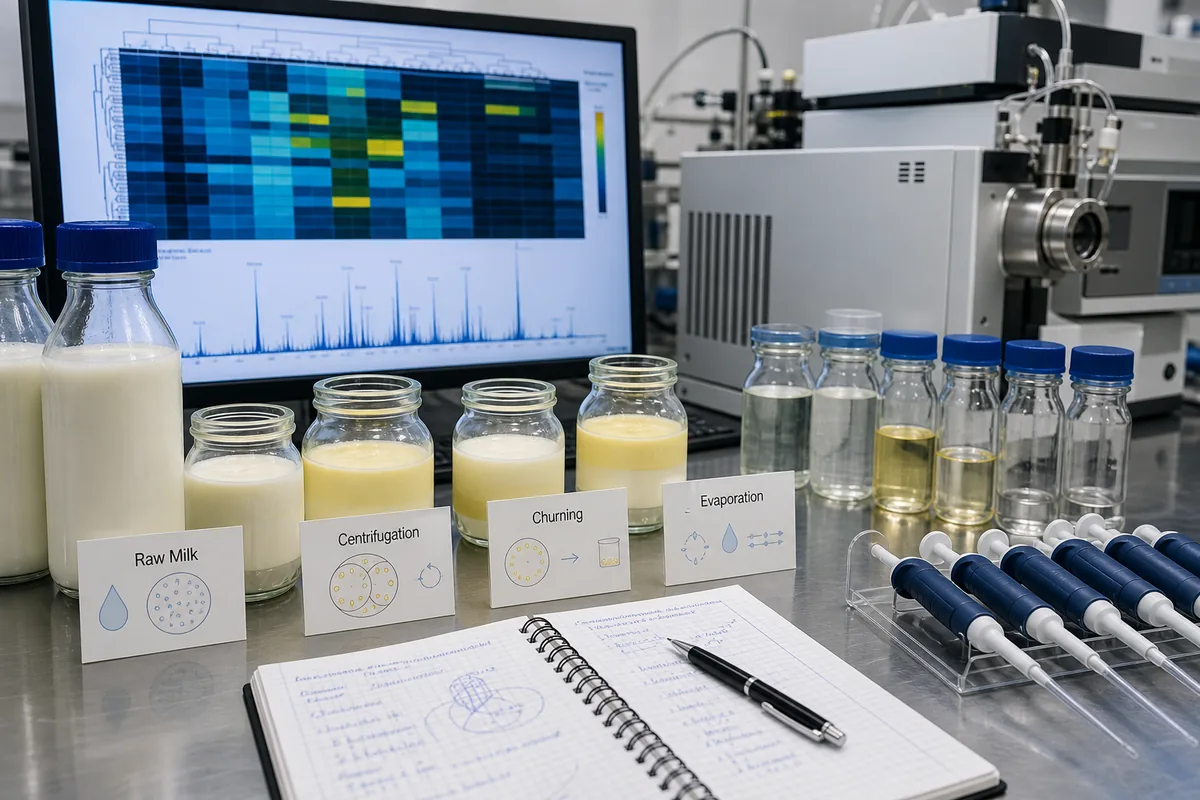
Process Map
The Food Chemistry study monitored polar lipid changes at multiple stages of producing milk fat globule membrane-enriched ingredients from raw bovine milk.
Researchers tracked phospholipids, gangliosides, and differential lipid species after centrifugation, cream churning, rennet coagulation, ultrafiltration, and evaporation.
Largest Losses
The authors report that centrifugation caused the biggest drop, with 49% phospholipid loss and 18% ganglioside loss, while cream churning caused another 11% phospholipid loss and 7% ganglioside loss.
Later steps further shifted class composition, including decreases in phosphatidylserines and phosphatidylinositols after coagulation and losses of polyunsaturated and ether phospholipids after evaporation.
Buyer Takeaway
For MFGM ingredient buyers, this is a reminder that two materials sold under similar high-level labels can differ meaningfully depending on how recovery and concentration were performed.
Supplier discussions should cover not only total phospholipid numbers but also processing history, class distribution, and where sensitive lipid species may be lost.